
Last updated on May 6th, 2026 at 08:06 am
Medically responsible content note:
This article is for education only and does not diagnose or treat medical, dental, or sleep conditions. Bruxism, jaw pain, headaches, snoring, breathing pauses, and respiratory symptoms can have multiple causes. Seek care from a qualified medical, dental, sleep, or orofacial pain professional when symptoms are persistent, worsening, severe, or disruptive.
You did what you were told to do. You saw your dentist, got a mouthguard, and wore it at night. So why does your jaw still feel tight? Why do your temples still ache? Why do you still catch yourself clenching during the day? If your mouthguard does not stop clenching, you are not imagining it. A night guard can help protect your teeth from grinding forces, but it may not stop the jaw muscles from tightening. That difference matters. Tooth protection and clenching behavior are not the same problem, and they may need different solutions.
To understand why this happens, read the guide to awake bruxism vs sleep bruxism.
Quick Answer: Why Doesn’t a Mouthguard Stop Clenching?
A mouthguard may protect your teeth from grinding damage, but it does not automatically stop the jaw muscles from tightening. If your brain and nervous system continue the clenching pattern, you may still press into the guard.
That is why a mouthguard can protect teeth while jaw pain, muscle tension, headaches, or daytime clenching continue. The mouthguard may be doing one important job, but the clenching habit itself may need a different strategy.
This article is part of our larger guide to Bruxism: Symptoms, Causes, Treatment, and How to Stop Teeth Grinding, where we explain how headache, jaw pain, dry mouth, fatigue, breathing symptoms, and sleep quality can overlap.
What a Mouthguard for Bruxism Is Designed to Do
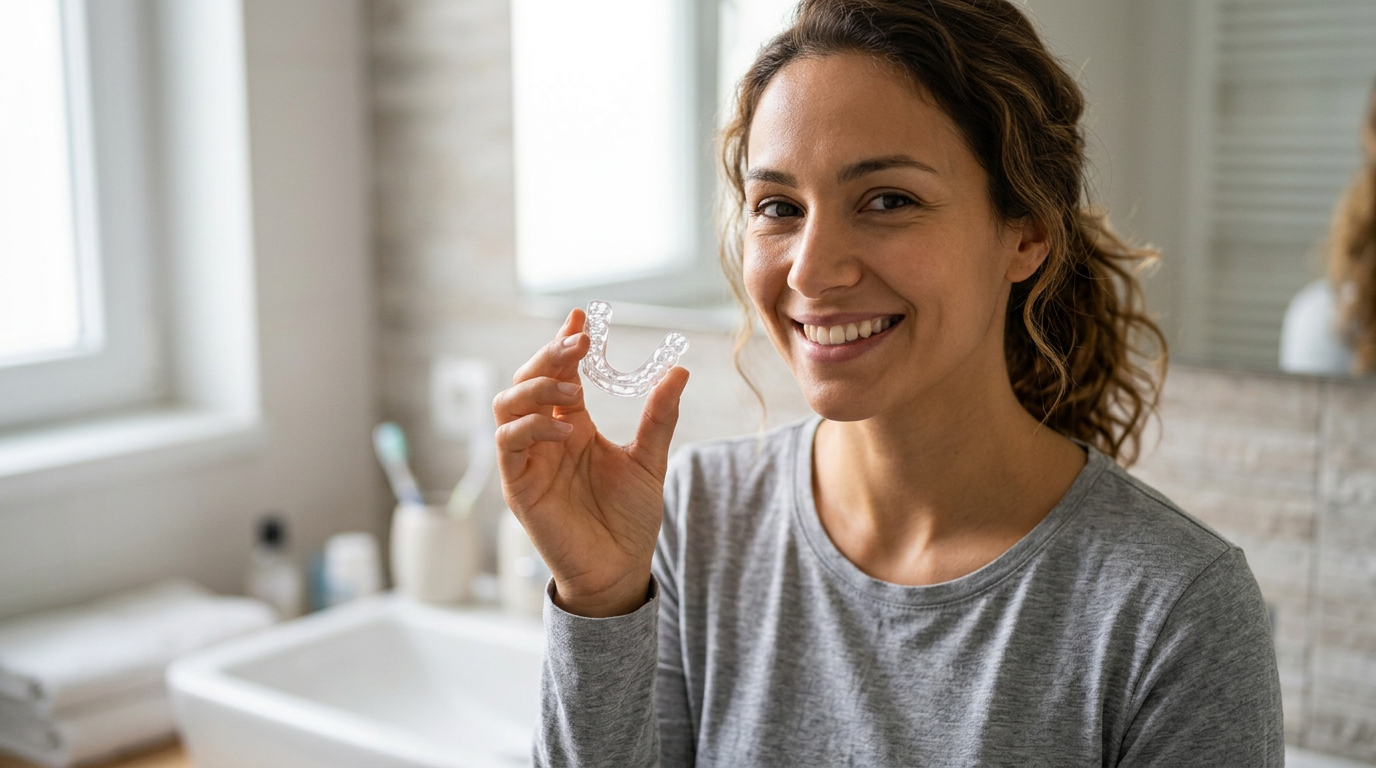
A mouthguard for bruxism is usually designed to create a protective barrier between the upper and lower teeth. This can matter when a person has tooth wear, chipped enamel, cracked restorations, sore teeth, or signs that the teeth are absorbing too much force.
A mouthguard may help:
- reduce direct tooth-to-tooth contact
- protect enamel from grinding wear
- reduce the risk of chipped or cracked teeth
- protect crowns, fillings, veneers, or other dental work
- help your dentist monitor grinding or clenching marks
- distribute biting forces more safely when properly designed and adjusted
That protection is valuable. If your dentist prescribed a night guard, it may be an important part of protecting your teeth.
But protection is not the same as stopping the behavior.
Bruxism is commonly described as masticatory muscle activity that can occur during sleep or wakefulness. Awake bruxism may involve repeated or sustained tooth contact, jaw bracing, or mandibular thrusting. Sleep bruxism occurs during sleep and may involve rhythmic or non-rhythmic jaw muscle activity.¹,²
In other words, the teeth may show the damage, but the muscles create the force.
A mouthguard protects teeth from the consequences of bruxism. It does not automatically turn off the jaw muscles that create the pressure.
If you are still learning how these symptoms connect, start with the broader guide to bruxism symptoms, causes, and pain patterns.
Why You May Still Clench With a Mouthguard
A mouthguard sits between the teeth. It does not automatically teach the jaw to relax.
If your brain and nervous system continue to activate the clenching pattern, your jaw muscles can still tighten against the guard. That is why some people see bite marks on the guard, wake with sore muscles, or feel like their jaw is still working all night.
You may still be clenching with a night guard if:
- you wake with tired or sore jaw muscles
- your mouthguard has bite marks or pressure marks
- your temples ache in the morning
- your jaw feels tight after stressful days
- you catch yourself clenching while working, driving, or concentrating
- your teeth feel protected, but your muscles still feel overworked
Your mouthguard may protect your teeth while your jaw muscles continue doing the same squeezing behavior.
This is one of the most important bruxism mouthguard limitations to understand. A night guard can reduce damage from force. But the force may still be happening.
So when someone says, “My teeth are protected, but I am still clenching,” both things can be true.
Many people also clench during work, driving, scrolling, or concentration without realizing it.
Is Your Night Guard Not Working, or Is It Doing Only One Job?
If you are searching for “night guard not working,” the first question is: What job did you expect the night guard to do?
If the guard is protecting your teeth from wear, fractures, or restoration damage, it may be doing part of its job. But if you still have jaw soreness, temple tension, or daytime clenching, the guard may not be addressing the muscle behavior behind the force.
Your night guard may be doing only one job if:
- your teeth seem protected, but your jaw still hurts
- you see bite marks on the appliance
- you wake with sore jaw muscles
- you still clench during the day
- your headaches continue despite wearing the guard
- your symptoms build during work, stress, or screen time
This does not mean the night guard is useless. It means the treatment target may need to expand.
A mouthguard can help manage dental risk. It may not directly retrain your jaw posture, interrupt daytime teeth contact, reduce stress-related jaw bracing, or address sleep-related contributors.
If your night guard causes new pain, feels uneven, changes your bite, or becomes uncomfortable, ask your dentist to check the fit and bite contact.
Why Jaw Pain Can Continue Even When Teeth Are Protected
Jaw pain can continue for several reasons, even when a mouthguard is protecting the teeth.
The muscles may still be working too hard. The jaw joints may already be irritated. Daytime clenching may be adding hours of extra tension. The appliance may also need adjustment if it is uncomfortable, uneven, or changing how your bite feels.
Common reasons for ongoing jaw pain with a night guard include:
- You may still be clenching forcefully against the guard.
- Your jaw muscles may remain tense even without direct tooth damage.
- The guard may need adjustment if bite contacts are uneven.
- Daytime clenching may continue even if the guard is only worn at night.
- Existing TMD or orofacial pain may need separate evaluation.
- Sleep bruxism may continue because it is not fully under conscious control.
Temporomandibular disorders, often called TMDs, involve pain or dysfunction in the jaw muscles, temporomandibular joints, or related structures. They can overlap with jaw pain, chewing pain, limited opening, headaches, and facial discomfort.⁶,⁷
Do not assume all jaw pain means the guard is wrong. But do not ignore pain that persists, worsens, changes your bite, or makes the guard uncomfortable to wear. A dentist should evaluate the fit, bite contact, and symptoms.
If jaw pain spreads into the face, temples, neck, or ears, or if you have locking, limited opening, or pain with chewing, the problem may need a broader dental, medical, or orofacial pain evaluation.
If your jaw pain is worse in the morning, the pattern may involve sleep bruxism, daytime clenching, or both.
Can a Mouthguard Stop Teeth Grinding?
A mouthguard may reduce damage from teeth grinding, but it should not be understood as a guaranteed way to stop grinding or clenching altogether.
Some people may grind less because the appliance changes the contact surface or reduces irritation. Others continue to clench or grind against it.
A review of occlusal splints for sleep bruxism found limited evidence that splints eliminate sleep bruxism activity, although they may have value for dental protection.³ This supports the main point: a splint may help protect teeth, but it may not stop the underlying bruxism pattern.
It also helps to separate grinding from clenching.
Teeth grinding usually involves rubbing or sliding the teeth.
Jaw clenching usually involves sustained pressure or squeezing.
Awake bruxism often involves daytime teeth contact, jaw bracing, or clenching habits.
Sleep bruxism occurs during sleep and may involve jaw muscle activity that the person does not consciously control.¹,²
The better question is not only, “Can a mouthguard stop teeth grinding?” It is also, “What kind of bruxism pattern do I have, and what problem am I trying to solve?”
Sleep bruxism and awake bruxism often need different management strategies because they happen under different conditions.
Awake Clenching vs Sleep Bruxism: Why the Difference Matters
A mouthguard is most commonly worn at night. But many people clench during the day.
If most of your jaw tension happens during work, driving, screen time, stress, or concentration, a night guard cannot interrupt those daytime moments. It may protect your teeth while you sleep, but it cannot help you notice that your teeth are touching during a stressful email or a long drive.
Awake clenching may show up as:
- teeth touching while working
- jaw tightness during stressful conversations
- clenching while driving
- jaw bracing during focus
- tongue pressing or facial tension
- afternoon temple headaches
- end-of-day jaw fatigue
Sleep bruxism may show up as:
- morning jaw soreness
- tooth wear
- bite marks on the guard
- morning headaches
- reports of grinding sounds
- waking with facial or jaw tightness
Sleep bruxism can be associated with sleep arousals and may overlap with other sleep-related issues in some people.⁴,⁵ The mechanisms are complex, and sleep bruxism should not automatically be blamed on one cause.
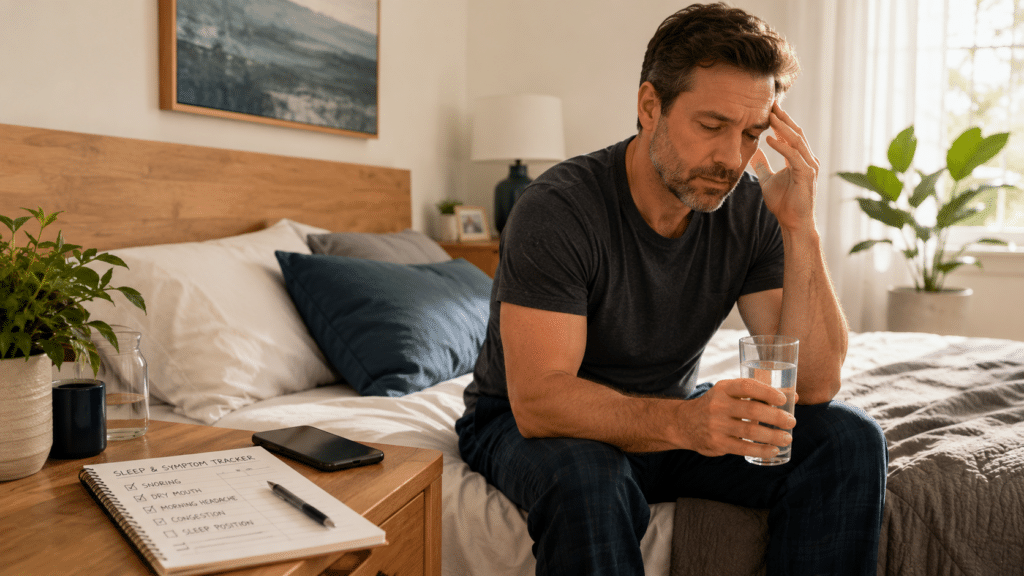
If you also snore, wake with dry mouth, have morning headaches, feel unrefreshed, or have witnessed breathing pauses, it is worth discussing sleep evaluation with a qualified medical provider.
If stress is one of your main triggers, it may help to understand why stress often shows up in the jaw.
What This Does Not Mean
This does not mean mouthguards are useless.
It does not mean you should stop wearing a dentist-prescribed appliance.
It does not mean every jaw symptom is caused by bruxism.
It does not mean every headache, ear symptom, or facial pain pattern is dental.
It simply means that tooth protection and clenching behavior are different treatment targets.
A mouthguard may be one part of care. But if pain, tension, or clenching continues, you may need to look at the bigger pattern: jaw muscles, daytime habits, sleep symptoms, stress response, posture, and pain sensitivity.
What Helps When a Mouthguard Is Not Enough
For many people, the better plan is not mouthguard versus awareness training. It is tooth protection plus behavior change.
This is why the phrase “alternatives to mouthguard for clenching” can be a little misleading. In many cases, the better word is add-ons.
A person with bruxism may need more than one strategy because the pattern can involve teeth, muscles, habits, stress physiology, sleep, posture, and pain sensitivity.
Helpful add-ons may include:
- dentist-guided adjustment of the mouthguard
- daytime jaw awareness training
- teeth-apart resting jaw posture
- biofeedback for awake clenching
- stress regulation and breathing practices
- physical therapy when appropriate
- orofacial pain evaluation when symptoms persist
- sleep evaluation when snoring, fatigue, dry mouth, or morning headaches are present
- CBT-informed habit work
- reducing overuse behaviors such as gum chewing or constant jaw bracing
For awake clenching, awareness is often the missing first step. A biofeedback tool such as ClenchAlert can be used as an awareness-training device. When the device detects clenching pressure, it gives real-time feedback so the user can notice the pattern, release the jaw, and return to a teeth-apart resting position.
This does not mean ClenchAlert replaces a dentist-prescribed mouthguard. It means awareness training may support a different goal: helping you notice and interrupt the clenching habit while it is happening.
For many readers, the missing piece is learning the teeth-apart resting jaw position during the day.
The Habit Loop Behind Daytime Clenching
Daytime clenching often becomes automatic.
It may start as a response to stress, focus, effort, frustration, or posture. Over time, the brain repeats the pattern without asking for permission. You may not decide to clench. You may only notice later, when your jaw feels tired or your temples start to ache.
A simple clenching habit loop may look like this:
- Trigger: stress, focus, traffic, screen time, deadlines, fatigue
- Automatic response: teeth contact, jaw tightening, tongue pressing, facial tension
- Temporary reward: a feeling of effort, control, focus, or bracing
- Reinforcement: the brain repeats the pattern next time
This is why “just stop clenching” usually does not work. Most people cannot change a clenching habit they do not notice. Awareness has to come before release.
The BRUX Method uses a simple sequence: Build Awareness, Relax the Response, Understand Triggers, and eXchange the Pattern. In this article’s context, the first step matters most. You need to catch the clenching pattern early enough to release it before pain builds.
For a deeper look at automatic jaw habits, read the guide to why the jaw habit loop keeps clenching automatic.
What to Do This Week If You Still Clench With a Mouthguard
If your night guard is not working the way you expected, do not assume there is only one answer. Start by gathering better information about your pattern.
1. Keep using your guard as directed unless your dentist tells you otherwise
If your mouthguard was prescribed to protect your teeth, do not stop wearing it without guidance. Your dentist may still want you to wear it to reduce damage while you work on the clenching pattern.
2. Ask your dentist to check the fit
Persistent pain, bite changes, rocking, pressure spots, or new discomfort should be evaluated. A small adjustment may make a meaningful difference.
3. Track when symptoms happen
Morning symptoms may suggest nighttime activity. Afternoon or evening symptoms may point toward daytime clenching. Symptoms that appear after driving, computer work, or stress may reveal a pattern you have missed.
4. Check whether your teeth are touching during the day
Your teeth should not be held together all day. Use simple reminders to ask: “Are my teeth touching right now?”
5. Practice the teeth-apart resting position
Relax your jaw. Let the lips rest gently together if comfortable. Keep the teeth slightly apart. Let the tongue rest lightly on the palate.
6. Notice your triggers
Pay attention to email, driving, deadlines, phone scrolling, concentration, conflict, or emotional pressure. These ordinary moments often reveal the clenching habit.
7. Discuss sleep symptoms if they are present
Snoring, dry mouth, morning headaches, fatigue, and witnessed breathing pauses should be discussed with a medical provider.
8. Add awareness training if daytime clenching is part of the pattern
Biofeedback, habit cues, and jaw relaxation practice may help you notice and interrupt the clenching pattern.
If you are trying to reduce daytime clenching, a practical awareness plan for daytime clenching can help you build the habit of noticing and releasing your jaw.
What This Symptom Pattern May Mean
The goal is not to diagnose yourself. The goal is to recognize patterns that may help you ask better questions.
Pattern 1: Your teeth are protected, but your jaw still feels tired
This may suggest that the mouthguard is reducing dental damage while clenching pressure continues.
Pattern 2: Your jaw hurts most in the morning
This may suggest sleep bruxism, sleep fragmentation, or another nighttime contributor. It does not prove one cause.
Pattern 3: Your jaw pain builds during the workday
This may point toward awake clenching, focus clenching, posture strain, screen tension, or stress-related jaw bracing.
Pattern 4: You also have headaches, ear pressure, or facial pain
Jaw muscles and temporomandibular joints can refer pain into nearby areas. However, ear symptoms, dizziness, hearing changes, infection symptoms, or sudden severe pain should be medically evaluated.
Pattern 5: You snore, wake tired, or have morning headaches
This may suggest that sleep quality or sleep-breathing symptoms should be discussed with a qualified medical provider.
If headaches are part of your symptom pattern, jaw clenching may contribute to temple headaches.
What to Track Before You Talk to a Dentist or Clinician
Track these details for one to two weeks:
- When does jaw pain happen: morning, afternoon, evening, or after stress?
- Do you wake with sore teeth, jaw muscles, or temples?
- Do you notice clenching while working, driving, or concentrating?
- Does your guard have new bite marks or wear marks?
- Does your mouthguard feel tight, uneven, loose, or uncomfortable?
- Has your bite changed?
- Do you have tooth sensitivity, cracks, or broken restorations?
- Do your headaches start in the temples?
- Do you have ear fullness, ear pressure, or facial pain?
- Do you snore, wake with dry mouth, or feel unrefreshed?
- Are you taking medications that may be associated with bruxism?
- Does stress make symptoms worse?
The goal is not to diagnose yourself. The goal is to bring better information to the professional who is helping you.
When to Seek Professional Help
Seek dental or medical evaluation if:
- jaw pain persists or worsens
- your mouthguard causes new pain
- your bite feels different
- your jaw locks or opening becomes limited
- chewing becomes painful
- you have tooth sensitivity, cracks, or broken restorations
- you have frequent morning headaches
- you have ear symptoms that have not been medically evaluated
- pain spreads into the face, neck, temples, or ears
- you snore loudly, wake choking or gasping, or have possible sleep apnea symptoms
Ear pain, ear pressure, dizziness, hearing changes, infection symptoms, or sudden severe pain should not be assumed to be dental or bruxism-related. These symptoms should be medically evaluated.
A mouthguard can be part of the answer, but persistent symptoms deserve a closer look.
FAQ
Why am I still clenching with a mouthguard?
You may still be clenching because a mouthguard protects the teeth but does not automatically stop the jaw muscles from tightening. If your nervous system continues to activate the clenching pattern, you may press into the guard while your teeth remain protected.
Does a mouthguard stop bruxism?
A mouthguard may reduce tooth damage from bruxism, but it does not always stop grinding or clenching. Its main role is often protection. Awake clenching may also need awareness training, habit retraining, stress regulation, or other strategies.
Can a mouthguard stop teeth grinding?
A mouthguard may reduce damage from teeth grinding, but it is not a guaranteed way to stop grinding altogether. Some people may grind less with an appliance. Others continue to grind or clench against it.
Why does my jaw still hurt with a night guard?
Your jaw may still hurt because the muscles can continue tightening against the guard. The guard may protect your teeth, but the jaw muscles may still be overworked. If pain continues, worsens, or changes your bite, ask your dentist to evaluate the appliance.
Is my night guard not working if I still have jaw pain?
Not always. Your night guard may still be protecting your teeth, even if jaw pain continues. However, persistent pain may mean the guard needs adjustment or that you need additional support for muscle tension, daytime clenching, TMD, or sleep-related factors.
Can a night guard make jaw clenching worse?
A night guard does not usually “teach” the jaw to clench, but an appliance that does not fit well or creates uneven pressure may contribute to discomfort. If your jaw pain worsens after wearing a guard, have your dentist check the fit and bite contact.
What are the limitations of a bruxism mouthguard?
A bruxism mouthguard may protect teeth from wear and damage, but it may not stop the jaw muscles from clenching. It may not address daytime teeth contact, stress-related jaw bracing, sleep arousals, posture, or the habit loop behind awake clenching.
What can I do besides wearing a mouthguard?
Depending on your symptoms, options may include jaw awareness training, teeth-apart posture practice, biofeedback, stress regulation, physical therapy, or evaluation for sleep-related contributors. The right plan depends on whether the pattern is awake clenching, sleep bruxism, or both.
Is ClenchAlert a mouthguard?
ClenchAlert is best understood as a biofeedback awareness-training tool for clenching. A traditional mouthguard mainly protects teeth. A biofeedback device helps the user notice clenching pressure in real time so they can release the jaw.
Should I stop wearing my mouthguard if I still clench?
Do not stop wearing a prescribed dental appliance without talking to your dentist. If it is uncomfortable or symptoms continue, ask your dentist to check the fit and discuss additional strategies.
Conclusion: Protection Matters, But Awareness May Be the Missing Piece
A mouthguard can be valuable, especially when teeth are at risk. It can protect enamel, reduce direct tooth contact, and help prevent damage to dental work.
But if your mouthguard does not stop clenching, that does not mean you are failing. It does not mean you are imagining your symptoms. And it does not automatically mean the mouthguard is useless.
It may mean the mouthguard is doing one job while your jaw muscles still need another kind of support.
The next step is not necessarily to abandon the guard. It is to ask whether you also need help with jaw awareness, daytime habits, sleep symptoms, muscle pain, or stress-related jaw tension.
Tooth protection matters. Jaw muscle behavior matters too. Daytime clenching often needs awareness. Sleep bruxism may require a broader sleep and medical evaluation when symptoms suggest it. Persistent jaw pain should be professionally evaluated.
For many people, the most complete plan is not just protection or just behavior change. It is both.
To continue building a complete plan, read the practical guide on how to stop clenching your jaw during the day.
References
- Lobbezoo F, Ahlberg J, Raphael KG, et al. International consensus on the assessment of bruxism: report of a work in progress. J Oral Rehabil. 2018;45(11):837-844.
- Lobbezoo F, Ahlberg J, Glaros AG, et al. Bruxism defined and graded: an international consensus. J Oral Rehabil. 2013;40(1):2-4.
- Macedo CR, Silva AB, Machado MAC, Saconato H, Prado GF. Occlusal splints for treating sleep bruxism. Cochrane Database Syst Rev. 2007;(4):CD005514.
- Kim HK, et al. Sleep bruxism in adults: a comprehensive review of diagnosis, consequences, comorbidities, and management. Sleep Med Res. 2024.
- Kato T, et al. Understanding the pathophysiology of sleep bruxism. J Oral Biosci. 2023.
- Matheson EM, Fermo JD, Blackwelder RS. Temporomandibular disorders: rapid evidence review. Am Fam Physician. 2023;107(1):52-58.
- Li DTS, Leung YY. Temporomandibular disorders: current concepts and controversies in diagnosis and management. Diagnostics (Basel). 2021;11(3):459.

Randy Clare is a writer, educator, and health communicator focused on making complex clinical topics easier to understand. Through The Sleep and Respiratory Scholar, he creates clear, practical content on bruxism, headache, sleep, airway health, and respiratory symptoms. He is the author of The Brux Method, President of ClenchAlert.com and host of The Clenching Chronicle Podcast, where he explores jaw tension, clenching, headaches, and behavior-based approaches to relief. His work helps readers better understand symptoms, recognize patterns, and take more informed next steps.