

Last updated on April 30th, 2026 at 05:50 am
Medically responsible content note:
This article is for education only and does not diagnose or treat medical, dental, or sleep conditions. Bruxism, jaw pain, headaches, snoring, breathing pauses, and respiratory symptoms can have multiple causes. Seek care from a qualified medical, dental, sleep, or orofacial pain professional when symptoms are persistent, worsening, severe, or disruptive.
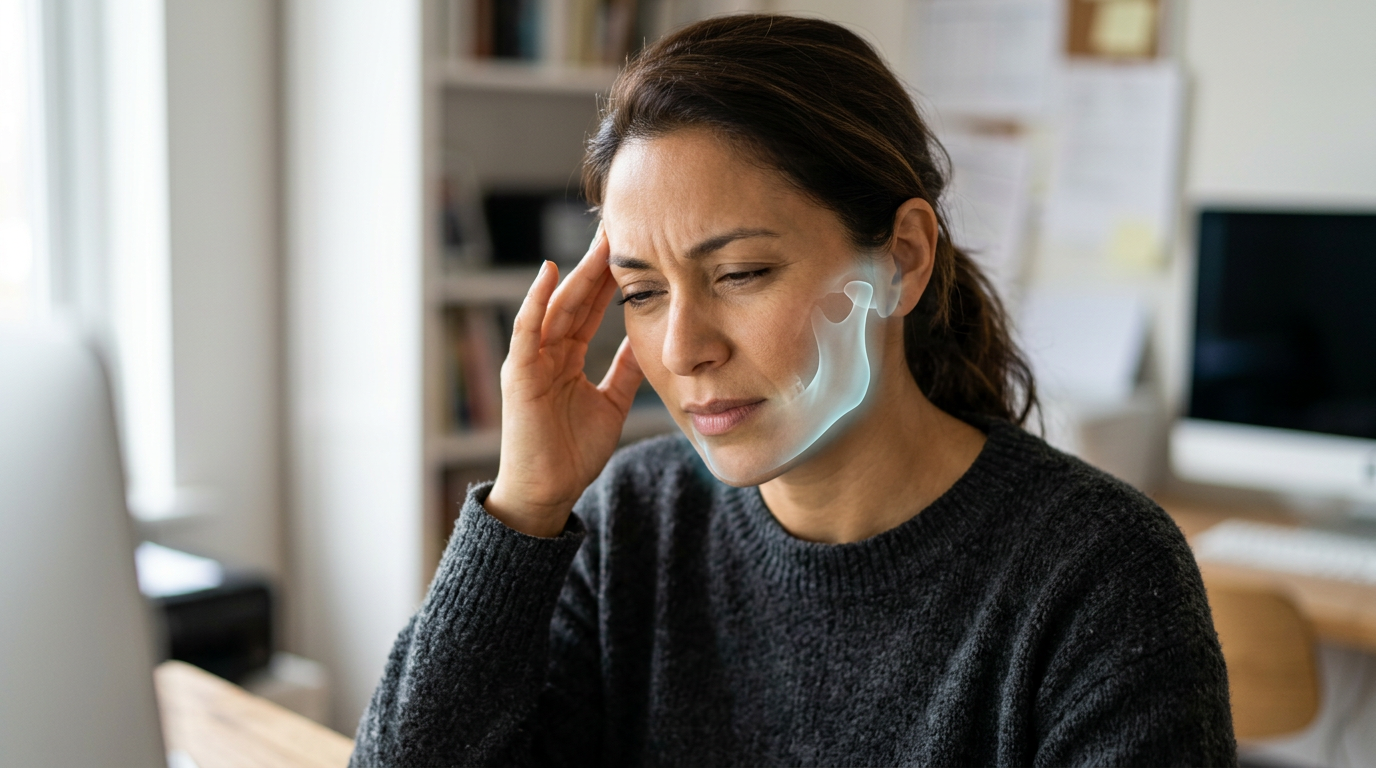
A temple headache can feel like pressure, tightness, aching, or a dull band of pain on one or both sides of your head. You may blame stress, screen time, poor sleep, or a long day at work. Those can all play a role. But there is another possible contributor many people miss: jaw clenching. Jaw clenching and temple headaches can be connected because one of the main chewing muscles, the temporalis muscle, reaches into the temple area. This muscle helps close your jaw when you chew, bite, or clench. When it is overworked, the pain may feel like it is coming from the side of your head rather than from your jaw.
This does not mean every temple headache is caused by clenching. Headaches can come from migraine, tension-type headache, sinus problems, medication patterns, vision strain, sleep disorders, blood pressure changes, and other medical concerns. But if your temple pain appears with jaw tightness, tooth contact, morning soreness, chewing fatigue, or stress clenching, your jaw muscles deserve attention.
The goal is not to diagnose yourself. The goal is to recognize a pattern. If the pain shows up when your jaw has been working too hard, you can track that pattern and ask better questions at your next dental or medical visit.
Quick answer: Jaw clenching may contribute to temple headaches when the temporalis muscle, a chewing muscle on the side of the head, stays active too long. If temple pain appears with tooth contact, jaw tightness, morning soreness, or chewing fatigue, clenching may be part of the pattern.
To understand the bigger pattern behind jaw clenching, read Bruxism and Jaw Tension: Why This Pattern Can Be Confusing.
What Is the Temporalis Muscle?
The temporalis muscle is one of the major muscles used for chewing. It begins along the side of the skull and attaches to the lower jaw. When it contracts, it helps lift and close the jaw.
You use this muscle when you chew food. But it can also become active when you clench your teeth, brace your jaw, hold your mouth tight, chew gum for long periods, or carry stress in your face.
Because the temporalis muscle sits in the temple region, soreness in this muscle may feel like a temple headache. Some people feel pressure. Others notice tightness, scalp tenderness, or a dull ache near one or both temples.
The temporalis is not the only chewing muscle involved. The masseter muscle in the cheek can also become sore with clenching, but the temporalis is especially relevant when pain is felt near the temples.
A practical clue is tenderness. If the temple area feels sore when gently pressed, or if chewing, yawning, or clenching changes the pain, the jaw muscles may be part of the picture. Diagnostic criteria for headache attributed to temporomandibular disorders include headache affected by jaw movement, jaw function, or jaw parafunction, along with familiar pain provoked by examination of the temporalis muscle.[1,2]
How Jaw Clenching and Temple Headaches Are Connected
Jaw clenching is different from normal chewing. Chewing is rhythmic and temporary. Clenching can be sustained, unconscious, and repetitive. You may hold your teeth together while working, reading, driving, scrolling, exercising, or managing stress.
That steady contraction can fatigue the muscles that close the jaw. If the temporalis muscle stays active when you are not eating or speaking, it may become sore, tender, or irritated. The pain may then show up as a temple headache, facial muscle tension, jaw fatigue, or tooth sensitivity.
For some readers, the pattern feels like a tension headache from jaw clenching rather than a sharp or throbbing headache. Others describe it as a headache from clenching teeth that builds after stress, focus, or sleep.
This pattern may happen during the day, during sleep, or both. For example, you may clench through a deadline, then notice temple pressure later in the afternoon. Or you may wake up with sore temples and a tired jaw after a night of sleep bruxism.
A key clue is timing. The source may be muscular when the headache appears after periods of tooth contact, jaw bracing, hard chewing, emotional stress, or waking with jaw soreness.
If you notice tooth contact during work, screens, or driving, read Why You Clench Your Jaw While Working, Driving, or Concentrating.
Signs You May Have a Temple Headache From Jaw Clenching
Temple headaches are easy to misread because the pain location can distract from the source. You feel pain in your head, so you may assume the problem starts only in your head. But jaw-related pain can be referred. That means pain may be felt in one area even when another area is contributing to the problem.
The jaw system includes the teeth, jaw joints, chewing muscles, facial muscles, nerves, and neck-related structures. When one part of that system is overloaded, the pain pattern can spread or blur.
Your temple headache may involve jaw clenching if you notice several of these clues:
- Your teeth touch when you concentrate.
- Your temples feel sore when you press them.
- Your headache appears after work, driving, or screen time.
- Chewing makes the pain worse.
- You wake up with jaw soreness or temple pressure.
- You have tooth sensitivity, worn teeth, or jaw fatigue.
- Your jaw feels tight during stress.
- You notice neck and shoulder tension with the headache.
- You grind or clench your teeth at night.
- A dentist has mentioned signs of bruxism.
These signs do not prove that clenching is the cause. They simply show that your jaw may be part of the symptom pattern. That distinction matters because many headache problems have more than one contributor.
Awake Clenching, Sleep Bruxism, or Both?
Temple headaches may be related to awake clenching, sleep bruxism, or both. These are not the same pattern.
Awake bruxism often involves sustained tooth contact, jaw bracing, or clenching during the day. It may happen during work, stress, concentration, driving, screens, or emotional pressure. Many people do not notice it until they feel jaw fatigue, tooth pressure, or headache.
Sleep bruxism happens during sleep. It may involve rhythmic jaw muscle activity, grinding sounds, or clenching episodes. It is harder to observe because you are asleep when it happens. Research commonly describes sleep bruxism as repetitive jaw muscle activity during sleep that may include clenching or grinding.[3]
The distinction matters because management may differ. Awake clenching often calls for awareness training, habit cues, stress regulation, posture changes, and behavior-based strategies. Sleep bruxism may require a broader look at sleep quality, airway health, arousals, medications, alcohol use, stress load, and dental protection.
Some people have both. They clench while working and also wake up with jaw soreness. In that case, temple headaches may be fed by daytime muscle overload and nighttime jaw activity.
To understand why daytime clenching and nighttime grinding may need different strategies, read Awake Bruxism vs Sleep Bruxism: Why the Difference Matters.
Why Stress, Screens, and Posture Can Make It Worse
Jaw clenching, temple headaches, facial muscle tension, and stress often overlap because the jaw is part of the body’s bracing system. When you are under pressure, your body may prepare for action. Your shoulders rise. Your breathing changes. Your facial muscles tighten. Your jaw may lock into a firm bite.
This is why some people clench during emails, deadlines, difficult conversations, traffic, video calls, or intense focus. The jaw becomes part of the stress response.
Screens can add another layer. A fixed gaze, forward head posture, rounded shoulders, and long periods without movement may increase jaw and neck tension. You may not feel yourself clenching in the moment. You may only notice the result later, when your temples ache or your jaw feels tired.
The loop can also move in the other direction. Pain can increase vigilance. Vigilance can increase muscle tension. Muscle tension can increase pain. Over time, the pattern may become automatic.
That is why “just relax your jaw” is usually not enough. You need a way to notice the behavior while it is happening, then interrupt it before the muscle becomes overloaded.
If stress seems to show up directly in your jaw, read Stress Jaw: Why Anxiety Shows Up in Your Teeth.
What This Symptom Pattern May Mean
A temple headache connected to jaw clenching may mean your jaw muscles are working when they should be resting.
At rest, your teeth should usually be apart. Your lips may be closed, your tongue may rest lightly against the palate, and your jaw should not be held in a firm bite. For many clenchers, that resting pattern has been replaced by a habit loop.
The loop may look like this:
- Stress, focus, posture, or sleep disruption increases tension.
- The teeth touch or the jaw braces.
- The jaw muscles stay active.
- Muscle fatigue builds.
- Pain appears in the temples, jaw, face, teeth, head, or neck.
- The discomfort makes you more tense and aware of the area.
This pattern does not prove cause and effect. Research has found associations among bruxism, temporomandibular disorders, and headache disorders, but causality can be difficult to establish because pain, stress, sleep, and psychosocial factors often overlap.[4]
That caution is important. Jaw clenching may be one contributor, not the whole explanation. The practical value is that clenching is observable, trackable, and often modifiable.
What to Track Before You Seek Help
Tracking does not replace professional care, but it can make your appointment more useful. Instead of saying, “I get headaches,” you can describe when they happen, what they feel like, and whether jaw activity seems connected.
Track these patterns for one to two weeks:
Time of day: Morning, afternoon, evening, or middle of the night.
Location: One temple, both temples, forehead, jaw, ear, neck, or behind the eyes.
Jaw clues: Tooth contact, clenching, chewing fatigue, jaw clicking, jaw locking, soreness, or limited opening.
Triggers: Work stress, driving, screens, deadlines, exercise, caffeine, alcohol, poor sleep, or emotional stress.
Morning signs: Jaw soreness, tooth sensitivity, headache on waking, dry mouth, snoring, or non-restorative sleep.
Pain behavior: Does chewing make it worse? Does pressing the temple reproduce the pain? Does heat, massage, rest, or jaw relaxation help?
Dental signs: Worn teeth, cracked restorations, cheek biting, tongue scalloping, or broken night guards.
This tracking helps you see whether the headache behaves like a jaw-related pattern, a sleep-related pattern, or something that needs medical evaluation.
What May Help
The right next step depends on the cause. Still, several conservative strategies may help reduce jaw-muscle overload.
Practice the Teeth-Apart Resting Position
For many clenchers, the first skill is relearning rest. Teeth should not be held together all day. A useful cue is: lips together, teeth apart, tongue resting lightly on the palate.
This should not feel forced. The goal is to notice when the teeth touch and gently return to a relaxed jaw position.
To relearn a healthier baseline, read The Teeth-Apart Resting Jaw Position: Why Clenchers Need to Relearn It.
Use Awareness Cues
Set reminders during common clenching moments. These may include opening email, starting the car, sitting at your computer, picking up your phone, entering a meeting, or beginning focused work.
When the cue appears, check your jaw. Are your teeth touching? Are your temples tight? Is your tongue tense? Then release.
Reduce Jaw Overload
Avoid chewing gum if it worsens symptoms. Limit hard, chewy foods during flare-ups. Do not repeatedly clench to test whether the jaw still hurts. That can keep the muscle irritated.
Use Heat and Gentle Relaxation
Warm compresses may help some people relax sore jaw muscles. Gentle jaw relaxation can be useful, but aggressive stretching or deep pressure may irritate symptoms in some cases. Keep self-care gentle unless a clinician gives you a specific plan.
Consider Biofeedback for Daytime Clenching
If your temple headaches often appear after long periods of unnoticed tooth contact, awareness training may help you catch the pattern earlier. Biofeedback tools such as ClenchAlert are designed to signal when clenching occurs, giving you a chance to release the jaw and return to a teeth-apart resting position.
This should be viewed as habit awareness training, not as a stand-alone treatment for headache or bruxism.
Ask About Dental Protection
A mouthguard or oral appliance may protect teeth from damage, especially when sleep bruxism is present. But a guard does not automatically stop the clenching behavior. It may reduce tooth wear while other strategies address muscle tension, habit patterns, sleep quality, or airway concerns.
To understand the difference between protection and habit change, read Why a Mouthguard Protects Teeth But May Not Stop Clenching.
When to Seek Professional Help
You should seek professional help if temple headaches are frequent, worsening, new, severe, or interfering with daily life.
A dentist can evaluate tooth wear, bite changes, jaw muscle tenderness, cracked teeth, restorations, and possible signs of bruxism. An orofacial pain specialist can help evaluate complex jaw, facial, and headache overlap. A physician or headache specialist can assess primary headache disorders, migraine, medication-related headache, neurologic concerns, and other medical causes.
Seek urgent medical care for a sudden severe headache, headache with weakness or numbness, vision loss, confusion, fever, stiff neck, chest pain, shortness of breath, fainting, head injury, or a headache that feels dramatically different from your usual pattern.
Also ask about sleep if morning temple headaches come with loud snoring, witnessed breathing pauses, dry mouth, daytime sleepiness, or waking unrefreshed. Sleep-disordered breathing can overlap with bruxism and morning headache patterns, and it requires medical evaluation.
Conclusion
A temple headache may feel like a head problem. Sometimes, the jaw is part of the pattern.
Jaw clenching can overload the temporalis muscle, one of the main muscles that helps close the jaw. Because this muscle sits in the temple area, soreness from clenching may feel like temple pressure, tightness, or headache.
The most useful step is pattern recognition. Notice when your teeth touch. Track when the headache appears. Pay attention to work, screens, driving, sleep, stress, and morning symptoms. Practice the teeth-apart resting position. Reduce unnecessary jaw loading. Consider awareness training if you clench without realizing it.
And do not ignore headaches that are severe, changing, persistent, or unusual. Jaw clenching may be one clue, but it is not the only possible explanation. A qualified dental or medical professional can help you understand whether your temple headaches are related to the jaw, sleep, headache disorders, or another cause that needs care.
FAQ
Can jaw clenching cause temple headaches?
Jaw clenching may contribute to temple headaches in some people because the temporalis muscle helps close the jaw and sits in the temple region. When this muscle is overworked from clenching, chewing, or bracing, pain may be felt near the temples. Headache related to temporomandibular disorders may also be affected by jaw movement, jaw function, or jaw parafunction.[1]
What does a temple headache from jaw clenching feel like?
It may feel like dull pressure, aching, tightness, soreness, or tenderness on one or both sides of the head. Some people notice it after work, driving, screen use, stress, or waking in the morning. It may come with jaw fatigue, tooth sensitivity, or facial tightness.
What is the temporalis muscle?
The temporalis muscle is a large chewing muscle on the side of the head. It helps lift and close the lower jaw. Because it sits in the temple area, soreness in this muscle can feel like temple pain or a headache.
Why do my temples hurt when I clench my teeth?
Your temples may hurt when you clench because the temporalis muscle helps close the jaw and sits along the side of the head. When that muscle contracts strongly or repeatedly, it may become tender and refer pain into the temple area.
Can jaw clenching feel like a tension headache?
Yes. Jaw clenching can sometimes create a dull, tight, pressure-like pain pattern that feels similar to a tension headache. This may happen when the temporalis and other chewing muscles stay active for long periods during stress, focus, or sleep. A medical provider should evaluate frequent, severe, new, or changing headaches.
How do I know if my headache is related to clenching?
Clues include tooth contact during the day, jaw tightness, morning soreness, tender temples, chewing fatigue, worn teeth, tooth sensitivity, or headaches that worsen with chewing or jaw movement. These clues do not prove the cause, but they can help guide a dental or medical evaluation.
Can sleep bruxism cause morning temple headaches?
Sleep bruxism may contribute to morning jaw soreness, tooth sensitivity, and headache in some people. Sleep bruxism involves repetitive jaw muscle activity during sleep and may include clenching or grinding.[3] Morning headaches can also have other causes, including sleep apnea, migraine, medication patterns, or other medical issues.
Can stress cause jaw clenching and temple pain?
Stress can contribute to jaw bracing, tooth contact, and facial muscle tension. Some people clench during deadlines, traffic, screen time, or emotional pressure. When the jaw muscles stay active for long periods, temple discomfort may be part of the pain pattern.
Can a mouthguard stop temple headaches from clenching?
A mouthguard may help protect teeth from grinding or clenching damage, but it may not stop the muscle activity itself. If temple headaches are related to muscle overuse, you may also need awareness training, stress regulation, sleep evaluation, physical therapy, or care from a dentist or orofacial pain specialist.
Should I see a dentist or a doctor for temple headaches?
See a dentist if you also have jaw pain, tooth wear, tooth sensitivity, clenching, grinding, or chewing pain. See a physician if headaches are frequent, severe, new, changing, or come with other symptoms. Some people need both dental and medical evaluation.
When is a temple headache urgent?
Seek urgent medical care for a sudden severe headache, neurologic symptoms, fever, stiff neck, confusion, fainting, vision changes, head injury, chest pain, or a headache that feels very different from your usual pattern.

Randy Clare is a writer, educator, and health communicator focused on making complex clinical topics easier to understand. He is the author of The Brux Method, host of The Clenching Chronicle Podcast, and a contributor to ClenchAlert. He previously served as Director of Digital Marketing at Glidewell Dental, is President of Hawkeye Group, and co-founded the American Sleep and Breathing Academy.