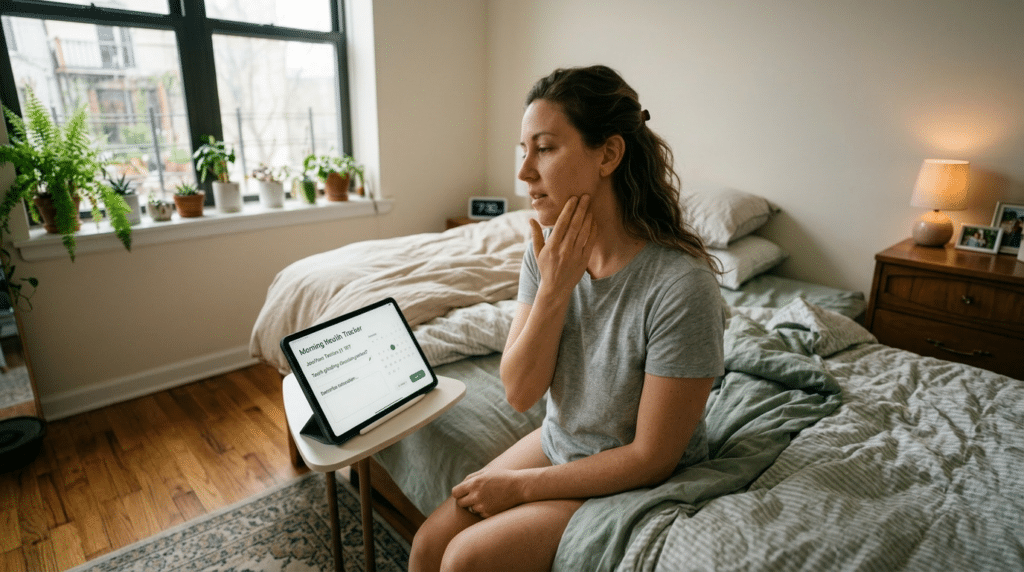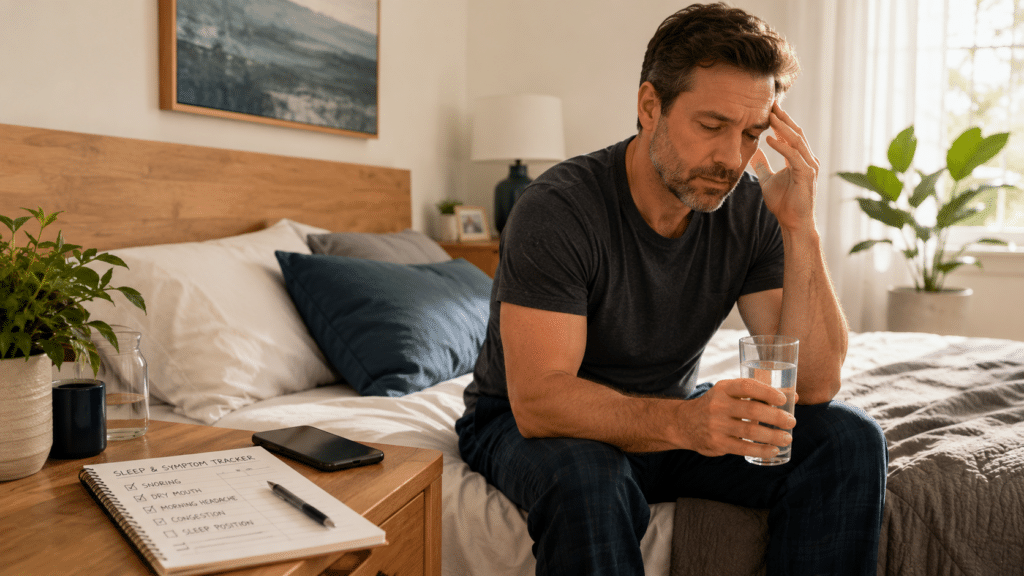

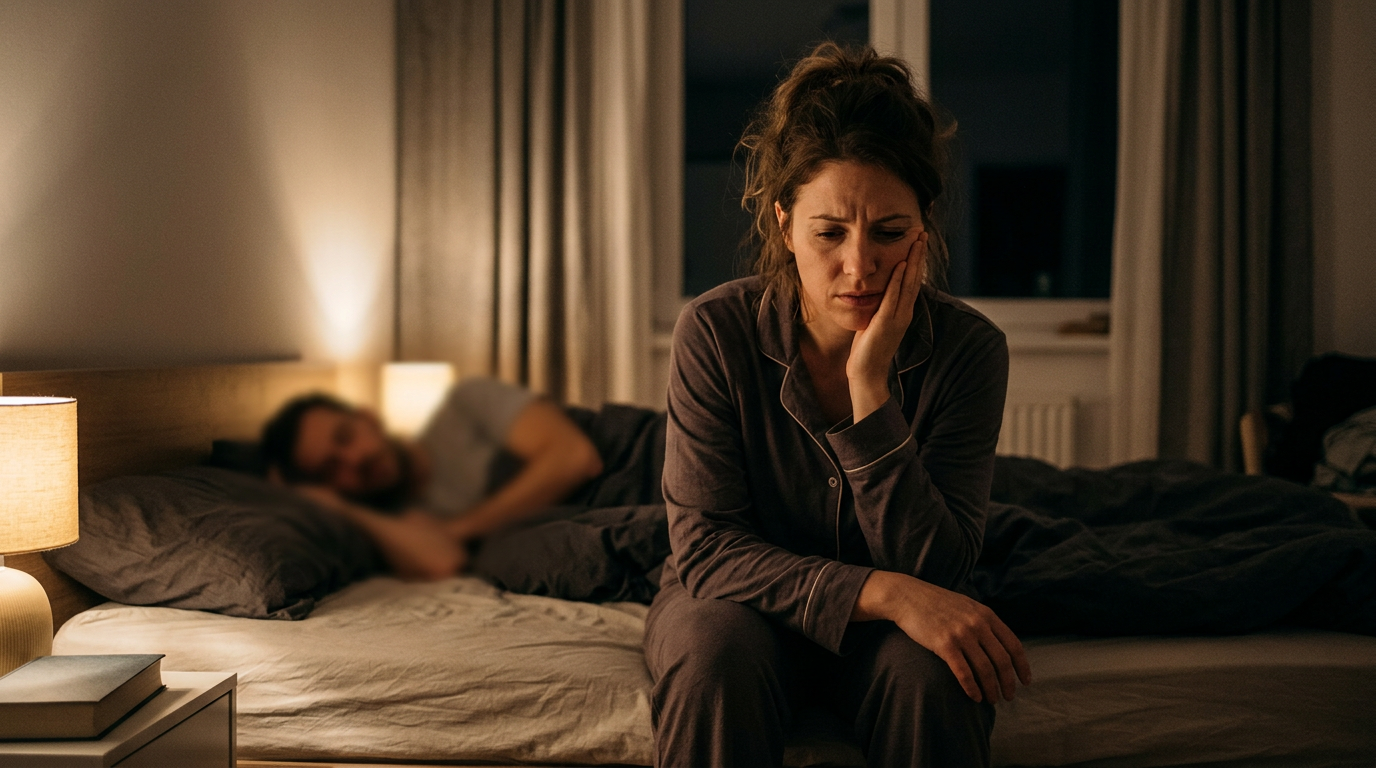
If you grind or clench your teeth at night, you may wonder about the connection between bruxism and sleep quality. You may sleep for seven or eight hours but still wake with a tight jaw, sore teeth, a dull temple headache, or a tired feeling that does not match the time you spent in bed.
Medically responsible content note:
This article is for education only and does not diagnose or treat medical, dental, or sleep conditions. Bruxism, jaw pain, headaches, snoring, breathing pauses, and respiratory symptoms can have multiple causes. Seek care from a qualified medical, dental, sleep, or orofacial pain professional when symptoms are persistent, worsening, severe, or disruptive.
Bruxism is often described as teeth grinding, but sleep bruxism is broader than that. It can include grinding, clenching, bracing, or rhythmic jaw muscle activity during sleep. Some people make grinding sounds. Others clench silently. Some wake with jaw pain and tooth sensitivity but have no memory of anything happening overnight.
This article does not assume that bruxism is the cause of every poor night of sleep. That would be too simple. Fatigue, morning headaches, snoring, stress, pain, insomnia, medications, alcohol, and sleep-disordered breathing can all affect how rested you feel.
The better question is: What pattern keeps showing up?
If you wake with jaw soreness, tooth sensitivity, headaches, dry mouth, fatigue, or reports of grinding or snoring, your body may be giving you useful clues. Those clues can help you decide whether to talk with a dentist, physician, or sleep professional.
For a broader overview of jaw tension, clenching, symptoms, and treatment options, read Bruxism and Jaw Tension: Why This Pattern Can Be Confusing.
If you are unsure whether your pattern is happening during the day, at night, or both, start with Awake Bruxism vs Sleep Bruxism: Why the Difference Matters.
Quick Answer: Can Bruxism Affect Sleep Quality?
Bruxism can affect sleep quality in some people, especially when nighttime grinding or clenching is associated with jaw pain, brief arousals, morning headaches, or bed partner disturbance. However, poor sleep can have many causes, including stress, insomnia, snoring, medications, alcohol, and sleep apnea.
Bruxism should be viewed as one possible part of a larger sleep pattern, not the only explanation.
What Is Sleep Bruxism?
Sleep bruxism is jaw muscle activity that happens while you are asleep. According to the international consensus definition, sleep bruxism is masticatory muscle activity during sleep that may be rhythmic or non-rhythmic.¹
In everyday language, that means your jaw muscles may become active at night even though you are not choosing to clench or grind.
Sleep bruxism may involve:
- Grinding sounds
- Silent clenching
- Jaw bracing
- Rhythmic jaw movements
- Sustained tooth contact
- Morning jaw soreness or tooth sensitivity
It is different from awake bruxism because you cannot notice it in real time. During the day, you may catch yourself clenching at your desk, in traffic, or while concentrating. At night, your first clues may come from morning symptoms or a bed partner’s report.
Sleep bruxism is not always harmful. In some people, it may be present without pain or obvious damage. But when it becomes frequent, forceful, painful, or connected with fatigue, headaches, or dental changes, it deserves attention.
Does Bruxism Affect Sleep?
Yes, bruxism can affect sleep quality for some people, but it is not always the only cause. Sleep bruxism may overlap with brief arousals, jaw muscle activation, pain, bed partner disturbance, snoring, or fragmented sleep.
A brief arousal is a short shift into lighter sleep. You may not remember it. You may not fully wake up. But your body may become more active for a few seconds.
In some people, jaw muscle activity happens around these brief arousal events.²˒³ This does not mean every bruxism episode is dangerous or disruptive. It means that sleep bruxism can be part of a broader sleep pattern.
Bruxism may also affect sleep quality through pain. If your jaw muscles work hard overnight, they may feel sore by morning. That soreness can make sleep feel less restorative, even if you were technically asleep for many hours.
A bed partner may also be affected. Grinding sounds, jaw movements, snoring, or restlessness can disturb the person sleeping next to you. Sometimes the bed partner notices the problem before the person with bruxism does.
The key point is this: sleep bruxism may contribute to poor sleep quality, but it may also be a sign that other sleep-disrupting issues are present.
Can Teeth Grinding Cause Poor Sleep?
Teeth grinding can contribute to poor sleep when it is associated with pain, jaw muscle fatigue, arousals, or bed partner disturbance. But teeth grinding and poor sleep do not always have a simple cause-and-effect relationship.
Some people grind their teeth and still feel rested. Others wake tired, sore, or foggy. The difference may depend on how often the jaw muscles activate, how much force is involved, whether pain develops, and whether other sleep problems are also present.
Poor sleep can also come from insomnia, snoring, sleep apnea, alcohol, medications, stress, chronic pain, nasal obstruction, or irregular sleep timing. That is why teeth grinding sleep quality concerns should be viewed as part of a larger pattern.
If you wake with jaw pain, morning headaches, fatigue, and partner-reported grinding, bruxism may be involved. If you also snore, gasp, wake with dry mouth, or feel sleepy during the day, sleep-disordered breathing should be considered too.
How Micro-Arousals May Connect Bruxism and Sleep Quality
A micro-arousal is a tiny interruption in sleep. Think of sleep as a steady rhythm. Micro-arousals are small breaks in that rhythm.
You may not open your eyes. You may not remember waking. But your nervous system may become more active for a moment. Your heart rate may shift. Your breathing pattern may change. Your muscle tone may increase.
Jaw muscles may activate around the same time.
Research has described sleep bruxism as an oromotor activity that can occur in relation to micro-arousals.² More broadly, sleep bruxism is considered a sleep-related movement activity with links to arousal physiology in some patients.³
This is one way sleep fragmentation bruxism patterns may overlap. The jaw activity may not be the only problem, but it may appear around brief changes in sleep depth, nervous system activation, and muscle activity.
This is also why it is important not to look at tooth grinding in isolation. If sleep bruxism appears with morning fatigue, snoring, gasping, morning headaches, or daytime sleepiness, the sleep side of the picture deserves attention too.
Jaw Muscle Activity Can Leave You Sore by Morning
Your jaw muscles are strong. The masseter muscles on the sides of your jaw and the temporalis muscles near your temples help you chew, close your jaw, and stabilize your bite.
If those muscles work while you sleep, they may feel like any other overused muscle. The difference is that you did not choose the workout and may not remember it happening.
Morning jaw soreness may feel like:
- Tightness when opening your mouth
- Aching in the cheeks
- Tenderness near the temples
- Tooth sensitivity
- Facial heaviness
- Jaw fatigue
- Soreness when chewing breakfast
For some people, this is mostly a muscle-fatigue issue. For others, it overlaps with headaches, neck tension, ear pressure, or TMJ discomfort.
If your main symptom is waking up with jaw soreness, Morning Jaw Pain: Sleep Bruxism, Daytime Clenching, or Both? can help you sort the timing of your symptoms.
Morning Headaches, Jaw Pain, and Poor Sleep Can Overlap
Morning headaches can have many causes. Bruxism is one possibility, but it is not the only one.
There are two common pathways to think about.
The first is the jaw muscle pathway. Clenching can load the temporalis muscle, which sits near the temples. When that muscle becomes tight, irritated, or overworked, it may contribute to temple tenderness or headache-like pain. This pattern is more suspicious when morning headache appears with jaw soreness, tooth sensitivity, facial tightness, or partner-reported grinding.
The second is the sleep pathway. Morning headaches can also appear with poor sleep quality, snoring, gasping, oxygen fluctuations, fragmented sleep, medications, alcohol, dehydration, migraine, neck tension, or sleep apnea. This pattern becomes more important when morning headache appears with loud snoring, witnessed breathing pauses, high blood pressure, dry mouth, or daytime sleepiness.
You do not need to diagnose yourself. You need to notice the pattern clearly enough to discuss it with the right professional.
If temple pain is part of your pattern, Jaw Clenching and Temple Headaches: How the Muscles Connect explains why the jaw muscles can refer pain into the sides of the head.
Bruxism, Snoring, and Sleep Apnea: Why Evaluation Matters
Bruxism and sleep apnea can coexist, but bruxism alone does not diagnose sleep apnea.
That distinction matters. Some people hear that teeth grinding can be connected to sleep apnea and assume that grinding automatically means they have a breathing disorder. That is too strong.
A 2022 scoping review found no significant association between obstructive sleep apnea and sleep bruxism in most adult studies, while noting possible association in children and substantial variability across research methods.⁴
So the careful message is this: sleep bruxism should not be used by itself as a sleep apnea diagnosis. But bruxism plus other warning signs should not be ignored.
Ask about medical evaluation or sleep testing when bruxism appears with:
- Loud, frequent snoring
- Gasping or choking during sleep
- Witnessed breathing pauses
- Morning headaches
- Dry mouth on waking
- Daytime sleepiness
- High blood pressure
- Unrefreshing sleep despite enough hours in bed
A dentist may help identify signs of bruxism, including tooth wear, jaw muscle tenderness, fractured restorations, or grinding-related damage. A physician or sleep specialist is needed to evaluate suspected sleep apnea.
If snoring, gasping, or morning fatigue are also present, Snoring vs Sleep Apnea: How to Know When It May Be More Than Noise is a helpful next article.
Bed Partner Sleep Disturbance Is Part of the Story
Sleep bruxism does not only affect the person who grinds or clenches. It may also affect the person sleeping nearby.
A bed partner may hear grinding sounds, notice restless jaw movements, or observe snoring and breathing changes. Sometimes the person with bruxism has no idea anything is happening until someone else mentions it.
These observations are not a diagnosis, but they are useful clues.
Ask your partner a few simple questions:
- Do you hear grinding?
- Do you hear loud snoring?
- Do you notice gasping, choking, or pauses in breathing?
- Does it seem worse during stressful weeks?
- Does it seem worse after alcohol, late caffeine, or short sleep?
These details can help your dentist or physician understand whether the issue looks mainly dental, muscular, behavioral, sleep-related, or mixed.
What This Symptom Pattern May Mean
Symptoms become more useful when you group them.
If you have jaw soreness without fatigue, the main issue may be muscle overuse, tooth protection, or daytime clenching that carries into the night.
If you have jaw soreness plus morning headaches, jaw muscle loading, sleep disruption, neck tension, migraine, or other headache triggers may overlap.
If you have jaw soreness plus snoring, gasping, or daytime sleepiness, sleep-disordered breathing should be considered.
If you have jaw soreness plus daytime clenching, your jaw may be under load both day and night.
If you have grinding sounds but no pain, you may still want a dental exam to check for tooth wear or restoration damage.
If you have fatigue without jaw symptoms, the sleep problem may be unrelated to bruxism and still deserves attention if it persists.
Waking Up Tired From Bruxism: What Else Can Affect Sleep Quality?
Waking up tired from bruxism is possible when nighttime jaw activity is associated with pain, morning headaches, muscle fatigue, bed partner disturbance, or fragmented sleep. But tired mornings should not automatically be blamed on teeth grinding.
Poor sleep quality can also involve insomnia, stress, alcohol, late caffeine, medication effects, nasal obstruction, restless legs, chronic pain, irregular sleep schedules, depression, mood changes, or sleep apnea.
That is why tracking symptoms is more useful than guessing.
The question is not, “Is bruxism the only reason I am tired?” The better question is, “What pattern keeps showing up with my tired mornings?”
If tired mornings usually appear with jaw soreness, temple headaches, tooth sensitivity, or partner-reported grinding, bruxism may be part of the picture. If tired mornings appear with snoring, gasping, dry mouth, or daytime sleepiness, sleep-disordered breathing should also be considered.
This is especially important for people searching for answers around morning fatigue teeth grinding. Morning fatigue may involve the jaw, but it may also involve breathing, sleep fragmentation, stress, or another sleep disorder.
What to Track If You Suspect Bruxism Is Affecting Your Sleep
A simple two-week tracking plan can help you see patterns more clearly. You do not need a complicated spreadsheet. A note on your phone is enough.
Jaw signs
- Morning jaw soreness
- Tooth sensitivity
- Temple tenderness
- Facial tightness
- Ear pressure or jaw joint discomfort
- Neck tension
Sleep signs
- Morning fatigue
- Daytime sleepiness
- Dry mouth on waking
- Partner-reported grinding
- Snoring
- Gasping or choking
- Restless sleep
Trigger clues
- Stress level
- Long screen time
- Intense concentration
- Driving tension
- Alcohol
- Caffeine timing
- Late meals
- Evening screen exposure
- Poor sleep schedule
This kind of tracking helps you separate random symptoms from repeated patterns. It also gives your dentist or physician better information.
If you also clench during work, driving, or screen time, Why You Clench Your Jaw While Working, Driving, or Concentrating can help you identify daytime triggers that may carry into the night.
If stress seems to be one of your strongest triggers, Stress Jaw: Why Anxiety Shows Up in Your Teeth explains why pressure, anxiety, and nervous system activation can show up as jaw tension.
What May Help Improve Sleep Quality When Bruxism Is Part of the Pattern
The right next step depends on what the pattern suggests. Think in three pathways: protect the teeth, evaluate sleep quality, and reduce jaw load.
1. Protect the teeth
If your main concern is tooth wear, cracked teeth, tooth sensitivity, or broken dental work, start with a dental exam.
A dentist can look for signs of grinding or clenching and may recommend a professionally made nightguard when tooth protection is needed. A nightguard can help protect teeth from damage, but it does not always stop the jaw muscle activity behind bruxism.
If you wear a nightguard but still wake with jaw tension, Why a Mouthguard Protects Teeth But May Not Stop Clenching explains the difference between protecting teeth and changing a clenching habit.
2. Evaluate sleep quality
If your main concern is fatigue, snoring, gasping, morning headaches, dry mouth, or daytime sleepiness, ask a medical provider whether sleep testing makes sense.
This is especially important if you have loud snoring, witnessed breathing pauses, high blood pressure, or unrefreshing sleep despite enough hours in bed.
A dental appliance, nightguard, or jaw exercise should not be used as a substitute for sleep evaluation when sleep-disordered breathing is possible.
3. Reduce jaw load
Some people load the jaw both day and night. They clench while working, driving, thinking, lifting, scrolling, or handling stress. By bedtime, the jaw muscles may already be tired.
Daytime jaw awareness may help reduce that total load.
Simple steps include:
- Practice “lips together, teeth apart”
- Notice tooth contact during work or screen time
- Relax the tongue and jaw during transitions
- Take brief jaw-release breaks during the day
- Build a calmer wind-down routine before bed
- Reduce late caffeine or alcohol if they worsen sleep
- Address nasal congestion or mouth breathing with a medical professional when needed
For people who also clench during the day, a biofeedback tool such as ClenchAlert can help build awareness of tooth contact during short daytime practice sessions. This does not replace a nightguard or sleep evaluation when those are needed, but it may help reduce the total jaw load across the day.
When to Seek Professional Help
You should consider professional evaluation when symptoms are persistent, painful, or connected to poor sleep.
Talk with a dentist if you have:
- Jaw pain that does not improve
- Tooth sensitivity
- Worn, chipped, or cracked teeth
- Broken dental work
- Morning jaw soreness
- Limited jaw opening
- Jaw locking or catching
- Frequent grinding reports from a partner
Talk with a physician or sleep specialist if you have:
- Loud snoring
- Gasping or choking during sleep
- Witnessed breathing pauses
- Morning headaches
- Daytime sleepiness
- High blood pressure
- Unrefreshing sleep despite enough time in bed
- Fatigue that affects work, driving, or daily function
A dentist can help evaluate tooth wear, jaw muscles, bite-related damage, and oral appliance options. A physician or sleep specialist can evaluate possible sleep-disordered breathing or other sleep conditions.
Conclusion
Bruxism and sleep quality can overlap, but the relationship is not always direct.
Sleep bruxism may involve jaw muscle activity, grinding, clenching, brief arousals, muscle fatigue, morning soreness, or bed partner disturbance. It may also appear alongside snoring, fragmented sleep, morning headaches, or daytime fatigue.
But bruxism is not the only cause of poor sleep. Poor sleep is not always caused by bruxism. Sleep bruxism does not automatically mean you have sleep apnea.
The most useful next step is to look for the pattern.
If the pattern points toward tooth wear, jaw soreness, or dental damage, start with a dental evaluation. If the pattern includes snoring, gasping, morning headaches, dry mouth, or daytime sleepiness, ask a medical provider whether sleep testing makes sense. If daytime clenching is part of the picture, awareness training may help reduce the total load on your jaw.
The goal is not to blame every tired morning on bruxism. The goal is to recognize when your jaw, sleep, and breathing symptoms may be telling the same story.
FAQ
Does bruxism affect sleep quality?
Bruxism can affect sleep quality in some people, but it is not always a simple cause-and-effect relationship. Sleep bruxism may occur near brief arousals, jaw muscle activation, pain, or other sleep disruptions. Some people wake with jaw soreness, headaches, or tooth sensitivity. Others may feel tired despite spending enough time in bed. Bruxism may also disturb a bed partner if grinding sounds are loud. However, poor sleep can have many causes, including stress, insomnia, medication effects, alcohol, caffeine, pain, snoring, or sleep apnea. Bruxism should be viewed as one possible part of the larger sleep pattern.
Can teeth grinding make me wake up tired?
Teeth grinding may contribute to tired mornings in some people, especially if it occurs with jaw pain, muscle fatigue, headaches, or fragmented sleep. But waking up tired should not automatically be blamed on bruxism. Fatigue can also come from sleep apnea, insomnia, stress, poor sleep timing, alcohol, medications, nasal obstruction, chronic pain, or other medical issues. If you wake tired and also notice jaw soreness, tooth sensitivity, or partner-reported grinding, track the symptoms for one to two weeks. If fatigue continues, or if snoring and gasping are present, professional evaluation is important.
Can jaw clenching at night cause poor sleep?
Jaw clenching at night may contribute to poor sleep when it is linked with jaw pain, tooth sensitivity, headaches, or brief arousals. However, poor sleep can also come from snoring, sleep apnea, stress, alcohol, caffeine, insomnia, medications, or irregular sleep schedules. If jaw clenching appears with fatigue, morning headaches, snoring, or daytime sleepiness, professional evaluation may help identify the larger pattern.
Is sleep bruxism a sign of sleep apnea?
Sleep bruxism can occur alongside sleep apnea, but it is not a reliable sign of sleep apnea by itself. Research has not shown a consistent adult association across most studies.⁴ However, bruxism plus loud snoring, gasping, witnessed breathing pauses, morning headaches, dry mouth, high blood pressure, or daytime sleepiness should raise concern for possible sleep-disordered breathing. A dentist may notice signs of grinding, but sleep apnea requires appropriate medical evaluation and sleep testing. Do not use tooth grinding alone to diagnose or rule out sleep apnea.
What is the connection between bruxism and sleep apnea?
Bruxism and sleep apnea can occur in the same person, but bruxism does not diagnose sleep apnea. The connection is still being studied, and adult research has not shown a consistent association across all studies. Bruxism becomes more concerning when it appears with loud snoring, gasping, witnessed pauses in breathing, morning headaches, dry mouth, high blood pressure, or daytime sleepiness. Those signs may point to a sleep-breathing problem that needs medical evaluation.
Can a mouthguard improve sleep quality?
A mouthguard may protect teeth from grinding damage and may reduce some discomfort related to tooth wear or clenching pressure. However, a mouthguard does not always stop the jaw muscle activity behind bruxism. Some people still clench or grind while wearing one. If your sleep feels poor because of fatigue, snoring, gasping, or morning headaches, a mouthguard alone may not address the whole problem. It is best to discuss persistent symptoms with a dentist and, when sleep-breathing signs are present, with a physician or sleep specialist.
Why does my partner hear grinding if I do not wake up?
Many people do not remember sleep bruxism because it happens while they are asleep. You may not fully wake during grinding or clenching episodes. A bed partner may notice sounds, jaw movements, snoring, gasping, or restlessness before you recognize the pattern yourself. Partner reports can be useful clues, especially when they are paired with morning jaw soreness, tooth sensitivity, headaches, or fatigue. These observations are not a diagnosis, but they can help your dentist or physician decide what needs to be evaluated.
Can stress make sleep bruxism worse?
Stress may contribute to jaw tension and bruxism patterns in some people, especially when stress also affects sleep quality. Many people clench during the day when concentrating, worrying, working, or driving. That daytime muscle tension can leave the jaw already fatigued before sleep begins. Stress may also make sleep lighter or more fragmented. Not every case of sleep bruxism is caused by stress, but stress is a useful pattern to track. Notice whether grinding, jaw soreness, or morning headaches are worse after high-pressure days.
What should I track if I think bruxism is affecting my sleep?
Track morning jaw soreness, tooth sensitivity, temple headaches, facial tightness, dry mouth, fatigue, daytime sleepiness, and partner-reported grinding or snoring. Also track stress level, caffeine timing, alcohol, late meals, screen use, and sleep schedule. This can help you see whether symptoms cluster together. For example, jaw soreness plus grinding reports may point toward sleep bruxism. Jaw soreness plus snoring and daytime sleepiness may suggest that sleep-disordered breathing should be evaluated. A simple two-week log can make your professional visit more useful.
References
- Lobbezoo F, Ahlberg J, Raphael KG, et al. International consensus on the assessment of bruxism: report of a work in progress. J Oral Rehabil. 2018;45(11):837-844.
- Kato T, Rompré P, Montplaisir JY, Sessle BJ, Lavigne GJ. Sleep bruxism: an oromotor activity secondary to micro-arousal. J Dent Res. 2001;80(10):1940-1944.
- Kato T, Lavigne GJ. Sleep bruxism: a sleep-related movement disorder. Sleep Med Clin. 2010;5(1):9-35.
- Pauletto P, Polmann H, Réus JC, et al. Sleep bruxism and obstructive sleep apnea: association, causality or spurious finding? A scoping review. Sleep. 2022;45(11):zsac073.
- American Academy of Sleep Medicine. Bruxism. Sleep Education. Updated May 6, 2021.

Randy Clare is a writer, educator, and health communicator focused on making complex clinical topics easier to understand. Through The Sleep and Respiratory Scholar, he creates clear, practical content on bruxism, headache, sleep, airway health, and respiratory symptoms. He is the author of The Brux Method, President of ClenchAlert.com and host of The Clenching Chronicle Podcast, where he explores jaw tension, clenching, headaches, and behavior-based approaches to relief. His work helps readers better understand symptoms, recognize patterns, and take more informed next steps.