

Last updated on April 30th, 2026 at 05:49 am
Medically responsible content note:
This article is for education only and does not diagnose or treat medical, dental, or sleep conditions. Bruxism, jaw pain, headaches, snoring, breathing pauses, and respiratory symptoms can have multiple causes. Seek care from a qualified medical, dental, sleep, or orofacial pain professional when symptoms are persistent, worsening, severe, or disruptive.
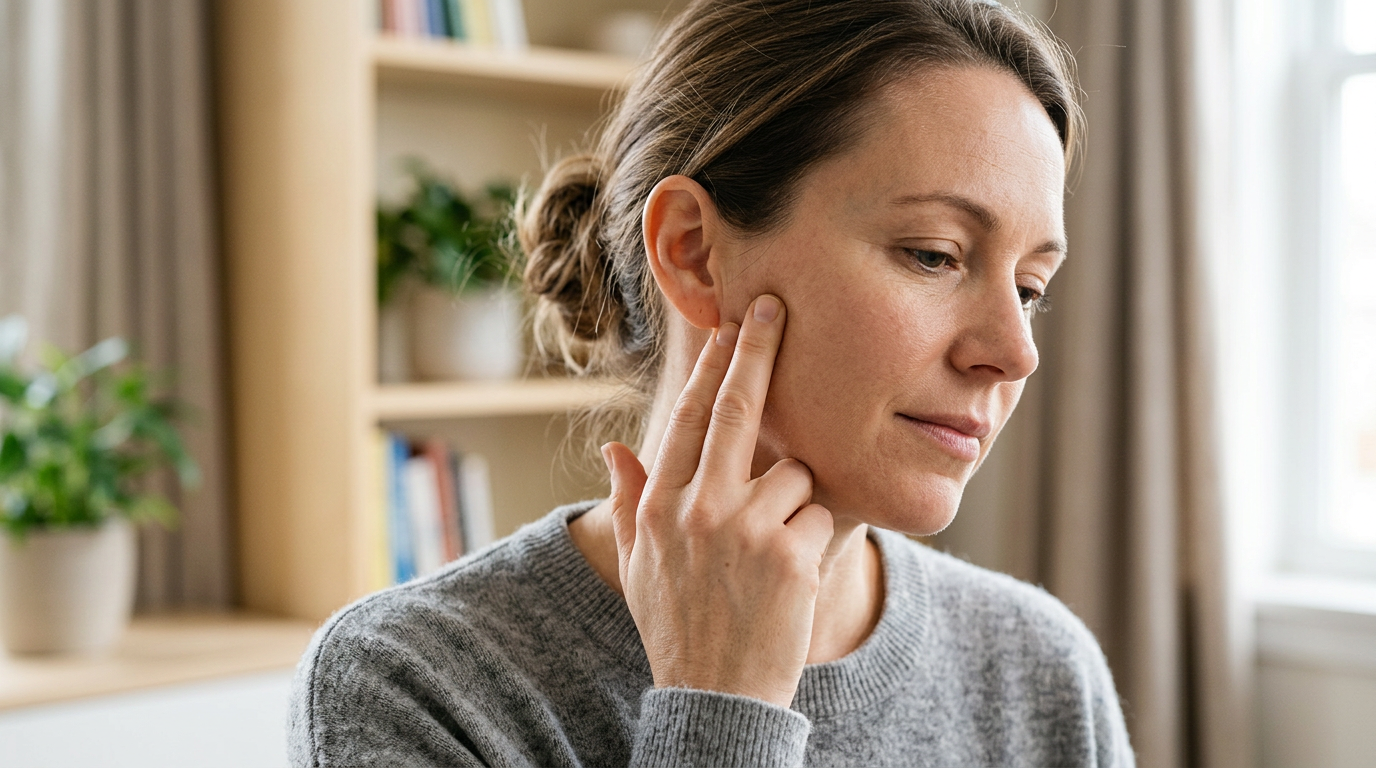
Can bruxism cause ear pain? In some people, yes. Jaw clenching and teeth grinding may contribute to pain that feels like it is coming from the ear, especially when ear discomfort appears with jaw soreness, temple headaches, tooth sensitivity, chewing pain, or morning jaw tightness.
But ear pain should not be automatically blamed on bruxism. Ear symptoms can come from many causes, including infection, wax buildup, sinus congestion, Eustachian tube problems, hearing changes, injury, or pressure changes. Medical references note that ear pain may come from the ear itself or from nearby areas that share nerve pathways with the ear, including the temporomandibular joint, or TMJ.¹
Quick answer: Bruxism may contribute to ear pain or ear pressure in some people because the jaw joint sits close to the ear and the chewing muscles can refer pain to the ear area. However, ear pain can also come from infection, wax buildup, sinus problems, Eustachian tube dysfunction, hearing issues, injury, or pressure changes. New, severe, persistent, one-sided, or worsening ear symptoms should be medically evaluated.
The jaw-ear connection matters because the temporomandibular joint sits just in front of the ear. The chewing muscles, jaw joint, nerves, and ear region are close together. When the jaw muscles or joint are irritated, pain can sometimes be felt around the ear, even when the ear itself is not the main problem.
This article explains how jaw clenching, teeth grinding, TMJ strain, and chewing muscle tension may overlap with ear pain, ear pressure, fullness, or an earache-like sensation. It will also help you know what to track and when to seek medical, dental, ENT, or orofacial pain care.
To understand the bigger pattern behind clenching and grinding, read our guide to bruxism and jaw tension.
Can Bruxism Cause Ear Pain?
Bruxism is repetitive jaw muscle activity. It can include clenching, grinding, bracing, or thrusting the jaw. Experts now describe bruxism as either awake bruxism or sleep bruxism, because daytime clenching and nighttime grinding are not always the same pattern.²
Awake bruxism often shows up as clenching during work, driving, stress, screen time, or concentration. Sleep bruxism happens during sleep and may involve rhythmic jaw muscle activity, tooth grinding sounds, morning jaw pain, or tooth sensitivity.
Both patterns can overload the jaw muscles and temporomandibular joints. When those tissues become sore or irritated, the pain may be felt in the jaw, cheek, temple, face, teeth, head, neck, or ear area. Temporomandibular disorders, or TMDs, include conditions that cause pain or dysfunction in the jaw joint and chewing muscles. Clinical reviews list earache, headache, facial pain, and jaw dysfunction among common TMD symptoms.³
So the careful answer is this: bruxism may contribute to ear pain in some people, but it is not the only possible cause. The pattern matters.
A possible jaw-related pattern may include:
| Symptom pattern | Why it may matter |
| Ear pain with jaw soreness | The jaw muscles or TMJ may be irritated. |
| Ear pressure with temple tension | Chewing muscle tension may be part of the pattern. |
| Ear fullness with chewing discomfort | Jaw movement may be influencing the symptom. |
| Earache with tooth sensitivity | Grinding or clenching may be overloading the teeth and jaw. |
| Ear pain that worsens with yawning or chewing | TMJ or muscle involvement may be worth evaluating. |
| Morning ear-area discomfort with jaw tightness | Sleep bruxism may be part of the picture. |
| Ear symptoms during work, driving, or concentration | Awake clenching may be part of the picture. |
If you are unsure whether your symptoms come from daytime clenching or nighttime grinding, this guide to awake bruxism vs sleep bruxism can help.
Why Jaw Clenching and TMJ Problems Can Feel Like Ear Pain
The jaw joint sits directly in front of the ear. You can feel this area by placing your fingers just in front of your ears and opening and closing your mouth. That joint is the TMJ.
Many people say “TMJ” when they mean jaw joint pain, jaw clicking, or jaw-related symptoms. Clinically, TMD refers to disorders that affect the temporomandibular joint, chewing muscles, and related structures. TMJ is the joint. TMD is the disorder or group of disorders.
When the TMJ, masseter muscle, temporalis muscle, or other chewing muscles become irritated, the pain may not stay in one neat location. The jaw and ear region share nearby nerve pathways, and pain from one area can be perceived in another. This is called referred pain.
That is why jaw pain and ear pressure can feel confusing. A person may say, “My ear hurts,” when the source may involve jaw muscle tension, joint irritation, or both.
This does not mean the ear should be ignored. It means the jaw should be considered when ear symptoms appear with jaw symptoms.
A useful clue is whether the ear pain changes with jaw movement. If pain increases when you chew, yawn, open wide, press on the jaw muscles, or clench your teeth, the jaw may be part of the picture. If the pain appears with fever, drainage, sudden hearing changes, dizziness, or illness, medical evaluation becomes especially important.
Can Jaw Clenching Cause Ear Pressure or Ear Fullness?
Some people do not describe the feeling as pain. Instead, they describe fullness, pressure, stuffiness, muffled hearing, or a blocked-ear sensation.
This is where the answer needs care. Ear pressure from jaw clenching is possible for some people, but ear fullness is not automatically a dental or jaw problem. Eustachian tube dysfunction, allergies, sinus congestion, fluid, infection, wax buildup, hearing disorders, and pressure changes from flying or diving can also cause ear fullness or pressure.
Still, the jaw may be involved when ear fullness appears with:
- Jaw tightness
- Cheek soreness
- Temple headaches
- Clicking or popping in the jaw
- Pain with chewing
- Morning jaw stiffness
- Daytime clenching
- Tooth sensitivity
- Neck and facial muscle tension
The Merck Manual lists earaches or stuffiness in the ears among symptoms that may occur with temporomandibular disorders, along with headaches, chewing muscle tenderness, jaw clicking or locking, neck stiffness, and disrupted sleep.⁴ That overlap is one reason ear fullness and jaw tension can be difficult to separate without a professional evaluation.
If your ear pressure appears alongside temple pain or headaches, this article on jaw clenching and temple headaches may help you connect the pattern.
Ear Symptoms: More Likely Ear-Related or Jaw-Related?
This table is not a diagnosis. It is a pattern guide. It can help you decide what to track and which professional may be the best starting point.
| Symptom clue | More likely medical or ear-related | More likely jaw, bruxism, or TMD-related |
| Fever | Yes | Less likely |
| Ear drainage | Yes | Less likely |
| Sudden hearing loss | Yes | Less likely |
| Dizziness or vertigo | Yes | Sometimes, but medical evaluation is important |
| Recent flight, diving, or pressure change | Yes | Less likely |
| Sinus congestion or allergies | Yes | Sometimes overlapping |
| Worse with chewing or yawning | Sometimes | Yes |
| Jaw clicking, popping, or locking | Less likely | Yes |
| Morning jaw soreness | Less likely | Yes |
| Tooth sensitivity or tooth wear | Less likely | Yes |
| Temple headache with jaw tightness | Sometimes | Yes |
| Pain when pressing jaw muscles | Less likely | Yes |
If symptoms are new, severe, persistent, worsening, or one-sided, get medical evaluation first. If the ear evaluation does not explain the symptoms, the jaw may deserve closer attention.
Signs Ear Pain May Be Related to Bruxism, Jaw Clenching, or TMD
The following signs do not prove that bruxism is causing your ear pain. They suggest that jaw clenching, teeth grinding, or TMD may be worth discussing with a dentist, physician, or orofacial pain specialist.
Your ear symptoms may be jaw-related if:
- The pain sits just in front of the ear rather than deep inside the ear.
- The discomfort changes when you chew, yawn, talk, or open wide.
- You have jaw soreness, tightness, clicking, popping, or locking.
- You wake with jaw pain, tooth sensitivity, or facial tension.
- You notice clenching during work, driving, stress, or concentration.
- Your temples, cheeks, or jaw muscles feel tender.
- You have headaches that travel with jaw tension.
- Your dentist has noticed tooth wear, cracked teeth, or signs of grinding.
- Ear testing or ear examination does not fully explain the symptoms.
- The discomfort eases when you relax your jaw and keep your teeth apart.
The strongest clue is pattern recognition. Ear pain alone can have many causes. Ear pain plus jaw soreness, chewing pain, temple tension, and clenching awareness tells a different story.
If you notice clenching during work, screens, or driving, read our guide on why you clench your jaw while concentrating.
What Ear Pain With Jaw Tension May Mean
The Sleep and Respiratory Scholar focuses on symptoms that often get treated separately. Ear pain, jaw tension, headaches, sleep disruption, stress, tooth sensitivity, and neck tension may seem unrelated at first. In some people, they are part of the same pattern.
For example, a person may feel ear pressure during a stressful workday, then notice jaw tightness and temple tension by evening. Another person may wake with jaw soreness, tooth sensitivity, and an ache near one ear. Someone else may have an “earache” that becomes worse when chewing or yawning.
These patterns may suggest that the jaw system is under strain.
Possible patterns include:
- Earache + morning jaw pain: Sleep bruxism may be involved.
- Ear pressure + work stress: Awake clenching may be involved.
- Ear fullness + temple headache: Temporalis muscle tension may be involved.
- Ear pain + chewing discomfort: TMJ or chewing muscle irritation may be involved.
- Ear symptoms + neck tension: Broader muscle guarding may be involved.
- Ear pain + snoring or morning headaches: Sleep quality and breathing may need attention.
The goal is not to self-diagnose. The goal is to notice whether your ear symptoms travel with jaw symptoms.
If symptoms are worse in the morning, read our article on morning jaw pain and whether sleep bruxism, daytime clenching, or both may be involved.
When Ear Pain Needs Medical Evaluation
Ear pain and ear pressure should be taken seriously. Do not assume they are caused by bruxism, even if you clench or grind your teeth.
Seek medical evaluation if ear symptoms are new, severe, persistent, worsening, or unexplained. This is especially important if you have:
- Sudden hearing loss
- Drainage from the ear
- Fever
- Dizziness or vertigo
- Severe one-sided ear pain
- New or worsening ringing in the ear
- Facial weakness or numbness
- Recent injury
- Symptoms after flying, diving, or major pressure changes
- Ear pain in a child
- Symptoms that keep returning
- Ear pain that does not improve
A medical provider can evaluate for infection, wax, inflammation, Eustachian tube dysfunction, sinus or allergy issues, hearing-related concerns, and other causes. If the ear itself does not explain the symptoms, the jaw, teeth, muscles, and TMJ may deserve closer attention.
What to Track Before You See a Professional
Tracking symptoms can make your appointment more useful. You do not need a complicated journal. A short note on your phone is enough.
Track these details:
- Which ear is affected
- Whether the feeling is sharp, dull, pressured, full, burning, or blocked
- Whether it happens in the morning, during work, after meals, or at night
- Whether chewing, yawning, talking, or opening wide changes the pain
- Whether you have jaw clicking, popping, locking, or limited opening
- Whether temple headaches or facial pain appear with the ear symptoms
- Whether you notice daytime clenching
- Whether you wake with tooth sensitivity, jaw soreness, or facial tightness
- Whether allergies, sinus congestion, illness, swimming, flying, or diving could be involved
- Whether symptoms improve when your teeth are apart and your jaw relaxes
A simple question can help: Do my ear symptoms change when my jaw changes?
If you are trying to identify daytime clenching patterns, our article on the teeth-apart resting jaw position explains a simple baseline to observe.
What May Help If Jaw Clenching Is Part of the Pattern
If a medical or dental professional believes jaw clenching, bruxism, or TMD may be contributing to your symptoms, the next step is usually conservative care. That means simple, low-risk strategies before more invasive options.
1. Start with medical evaluation when symptoms are new or concerning
If ear pain is new, severe, one-sided, associated with hearing changes, or linked to fever, drainage, dizziness, or illness, start with medical care. Jaw tension can overlap with ear symptoms, but it should not replace an ear evaluation.
2. Ask your dentist or orofacial pain provider about bruxism and TMD
A dentist or orofacial pain specialist may evaluate tooth wear, cracked teeth, jaw range of motion, bite discomfort, muscle tenderness, clicking, locking, and clenching patterns. TMD diagnosis is often based on history and physical examination.³
3. Practice the teeth-apart resting jaw position
At rest, your teeth should usually not be touching. A practical baseline is: lips gently together, teeth apart, tongue resting lightly, jaw relaxed.
Many clenchers hold their teeth together without realizing it. That constant low-level pressure can keep the jaw muscles active for hours.
4. Notice daytime clenching triggers
Common triggers include:
- Driving
- Deadlines
- Screen posture
- Phone use
- Emotional stress
- Concentration
- Multitasking
- Conflict
- Fatigue
You are not trying to force the jaw to relax all day. You are trying to notice the pattern sooner.
5. Use simple awareness cues
Choose one repeated cue. For example:
- Every time you check your phone, ask, “Are my teeth touching?”
- Every time you stop at a red light, soften your jaw.
- Every time you send an email, let the teeth separate.
- Every time you feel ear pressure, check your jaw position.
Small cues work because awake clenching is often automatic.
6. Consider biofeedback for awake clenching
If awake clenching is part of the pattern, awareness training may help. Biofeedback tools such as ClenchAlert are designed to help people notice clenching pressure in real time, so they can practice releasing the jaw instead of staying locked in the habit.
This fits best when the problem is unconscious daytime clenching, not when ear symptoms are new, severe, medically unexplained, or clearly related to infection, hearing changes, or sinus problems.
For a broader explanation of awareness-based habit change, read our article on how to stop clenching your jaw during the day.
Who to See for Ear Pain, Jaw Pain, or Ear Pressure
Different professionals look at different parts of the problem.
A primary care clinician or urgent care provider can evaluate acute ear pain, fever, infection signs, illness, drainage, and unclear symptoms.
An ENT specialist can evaluate persistent ear pressure, hearing changes, recurrent ear symptoms, sinus concerns, Eustachian tube issues, and more complex ear-related complaints.
A dentist can evaluate tooth wear, cracked teeth, bite discomfort, clenching signs, jaw pain, and suspected bruxism.
An orofacial pain specialist can evaluate more complex patterns involving TMD, facial pain, headaches, jaw-ear pain, muscle tenderness, and referred pain.
A sleep physician may be important if ear-area discomfort appears with loud snoring, witnessed pauses in breathing, gasping, morning headaches, severe fatigue, or suspected sleep apnea.
If snoring, morning headaches, or poor sleep are also present, read our guide to how bruxism can affect sleep quality.
Conclusion
Bruxism can cause or contribute to ear pain in some people, but it should not be assumed to be the cause of every ear symptom. Ear pain, pressure, fullness, muffled hearing, or a blocked-ear feeling can come from several medical issues, including infection, wax buildup, sinus problems, Eustachian tube dysfunction, hearing-related conditions, injury, or pressure changes.
The jaw becomes part of the discussion when ear discomfort appears with jaw soreness, temple headaches, chewing pain, tooth sensitivity, clenching, grinding, clicking, popping, or morning jaw tightness.
The reason is anatomy. The TMJ sits just in front of the ear. The chewing muscles work around the cheek, temple, jaw, and side of the head. When those muscles or joints become irritated, pain can be hard to localize. It may feel like an earache even when the deeper problem involves jaw tension or TMD.
The safest approach is pattern-based. Get new or concerning ear symptoms medically evaluated. Then, if the ear does not fully explain the problem, look at the jaw. Track when the symptoms happen. Notice whether they change with chewing, yawning, clenching, stress, sleep, or teeth-apart relaxation.
This is not about choosing between “ear problem” and “jaw problem.” Sometimes symptoms overlap. The right next step is to gather clues, get appropriate evaluation, and address the pattern that is actually present.
FAQ
Can bruxism cause ear pain?
Yes, bruxism may contribute to ear pain in some people. Jaw clenching and teeth grinding can overload the chewing muscles and temporomandibular joints. Because the jaw joint sits close to the ear, pain from the jaw area may feel like ear pain. However, ear pain can also come from infection, wax, sinus problems, hearing-related issues, pressure changes, or other medical causes. New, severe, persistent, or worsening ear pain should be medically evaluated.
Can jaw clenching cause ear pressure?
Jaw clenching may contribute to ear pressure or fullness in some people, especially when it appears with jaw soreness, temple headaches, chewing discomfort, or TMJ symptoms. However, ear pressure is not always caused by the jaw. Allergies, sinus congestion, Eustachian tube dysfunction, infection, fluid, wax, and pressure changes can also cause ear fullness.
Why does my ear hurt when I clench my jaw?
Your ear may hurt when you clench because the jaw joint sits close to the ear and the chewing muscles can refer pain to the ear area. Clenching can also load the TMJ and surrounding muscles. If the pain happens only with jaw movement or clenching, the jaw may be part of the pattern. Still, persistent or severe ear pain should be evaluated.
Can TMJ cause ear pressure without an ear infection?
TMD may be associated with earache, stuffiness, headache, jaw pain, chewing muscle tenderness, and jaw clicking or locking.⁴ Some people feel pressure or fullness even when no ear infection is found. However, ear pressure can also come from Eustachian tube dysfunction, allergies, sinus problems, wax, hearing conditions, or pressure changes, so evaluation matters.
Can bruxism cause ear pain on one side?
Bruxism-related pain can be felt more on one side if one jaw joint, one chewing muscle group, or one side of the bite is under more strain. However, new, severe, persistent, or one-sided ear pain should be medically evaluated, especially if it comes with hearing changes, drainage, fever, dizziness, ringing, numbness, or facial weakness.
How do I know if my ear pain is from TMJ?
TMJ-related ear pain is more likely when ear discomfort appears with jaw pain, clicking, popping, limited opening, chewing pain, temple headaches, facial tenderness, or clenching habits. It may worsen when you chew, yawn, or open wide. Still, a professional evaluation is important because ear pain can have several causes.
Can teeth grinding cause an earache?
Teeth grinding can strain the jaw muscles and temporomandibular joints. In some people, that strain may create pain felt around the ear. This can feel like an earache even when the ear itself is not infected. A dentist or orofacial pain specialist can help evaluate whether grinding or clenching is part of the pattern.
Should I see a doctor or dentist for ear pain and jaw pain?
Start with a medical provider if ear pain is new, severe, persistent, or associated with hearing changes, fever, drainage, dizziness, or sudden symptoms. A dentist or orofacial pain specialist can evaluate jaw clenching, tooth wear, TMJ symptoms, and muscle tenderness. Some people need both medical and dental evaluation.
Can TMD cause ear fullness?
TMD may be associated with earache, stuffiness, headache, jaw pain, chewing muscle tenderness, and jaw clicking or locking.⁴ However, ear fullness can also come from sinus, allergy, infection, hearing, wax, pressure-change, or Eustachian tube problems. TMD should be considered when ear fullness appears with jaw tension, chewing pain, or clenching habits.
Is ear pain from bruxism dangerous?
Jaw-related ear pain is usually not dangerous in the same way an untreated infection or sudden hearing problem can be, but it still deserves attention. Chronic clenching can contribute to muscle pain, tooth wear, headaches, and TMD symptoms. The key is not to assume. Rule out medical ear causes first, then evaluate jaw-related contributors.
References
- Merck Manual Consumer Version. Earache. Reviewed February 2025. Accessed April 26, 2026.
- Lobbezoo F, Ahlberg J, Raphael KG, Wetselaar P, Glaros AG, Kato T, et al. International consensus on the assessment of bruxism: report of a work in progress. J Oral Rehabil. 2018;45(11):837-844. doi:10.1111/joor.12663
- Gauer RL, Semidey MJ. Diagnosis and treatment of temporomandibular disorders. Am Fam Physician.2015;91(6):378-386.
- Merck Manual Consumer Version. Temporomandibular Disorders (TMDs). Reviewed August 2025. Accessed April 26, 2026.

Randy Clare is a writer, educator, and health communicator focused on making complex clinical topics easier to understand. Through The Sleep and Respiratory Scholar, he creates clear, practical content on bruxism, headache, sleep, airway health, and respiratory symptoms. He is the author of The Brux Method, President of ClenchAlert.com and host of The Clenching Chronicle Podcast, where he explores jaw tension, clenching, headaches, and behavior-based approaches to relief. His work helps readers better understand symptoms, recognize patterns, and take more informed next steps.