
Last updated on April 30th, 2026 at 05:48 am
Medically responsible content note:
This article is for education only and does not diagnose or treat medical, dental, or sleep conditions. Bruxism, jaw pain, headaches, snoring, breathing pauses, and respiratory symptoms can have multiple causes. Seek care from a qualified medical, dental, sleep, or orofacial pain professional when symptoms are persistent, worsening, severe, or disruptive.
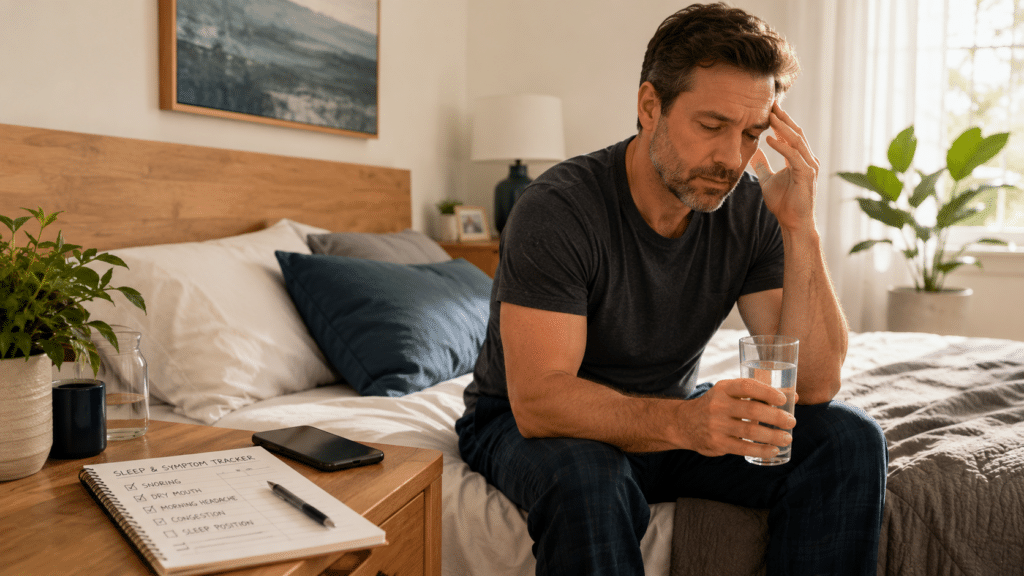
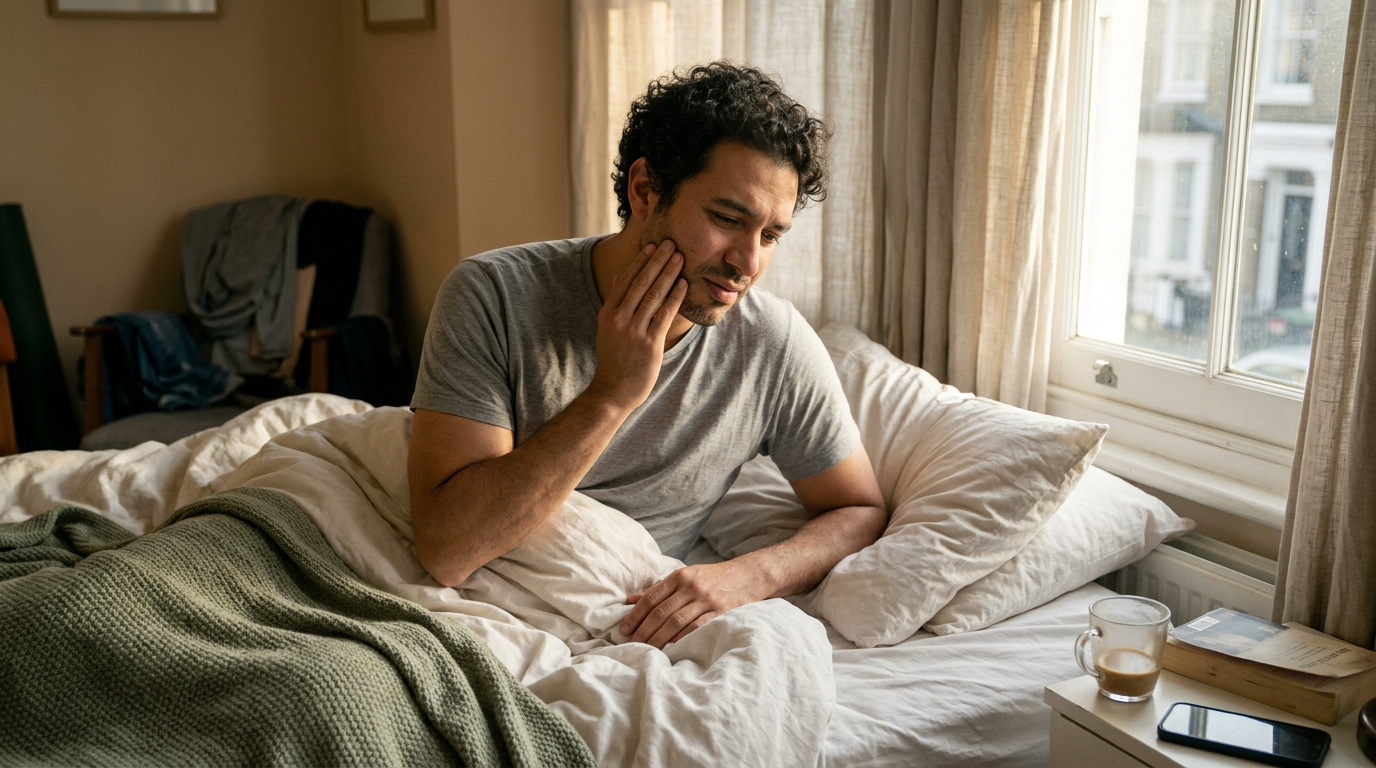
Waking up with jaw pain can be confusing. You may go to bed feeling fine, then wake up with sore jaw muscles, tight cheeks, temple tenderness, tooth sensitivity, or a dull headache. It can feel like something happened overnight, even if you do not remember grinding your teeth. Morning jaw pain can come from more than one pattern. Some people have sleep bruxism, which means jaw-muscle activity happens during sleep. Others clench during the day without realizing it, then carry that muscle fatigue into the night. Some people have both.
That distinction matters. A mouthguard may help protect teeth, but it may not train your jaw to relax during the day. Daytime awareness training may help you notice tooth contact while working or concentrating, but it may not address sleep disruption, snoring, or possible airway concerns. Sleep bruxism and awake bruxism are recognized as different forms of masticatory muscle activity, which is why timing matters when you are trying to understand morning jaw soreness.¹
This article will help you sort morning jaw pain by timing, symptoms, and possible triggers. It is not meant to diagnose you. It is meant to help you notice the pattern and decide when to talk with a dentist, physician, sleep professional, or orofacial pain specialist.
If you are unsure whether your jaw activity happens during the day, at night, or both, start by learning the difference between awake bruxism and sleep bruxism.
Quick Answer: Why Does My Jaw Hurt in the Morning?
Morning jaw pain may come from sleep bruxism, clenching teeth while sleeping, daytime clenching that carries into the night, TMJ irritation, poor sleep quality, or a combination. If you also wake with headaches, tooth sensitivity, jaw tightness, snoring, dry mouth, or fatigue, tracking those symptoms can help you decide whether to speak with a dentist, physician, or sleep professional.
What Morning Jaw Pain and Jaw Tightness When Waking Up Can Feel Like
Morning jaw pain does not always feel the same from person to person. Some people wake up with a dull ache in the cheeks. Others feel tightness near the temples, soreness around the jaw joints, tooth tenderness, or pressure near the ears. You may notice that chewing breakfast feels uncomfortable, opening wide feels stiff, or your jaw feels tired before the day has even started.
Jaw pain after sleeping may fade within an hour, last most of the morning, or build again during the workday. That timing matters. Pain that is strongest immediately after waking may point toward overnight jaw activity, sleep posture, or jaw position during sleep. Pain that worsens through the day may suggest awake clenching, stress jaw, screen posture, or repeated tooth contact while concentrating.
Common morning jaw pain symptoms may include:
- Jaw soreness when you wake up
- Jaw tightness when waking up
- Tight cheeks or temples
- Morning headache with jaw pain
- Tooth sensitivity or pressure
- TMJ pain in the morning
- Ear-area pressure or fullness
- Stiffness when opening the mouth
- A tired feeling in the jaw muscles
- Clicking, popping, or discomfort near the jaw joints
The key is not to assume that one symptom proves one cause. Morning jaw pain is often a pattern, not a single event.
Sleep Bruxism Jaw Pain and Teeth Grinding at Night Symptoms
Sleep bruxism is jaw-muscle activity that occurs during sleep. It may involve grinding, clenching, rhythmic jaw movement, or repeated bursts of muscle activity. Some people make audible grinding sounds. Others have no idea it is happening until a dentist sees tooth wear, a partner hears grinding, or they wake up with jaw soreness.
Sleep bruxism is not simply a “bad habit” you can consciously stop while asleep. It is a sleep-related pattern. The International Classification of Sleep Disorders places sleep bruxism within the sleep-medicine framework, and international bruxism consensus work separates sleep bruxism from awake bruxism.¹˒²
Teeth grinding at night symptoms may include waking with jaw soreness, tooth sensitivity, temple headache, cheek fatigue, or reports from a bed partner that you grind your teeth at night. Dentists may also notice worn tooth surfaces, chipped restorations, fractured teeth, or signs of heavy force.
Clenching teeth while sleeping can also be difficult to recognize because you are not conscious when it happens. Symptoms can raise suspicion, but they do not confirm the full cause by themselves. A dentist or sleep-trained clinician can help determine whether the pattern fits sleep bruxism, another jaw disorder, or a sleep-related issue.
A mouthguard can protect teeth, but it may not stop the clenching pattern itself.
Daytime Clenching Can Show Up as Morning Pain
Morning jaw pain is not always caused only by what happens at night. Daytime clenching can leave your jaw muscles tense before you ever go to sleep. You may be warming up the jaw muscles all day without realizing it.
This is common during work, driving, screen use, caregiving, exercise, emotional stress, deadlines, or focused concentration. You may check email with your teeth together. You may hold your jaw tight in traffic. You may brace during a difficult conversation. You may clench while cleaning, lifting, concentrating, or scrolling your phone.
Many people do not grind loudly during the day. Instead, they hold their teeth together in a low-level clench for long periods. That steady muscle contraction can create soreness, temple tension, facial fatigue, and jaw tightness that carries into the next morning.
Daytime clenching may be more likely if your jaw pain gets worse during computer work, stressful conversations, traffic, or long periods of focus. This is where awareness matters. Awake bruxism can often be approached through awareness and behavior change because it happens while you are awake, even when you are not yet aware of it.¹
The Carryover Effect: Why Pain Can Build Over 24 Hours
Jaw muscles do not reset perfectly at midnight. If you clench during the day and have jaw-muscle activity during sleep, the effects can stack. This is the carryover effect.
Think of it as total jaw load, not just nighttime grinding.
For example, you may spend the afternoon clenching during work stress, go to bed with tight facial muscles, sleep poorly, have bursts of jaw activity during the night, and then wake with jaw soreness. In that case, morning jaw pain is not only a nighttime problem. It is a 24-hour jaw pattern.
This is why tracking timing is so helpful. You may discover that your morning jaw pain is worse after stressful workdays, poor sleep, late alcohol, evening screen use, heavy chewing, intense workouts, or nights when you snore or wake frequently. You may also notice that symptoms improve when you practice jaw release cues during the day, reduce evening stimulation, or sleep more consistently.
The question is not only, “Do I grind at night?” It may also be, “How much tension does my jaw carry across the entire day and night?”
Morning Jaw Pain and Sleep Quality
Morning jaw pain can overlap with sleep quality. If you wake up unrefreshed, tired, foggy, or headachy, your jaw symptoms may be only one part of a larger sleep pattern.
Sleep bruxism has been studied as sleep-related jaw-muscle activity, and jaw-muscle activity may occur around brief arousals in some people.¹˒² Poor sleep, fragmented sleep, stress, alcohol, medications, and breathing disruptions may all influence what happens overnight. This does not mean every person with morning jaw pain has sleep apnea. It means sleep quality should not be ignored.
Sleep clues worth tracking include:
- Loud, frequent snoring
- Witnessed pauses in breathing
- Waking up choking or gasping
- Morning headaches
- Dry mouth on waking
- Daytime sleepiness
- High blood pressure
- Restless sleep
- Waking up often during the night
- Morning jaw pain plus fatigue
Symptoms such as loud snoring, gasping or choking during sleep, daytime sleepiness, restless sleep, and morning headaches can appear in obstructive sleep apnea and should be discussed with a medical provider when they are persistent or concerning.⁵
A dentist can help evaluate tooth wear, jaw muscles, TMJ symptoms, and oral appliance options, but suspected sleep-disordered breathing should be medically evaluated.
If morning jaw pain appears with snoring, fatigue, dry mouth, or morning headaches, it may be worth learning how sleep and airway symptoms can overlap.
TMJ Pain in the Morning: Could Jaw Joint Problems Be Involved?
TMJ pain in the morning may involve the jaw joints, the muscles around the joints, or both. The temporomandibular joints sit just in front of the ears. They help guide opening, closing, chewing, and side-to-side jaw movement. When the jaw muscles are overloaded, the joints may also become irritated.
Morning TMJ symptoms may include pain near the joint, clicking, popping, locking, limited opening, or tenderness around the ear. Some people feel pressure or fullness near the ear even when the ear itself is not the primary problem. Because ear symptoms can also come from infection, sinus problems, hearing conditions, or other medical issues, new or persistent ear pain should be medically evaluated.
TMJ symptoms do not always mean there is permanent joint damage. Sometimes the muscles around the joint are the main source of pain. The Diagnostic Criteria for Temporomandibular Disorders were developed to help clinicians evaluate common pain-related TMDs and certain joint-related conditions in a structured way.³ A dentist, orofacial pain specialist, or appropriately trained clinician can help sort muscle pain from joint-related problems.
If ear pressure or ear pain appears with jaw tightness, it may help to understand how bruxism and TMJ symptoms can overlap.
What This Symptom Pattern May Mean
| Pattern you notice | What it may suggest |
| Pain is strongest right after waking | Sleep bruxism, overnight clenching, sleep posture, or fragmented sleep may be involved. |
| Pain gets worse through the day | Awake clenching, stress jaw, screen habits, or concentration-related tension may be contributing. |
| Pain appears with tooth sensitivity, chipped teeth, or worn enamel | Nighttime grinding or heavy clenching should be discussed with a dentist. |
| Pain appears with temple tenderness or morning headache | The temporalis and masseter muscles may be part of the pain pattern. |
| Pain appears with snoring, dry mouth, fatigue, or unrefreshing sleep | Sleep quality and airway screening may deserve attention. |
| Pain appears with clicking, locking, limited opening, or ear-area discomfort | TMJ evaluation may be appropriate. |
The most useful question is not “Which single cause is it?” A better question is “What pattern keeps showing up?”
Why These Symptoms Can Overlap
Morning jaw pain can overlap with headaches, tooth sensitivity, ear-area pressure, poor sleep, and daytime fatigue because the jaw is part of a larger system. The jaw muscles connect with chewing, facial expression, posture, breathing, stress response, and sleep behavior.
The masseter muscles in the cheeks and the temporalis muscles at the temples can become sore when they are overused. If these muscles are active during sleep or braced during the day, pain can spread into the temples, cheeks, jaw joints, teeth, ears, neck, or head.
Stress can also keep the body in a guarded state. You may not feel emotionally anxious, but your body may still show tension through shallow breathing, raised shoulders, tight facial muscles, or tooth contact.
Sleep adds another layer. If sleep is fragmented, the nervous system may stay more reactive overnight. For some people, jaw-muscle activity may occur around brief arousals.¹˒² That is why morning jaw pain often makes more sense when you look at the whole 24-hour pattern.
What to Track for One Week
A simple tracking plan can help you see whether your morning jaw pain is mostly nighttime, daytime, or mixed. You do not need a complicated app. A notebook or phone note is enough.
Track these items for seven days:
- Morning jaw pain level: Rate it from 0 to 10 when you wake up.
- Pain location: Cheeks, temples, teeth, jaw joints, ears, neck, or head.
- Morning symptoms: Headache, dry mouth, tooth sensitivity, fatigue, or ear-area pressure.
- Sleep clues: Snoring, waking often, alcohol, late caffeine, poor sleep, or sleeping position.
- Daytime clenching: Notice whether your teeth touch during work, driving, scrolling, or stress.
- Stress level: Rate your stress from 0 to 10.
- Jaw release practice: Note whether you practiced lips together, teeth apart during the day.
- Mouthguard use: Track whether symptoms are better, worse, or unchanged with the appliance.
- Chewing load: Note gum chewing, tough foods, nail biting, or long dental work.
- Pattern note: Write one sentence about what seemed connected that day.
After a week, look for patterns. Do symptoms follow poor sleep? Stressful workdays? Long screen time? Nights without a mouthguard? Snoring? Morning headache?
Bring this pattern log to your appointment. It can help your clinician understand whether the problem looks more like sleep-related activity, daytime bracing, TMJ irritation, or a mixed pattern.
What May Help
The right approach depends on the cause. Start by trying to reduce the total jaw load across the day and night.
Start with daytime awareness
During the day, check whether your teeth are touching. At rest, the jaw should usually be relaxed, with the lips gently together and the teeth apart. If your teeth are together during work or stress, treat that as a cue to release, not a failure.
The teeth-apart resting jaw position is one of the simplest starting points for reducing unnecessary daytime jaw muscle load.
Reduce muscle load before bed
If your jaw is already tense at bedtime, the night begins with a higher muscle load. Try a simple evening reset: relax your shoulders, unclench your teeth, let your tongue rest lightly, and breathe slowly through your nose if you can do so comfortably.
Avoid adding extra chewing strain when your jaw is sore. Gum chewing, hard foods, nail biting, or prolonged chewing can add load to already tired jaw muscles.
Protect teeth when needed
If your dentist sees tooth wear, fractures, or signs of grinding, a properly fitted mouthguard or oral appliance may help reduce dental damage. Oral appliances are commonly used in TMD and bruxism-related care, but their role depends on the diagnosis, appliance design, and clinical goal.⁴
A mouthguard should not be treated as proof that the problem is solved. If you still wake up with jaw pain while wearing one, ask your dentist to check the fit and discuss whether muscle tension, TMJ strain, or sleep quality may be involved.
Use biofeedback if clenching is hard to catch
If your tracking shows that daytime clenching is part of the pattern, awareness training becomes important. Some people use sticky notes, phone reminders, or computer prompts. Others benefit from real-time feedback.
A biofeedback tool such as ClenchAlert can help you notice tooth contact as it happens, giving you a chance to release the jaw before tension builds. This may be especially relevant if your morning jaw pain seems connected to daytime stress, focus clenching, or the habit of holding your teeth together.
Screen sleep when symptoms point beyond the jaw
If morning jaw pain appears with snoring, choking or gasping, dry mouth, morning headaches, high blood pressure, or daytime sleepiness, talk with a medical provider or sleep professional. These symptoms do not prove sleep apnea, but they do justify a closer look at sleep quality and breathing during sleep.
When to Seek Professional Help
Talk with a dentist, physician, or qualified clinician if morning jaw pain is persistent, worsening, or interfering with eating, sleep, work, or quality of life.
Start with a dentist if you notice tooth wear, broken fillings, chipped teeth, tooth sensitivity, jaw clicking, jaw locking, or pain when chewing. A dentist can evaluate the teeth, bite, jaw muscles, and TMJ area. They can also discuss whether a mouthguard, oral appliance, or referral is appropriate.
Talk with a physician or sleep professional if morning jaw pain occurs with loud snoring, witnessed breathing pauses, waking up choking or gasping, morning headaches, high blood pressure, or daytime sleepiness. These symptoms may require medical sleep evaluation.
Consider an orofacial pain specialist if pain is complex, persistent, spreading, or not responding to basic dental care. Orofacial pain specialists are trained to evaluate jaw muscle pain, TMJ disorders, nerve-related facial pain, headache overlap, and complex oral-facial symptoms.
Seek urgent care if jaw pain appears with chest pain, shortness of breath, severe sudden headache, facial weakness, injury, fever, swelling, or symptoms that feel unusual or severe.
Conclusion
Morning jaw pain is not always a simple sign that you grind your teeth at night. It may involve sleep bruxism, daytime clenching, carryover muscle fatigue, poor sleep quality, TMJ irritation, airway-related sleep disruption, or a combination of these patterns.
That is why timing matters. If you wake up sore but also clench during work, driving, or stress, your jaw may be carrying tension across the full day and night. If morning jaw pain appears with snoring, fatigue, dry mouth, or morning headaches, sleep quality deserves attention. If tooth wear, chipped teeth, or dental sensitivity are present, tooth protection may be important. If your symptoms include jaw locking, joint pain, or ear-area discomfort, TMJ evaluation may be needed.
The most helpful first step is observation. Track your symptoms for one week. Notice when your teeth touch. Notice whether pain is worse after stress, poor sleep, long screen time, alcohol, or restless nights. Then bring that information to a dentist, physician, or sleep professional.
Morning jaw pain is not just a symptom to silence. It is a clue that can help you understand what your jaw is doing across the full 24-hour day.
To continue building the full picture, read the main bruxism and jaw tension pillar article next, then use the related cluster articles on awake bruxism, mouthguards, stress jaw, and the teeth-apart resting position to narrow your pattern.
FAQ
Why does my jaw hurt when I wake up?
Your jaw may hurt when you wake up because of sleep bruxism, nighttime clenching, sleep posture, TMJ irritation, or muscle fatigue that carried over from daytime clenching. Morning jaw pain may also overlap with poor sleep quality, stress, headaches, tooth sensitivity, or airway-related sleep symptoms. If it happens often, track your symptoms and talk with a dentist.
Is morning jaw pain always caused by grinding my teeth at night?
No. Morning jaw pain is not always caused by nighttime grinding. Some people clench during the day without realizing it, especially during work, driving, stress, or concentration. That daytime muscle tension can carry into the night and make the jaw feel sore in the morning.
What are common sleep bruxism jaw pain symptoms?
Common sleep bruxism jaw pain symptoms may include jaw soreness after sleeping, tooth sensitivity, worn teeth, chipped teeth, cheek fatigue, temple headaches, tight jaw muscles, and reports from a bed partner that you grind your teeth at night. A dentist can check for signs of tooth wear and muscle tenderness.
Can clenching teeth while sleeping cause morning headaches?
Yes, clenching teeth while sleeping may contribute to morning headaches in some people, especially when the temporalis muscles near the temples are overworked. However, morning headaches may also be related to sleep quality, sleep apnea, medication, alcohol, dehydration, or other medical causes. Persistent morning headaches should be evaluated.
Can daytime clenching cause jaw pain in the morning?
Yes. Daytime clenching can fatigue the jaw muscles before sleep. If you hold your teeth together while working, driving, scrolling, or concentrating, the muscles may stay tense for hours. That tension can carry over into sleep and make the jaw feel sore when you wake up.
Why do I wake up with jaw pain on one side?
Waking up with jaw pain on one side may happen when one side of the jaw muscles or jaw joint is more irritated than the other. It may also relate to sleep position, uneven clenching pressure, TMJ irritation, dental problems, or chewing habits. One-sided jaw pain that persists, worsens, or comes with swelling, tooth pain, ear symptoms, or limited opening should be evaluated by a dentist or medical professional.
Should my teeth touch when my jaw is resting?
Usually, no. At rest, your lips may be gently together, but your teeth should usually be slightly apart. Many clenchers need to relearn this position because they hold their teeth together without noticing. Practicing a teeth-apart resting position may help reduce unnecessary jaw muscle activity during the day.
Can a mouthguard stop morning jaw pain?
A mouthguard may help protect teeth from wear, chips, and fractures, but it may not stop the clenching or grinding behavior itself. If you still wake up with jaw pain while wearing a mouthguard, ask your dentist to check the fit and discuss whether muscle tension, TMJ strain, or sleep quality may be involved.
When should I see a dentist for morning jaw pain?
See a dentist if morning jaw pain lasts more than a few days, keeps returning, affects chewing, or appears with tooth sensitivity, chipped teeth, worn teeth, jaw clicking, jaw locking, or headaches. A dentist can evaluate your teeth, jaw muscles, and TMJ area.
When should morning jaw pain be evaluated for sleep apnea?
Morning jaw pain should raise the question of sleep evaluation if it appears with loud snoring, witnessed breathing pauses, choking or gasping during sleep, morning headaches, dry mouth, daytime sleepiness, or high blood pressure. These symptoms do not prove sleep apnea, but they are worth discussing with a medical provider.
What can I do today to reduce morning jaw pain?
Start by tracking your symptoms and checking your jaw during the day. Keep your lips relaxed and your teeth apart at rest. Avoid gum chewing if your jaw is sore. Use heat or gentle relaxation if recommended by your clinician. Contact a dentist if pain persists, worsens, or appears with tooth or TMJ symptoms.
References
- Lobbezoo F, Ahlberg J, Raphael KG, Wetselaar P, Glaros AG, Kato T, et al. International consensus on the assessment of bruxism: report of a work in progress. J Oral Rehabil. 2018;45(11):837-844. doi:10.1111/joor.12663.
- Sateia MJ. International Classification of Sleep Disorders-Third Edition: highlights and modifications. Chest.2014;146(5):1387-1394. doi:10.1378/chest.14-0970.
- Schiffman E, Ohrbach R, Truelove E, Look J, Anderson G, Goulet JP, et al. Diagnostic Criteria for Temporomandibular Disorders for clinical and research applications: recommendations of the International RDC/TMD Consortium Network and Orofacial Pain Special Interest Group. J Oral Facial Pain Headache.2014;28(1):6-27. doi:10.11607/jop.1151.
- Klasser GD, Greene CS. Oral appliances in the management of temporomandibular disorders. Oral Surg Oral Med Oral Pathol Oral Radiol Endod. 2009;107(2):212-223. doi:10.1016/j.tripleo.2008.10.007.
- Alshehri AM, Alghamdi AS, Alharthi SR, et al. Knowledge, awareness, and attitudes toward obstructive sleep apnea among the population of the western region of Saudi Arabia. Cureus. 2020;12(3):e7254. doi:10.7759/cureus.7254.

Randy Clare is a writer, educator, and health communicator focused on making complex clinical topics easier to understand. Through The Sleep and Respiratory Scholar, he creates clear, practical content on bruxism, headache, sleep, airway health, and respiratory symptoms. He is the author of The Brux Method, President of ClenchAlert.com and host of The Clenching Chronicle Podcast, where he explores jaw tension, clenching, headaches, and behavior-based approaches to relief. His work helps readers better understand symptoms, recognize patterns, and take more informed next steps.