
Last updated on May 6th, 2026 at 10:29 am
Medically responsible content note:
This article is for education only and does not diagnose or treat medical, dental, or sleep conditions. Bruxism, jaw pain, headaches, snoring, breathing pauses, and respiratory symptoms can have multiple causes. Seek care from a qualified medical, dental, sleep, or orofacial pain professional when symptoms are persistent, worsening, severe, or disruptive.
Bruxism and jaw tension can show up in your teeth, jaw, head, face, and sleep. You may notice jaw soreness, tooth sensitivity, temple headaches, facial tightness, morning pain, or a sense that your jaw never fully relaxes.
That overlap can be confusing. Some people grind their teeth during sleep. Others clench during the day while working, driving, concentrating, or feeling stressed. Many people do both.
Bruxism is commonly described as repetitive jaw muscle activity that can include clenching, grinding, bracing, or thrusting of the jaw. Experts separate awake bruxism from sleep bruxism because they happen in different states and may involve different patterns.¹
This article explains how bruxism and jaw tension may feel, why symptoms can overlap, what patterns to track, and when to talk with a dentist, physician, sleep specialist, or orofacial pain specialist.
Quick Pattern Check: Where Do Your Symptoms Fit?
Before you read the full article, start with the pattern that sounds most familiar.
If your jaw hurts mostly in the morning, look at sleep bruxism, sleep quality, mouth breathing, snoring, or whether your nightguard is helping or irritating your jaw.
If your jaw feels tight by the end of the workday, look at awake bruxism, posture, concentration clenching, stress, screen time, and jaw habits.
If your pain sits near the temples, jaw muscle overuse may be part of the pattern. The temporalis muscles on the sides of the head help close the jaw. When they are overworked, they can feel like a temple headache.
If you notice tooth wear, tooth sensitivity, chips, or cracks, start with a dental evaluation.
If you snore, wake gasping, have witnessed breathing pauses, or feel very sleepy during the day, ask a medical provider whether sleep testing is appropriate. Sleep apnea is diagnosed with appropriate testing, not symptoms alone. ²
What Bruxism and Jaw Tension Mean
Bruxism is not just teeth grinding. It can include several jaw behaviors.
You may clench your teeth together. You may grind your teeth side to side. You may hold the jaw muscles tight without obvious tooth contact. You may brace your jaw while concentrating, driving, exercising, or working through stress.
Jaw tension is the feeling that the jaw muscles are tight, tired, sore, or difficult to relax. Jaw tension may happen with bruxism, but it can also overlap with stress, posture strain, temporomandibular disorders, headache patterns, neck tension, or other muscle pain problems.
Awake bruxism often involves clenching, bracing, or holding tension during the day. Sleep bruxism happens during sleep and may involve rhythmic jaw muscle activity. Sleep bruxism can be difficult to notice unless a bed partner hears grinding sounds or a dentist sees signs of tooth wear. ¹,³
To understand why these two patterns, need different strategies, read Awake Bruxism vs Sleep Bruxism: Why the Difference Matters.
Common Bruxism Symptoms and Pain Patterns
Bruxism symptoms can be mild, occasional, or persistent. Some people have obvious tooth damage. Others mainly feel muscle pain, headaches, or facial tightness.
Dental symptoms
You may notice tooth sensitivity, worn biting edges, flattened teeth, chipped teeth, cracked teeth, sore teeth, or discomfort when chewing. A dentist may see wear patterns before you feel pain.
Jaw and muscle symptoms
You may feel jaw soreness, jaw fatigue, tightness in the cheeks, pain while chewing, limited opening, or a sense that your jaw is working even when you are not eating.
Head, face, and ear symptoms
Bruxism and jaw tension may contribute to temple tenderness, cheek pain, facial muscle soreness, neck tension, or ear pressure. Ear symptoms can be confusing because the temporomandibular joint and nearby muscles sit close to the ear.
Sleep-related symptoms
You may wake with jaw soreness, tooth sensitivity, morning headaches, or unrefreshing sleep. A bed partner may notice grinding sounds.
Jaw pain, headache, TMJ pain, and chewing muscle pain can overlap. The Diagnostic Criteria for Temporomandibular Disorders recognize several related pain categories, including jaw muscle pain, joint pain, headache attributed to TMD, and functional jaw limitation. ⁴
This does not mean every person with jaw tension has TMD. It means ongoing jaw pain deserves careful attention, especially when it affects eating, sleep, work, or quality of life.
What Your Bruxism and Jaw Tension Pattern May Mean
Bruxism and jaw tension may mean that your jaw muscles are working harder than they should.
The most useful clue is timing.
If your symptoms are worse in the morning, sleep bruxism may be involved. Morning symptoms can also overlap with poor sleep, mouth breathing, snoring, alcohol use, medication effects, or sleep-disordered breathing.
If your symptoms build through the day, awake bruxism may be involved. This can happen when you clench while focusing, driving, lifting, scrolling, emailing, or managing pressure.
If your pain sits near the temples, jaw clenching headaches may be part of the pattern. The temporalis muscles help close the jaw. When those muscles are overused, pain can be felt as temple pressure or headache-like discomfort.
If you notice ear pressure with jaw soreness, the jaw joint or nearby muscles may be involved. That does not mean the ear is never the problem. It means jaw-related pain can sometimes feel like ear-area discomfort.
None of these patterns diagnoses the problem. They are clues. The goal is to notice the pattern clearly enough to ask better questions.
Awake Bruxism vs Sleep Bruxism: Why the Difference Matters
Awake bruxism and sleep bruxism are related, but they are not the same.
Awake bruxism
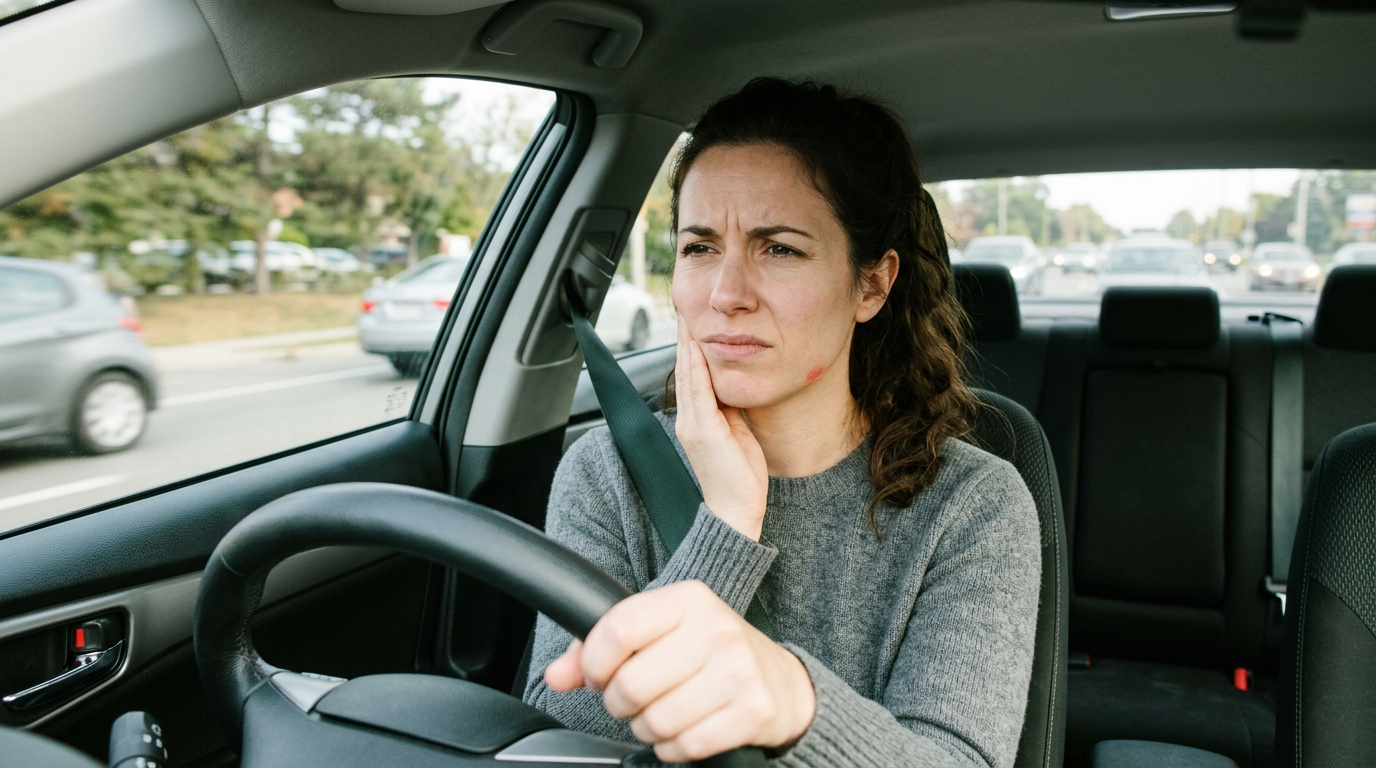
Awake bruxism often happens during attention, stress, or effort. You may clench while working at a computer, driving in traffic, exercising, concentrating, or trying to push through a demanding day.
Many people do not notice it while it is happening. They notice the result later: jaw fatigue, temple pressure, tooth sensitivity, or a tight face.
Awake bruxism is often tied to awareness and habit. The goal is not simply to “try harder” to stop. The goal is to notice the pattern earlier and return the jaw to a relaxed resting position.
Sleep bruxism
Sleep bruxism happens during sleep. It is considered a sleep-related movement activity and may occur around brief arousals or changes in sleep state. ³
You may not know it is happening unless someone hears grinding or your dentist notices tooth wear. You may wake with jaw soreness, tooth sensitivity, or morning headaches.
Because sleep bruxism occurs during sleep, daytime habit reminders may not be enough. You may need tooth protection, sleep evaluation, medication review, pain management, or care for related sleep and breathing symptoms.
What Causes Bruxism and Jaw Tension?
For most people, there is not one single cause. Bruxism and jaw tension often reflect several overlapping contributors.
Possible contributors may include stress, emotional pressure, high focus, sleep disruption, medications that affect the nervous system, alcohol, nicotine, caffeine, sleep-related breathing problems, jaw muscle pain, protective guarding, and repeated habit loops.
The older idea that bruxism is mainly caused by a “bad bite” is too narrow. Dental factors may matter for some people, but modern bruxism research treats bruxism as a behavior that may involve the nervous system, sleep regulation, muscle activity, and psychosocial factors. ¹,³
For awake clenching, the pattern may feel automatic because the brain links stress, concentration, or effort with jaw muscle activation. Over time, clenching can become a default body response.
For sleep bruxism, the person is not choosing the behavior. It happens during sleep and may need a different approach than daytime jaw awareness.
Why Jaw Symptoms Can Overlap with Headaches, Ear Pressure, and Sleep
The jaw is not isolated from the rest of the body. That is why bruxism and jaw tension can overlap with headaches, ear pressure, neck tension, poor sleep, and breathing-related symptoms.
The chewing muscles connect with the temples, cheeks, and jaw. The temporomandibular joints sit close to the ears. Neck and shoulder tension can influence how the jaw feels. Sleep disruption can make pain feel more intense.
Here are common overlap patterns to notice:
Morning jaw pain plus tooth sensitivity may suggest nighttime jaw muscle activity.
Temple headache plus jaw fatigue may suggest overworked chewing muscles.
Jaw tension plus neck tightness may reflect a broader muscle tension pattern.
Dry mouth plus morning headache plus snoring may suggest a sleep-breathing pattern worth discussing with a medical provider.
Ear pressure plus jaw soreness may involve the TMJ or nearby muscles.
Fatigue plus morning headache plus witnessed breathing pauses should prompt a discussion about sleep testing.
Bruxism Headaches and Jaw Clenching Headaches
Bruxism headaches often feel like pressure or soreness around the temples, forehead, cheeks, or jaw. Some people describe the pain as a tight band. Others feel it more on one side.
Jaw clenching headaches may happen because the muscles that close the jaw are repeatedly activated. The temporalis muscle sits on the side of the head. The masseter muscle sits at the side of the jaw. When these muscles are overworked, they may become sore, tender, or fatigued.
Headaches can have many causes. These include migraine, tension-type headache, sinus problems, medication overuse, sleep apnea, blood pressure issues, neurological conditions, and jaw-related pain. Bruxism may be one part of the pattern, but it should not be assumed to be the only cause.
Seek medical evaluation for new, severe, sudden, unusual, or worsening headaches. This is especially important if the headache comes with weakness, confusion, vision changes, fever, injury, chest pain, shortness of breath, or neurological symptoms.
Bruxism and Sleep: When to Look Beyond the Jaw
Bruxism and sleep can overlap in several ways.
Sleep bruxism may contribute to morning jaw pain, tooth sensitivity, and bed partner complaints about grinding sounds. Poor sleep may also make pain feel worse. When sleep is fragmented, the nervous system may become more sensitive to discomfort.
Some people with sleep bruxism also have snoring, mouth breathing, or symptoms that raise concern for obstructive sleep apnea. A systematic review reported associations between sleep bruxism and several sleep-related disorders, including obstructive sleep apnea, but an association does not prove that one condition always causes the other. ⁵
The key question is not only “Do I grind my teeth?” It is also “Do I have signs of disrupted breathing or unrefreshing sleep?”
If you snore loudly, wake gasping, have witnessed breathing pauses, wake with morning headaches, or feel unrefreshed despite enough sleep time, it is worth discussing sleep testing with a medical provider. A dentist may notice signs of tooth wear or bruxism, but obstructive sleep apnea requires appropriate medical evaluation and testing. ²
Mouthguard for Bruxism: Protection vs Stopping the Habit
A mouthguard for bruxism can be useful, especially when tooth protection is the main concern. A properly made dental nightguard can help protect teeth and restorations from grinding forces.
But a mouthguard does not always stop clenching. Many people still clench into the guard. In that case, the teeth may be protected, but the jaw muscles may still be overloaded.
For a deeper explanation of this distinction, read Why a Mouthguard Protects Teeth But May Not Stop Clenching.
A mouthguard may help protect the teeth. It may not fully address jaw muscle overactivity, daytime clenching habits, sleep disruption, stress-related jaw bracing, or airway-related symptoms.
Over-the-counter guards may help some people temporarily, but they may not fit well and can sometimes worsen discomfort. If you have jaw pain, tooth wear, dental restorations, TMJ symptoms, or possible sleep apnea symptoms, talk with a dentist before relying on a guard long term.
Stress Jaw Clenching and Daytime Awareness
Stress jaw clenching is common because the jaw often participates in the body’s stress response. You may tighten your jaw when you are focused, irritated, rushed, worried, or trying to stay composed.
This does not mean the pain is “all in your head.” It means the nervous system, muscles, and habits can interact.
To learn how emotional pressure can show up in the jaw, read Stress Jaw: Why Anxiety Shows Up in Your Teeth.
For daytime clenching, awareness is often the first step. The BRUX Method frames this as building awareness, relaxing the response, understanding triggers, and exchanging the clenching pattern for a healthier jaw habit. A biofeedback tool such as ClenchAlert may help some people notice clenching in real time so they can practice releasing the jaw.
The goal is not to shame yourself every time you clench. The goal is to catch the pattern earlier.
A useful cue is:
Lips together.
Teeth apart.
Tongue resting gently on the palate.
Jaw muscles soft.
That position gives the jaw a neutral place to return to during the day.
To practice this reset more intentionally, read The Teeth-Apart Resting Jaw Position: Why Clenchers Need to Relearn It.
How to Stop Clenching Your Jaw During the Day
You may not be able to stop every clenching episode immediately. A better first goal is to notice the pattern sooner and reduce how often your jaw stays tense.
Start with simple steps.
Set three daily jaw checks. Notice whether your teeth are touching. Practice lips together, teeth apart. Relax your tongue, cheeks, and shoulders. Place visual reminders near your computer, phone, bathroom mirror, or steering wheel.
Then look for your most common triggers. Many people clench during email, deadlines, driving, phone use, difficult conversations, exercise, or focused work.
Use the same reset each time:
Notice the clench.
Release the teeth.
Soften the jaw.
Relax the shoulders.
Take one slow breath.
Return to what you were doing.
For awake bruxism, the key is repeated interruption of the pattern. You are teaching your jaw a different default.
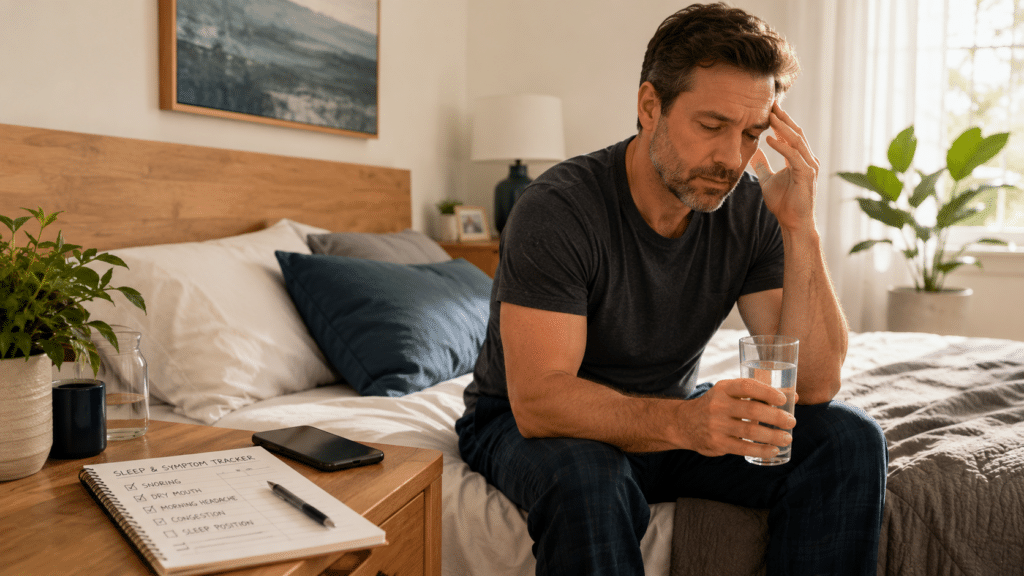
What to Track for 1 to 2 Weeks
Do not try to track everything forever. Track for 1 to 2 weeks, then look for the strongest pattern.
Use this checklist:
When the symptom happens.
Whether it is worse in the morning.
Whether it worsens during work, driving, or concentration.
Jaw soreness or tooth sensitivity.
Tooth wear, chips, or cracks.
Headache location.
Temple tenderness.
Ear pressure or ear pain.
Neck or shoulder tension.
Snoring or dry mouth.
Morning fatigue.
Sleep position.
Alcohol, caffeine, nicotine, or medication changes.
Stress level.
Whether a bed partner notices grinding sounds.
Whether a bed partner notices breathing pauses.
Whether a mouthguard helps, worsens, or does not change symptoms.
Bring this pattern to your appointment. It can help your provider decide whether the next step should be dental evaluation, sleep testing, pain-focused care, physical therapy, or another pathway.
What May Help for Bruxism and Jaw Tension
The right next step depends on the pattern you notice.
If your main pattern is daytime clenching
Focus on awareness and habit change. Check your jaw during work, driving, phone use, and stress. Practice lips together, teeth apart. Consider whether biofeedback, behavioral strategies, or coaching could help you notice the pattern earlier.
If your main pattern is tooth wear or tooth sensitivity
Start with a dentist. You may need a custom nightguard, dental evaluation, or restoration planning. A guard may protect the teeth, but it should be part of a broader discussion if pain continues.
If your main pattern is jaw muscle pain
Reduce overload where possible. Avoid gum if it worsens soreness. Use gentle jaw relaxation, short-term soft foods if chewing hurts, heat if comfortable, and professional evaluation if pain persists. An orofacial pain specialist or physical therapist may be helpful for ongoing muscle and joint symptoms.
If your main pattern is snoring, gasping, or unrefreshing sleep
Talk with a medical provider about sleep testing. Symptoms can raise suspicion, but testing is needed to diagnose obstructive sleep apnea. ²
If your main pattern is headache
Do not assume every headache is from bruxism. Track where the headache starts, when it happens, how often it occurs, and whether jaw symptoms appear at the same time. Frequent, changing, severe, or disabling headaches should be discussed with a medical provider or neurologist.
When to Seek Professional Help
Seek professional help when symptoms persist, worsen, or affect your daily life.
Talk with a dentist if you notice tooth wear, cracked teeth, tooth sensitivity, jaw pain when chewing, morning jaw soreness, grinding sounds, or a mouthguard that worsens symptoms.
Talk with a primary care physician or sleep physician if you notice loud snoring, witnessed breathing pauses, waking gasping or choking, morning headaches with fatigue, high daytime sleepiness, or poor sleep despite enough time in bed.
Talk with an orofacial pain specialist if you have long-lasting jaw, face, temple, or ear-area pain, pain that does not improve with basic dental care, complex headache and jaw pain overlap, or suspected TMD with significant muscle or joint involvement.
Talk with an ENT, pulmonologist, neurologist, or physical therapist when symptoms suggest airway, respiratory, neurological, sinus, ear, or neck-related contributors.
Urgent medical care is appropriate for sudden severe headache, facial drooping, weakness, confusion, chest pain, trouble breathing, injury, fever with stiff neck, or new neurological symptoms.
Conclusion
Bruxism and jaw tension can affect more than your teeth. They can show up as jaw pain, temple headaches, facial tightness, tooth sensitivity, ear pressure, morning soreness, and disrupted sleep.
The most useful next step is to look for patterns. Do your symptoms happen in the morning, during work, after stress, with headaches, or alongside snoring and fatigue? That pattern can help you decide whether to start with a dentist, medical provider, sleep physician, or orofacial pain specialist.
If you clench during the day, begin with awareness. Practice lips together, teeth apart, and notice your common triggers. If you grind at night or see signs of tooth damage, talk with a dentist about protection and evaluation. If you also snore, wake gasping, or feel unrefreshed, ask whether sleep testing is appropriate.
Related Reading
To go deeper into the most common bruxism and jaw tension patterns, read:
Awake Bruxism vs Sleep Bruxism: Why the Difference Matters
Why a Mouthguard Protects Teeth But May Not Stop Clenching
Stress Jaw: Why Anxiety Shows Up in Your Teeth
The Teeth-Apart Resting Jaw Position: Why Clenchers Need to Relearn It
FAQ
Can bruxism cause jaw tension?
Yes. Bruxism can overwork the chewing muscles, which may lead to jaw tension, soreness, fatigue, or pain. Jaw tension can also come from stress, posture, TMD, or other muscle pain patterns, so persistent symptoms should be evaluated.
Is jaw clenching the same as teeth grinding?
No. Jaw clenching means the teeth or jaw muscles are held tightly. Teeth grinding usually means the teeth move against each other. Both can be forms of bruxism.
Why do I wake up with jaw pain?
Morning jaw pain may involve sleep bruxism, clenching into a mouthguard, poor sleep, mouth breathing, or a sleep-breathing issue. If morning jaw pain happens with snoring, dry mouth, morning headaches, or fatigue, discuss sleep testing with a medical provider.
Can bruxism cause headaches?
Bruxism may contribute to headaches, especially near the temples, because the chewing muscles can become overworked. However, headaches can have many causes. New, severe, worsening, or unusual headaches should be evaluated medically.
Does a mouthguard stop bruxism?
A mouthguard can help protect teeth from grinding forces, but it may not stop clenching or grinding. Some people continue to clench into the guard, which means the jaw muscles may still be overloaded.
How do I stop clenching my jaw during the day?
Start by building awareness. Check whether your teeth are touching during work, driving, phone use, and stress. Practice lips together, teeth apart, with the jaw relaxed. Biofeedback, behavioral strategies, dental care, or orofacial pain care may help when awareness alone is not enough.
Is bruxism related to sleep apnea?
Sleep bruxism and sleep apnea can overlap in some people, but bruxism does not diagnose sleep apnea. Loud snoring, witnessed breathing pauses, gasping, morning headaches, and daytime sleepiness should be discussed with a medical provider.
When should I see a dentist for bruxism?
See a dentist if you have tooth wear, tooth sensitivity, cracked teeth, jaw pain, morning soreness, or grinding sounds reported by a bed partner. A dentist can check for dental damage and help decide whether a guard, referral, or further evaluation is needed.
References in AMA Format
-
- Lobbezoo F, Ahlberg J, Raphael KG, Wetselaar P, Glaros AG, Kato T, et al. International consensus on the assessment of bruxism: report of a work in progress. J Oral Rehabil. 2018;45(11):837-844. doi:10.1111/joor.12663.
-
- Kapur VK, Auckley DH, Chowdhuri S, Kuhlmann DC, Mehra R, Ramar K, Harrod CG. Clinical practice guideline for diagnostic testing for adult obstructive sleep apnea: an American Academy of Sleep Medicine clinical practice guideline. J Clin Sleep Med. 2017;13(3):479-504. doi:10.5664/jcsm.6506.
-
- Lobbezoo F, Ahlberg J, Glaros AG, Kato T, Koyano K, Lavigne GJ, de Leeuw R, Manfredini D, Svensson P, Winocur E. Bruxism defined and graded: an international consensus. J Oral Rehabil. 2013;40(1):2-4. doi:10.1111/joor.12011.
-
- Schiffman E, Ohrbach R, Truelove E, et al. Diagnostic Criteria for Temporomandibular Disorders for Clinical and Research Applications. J Oral Facial Pain Headache. 2014;28(1):6-27. doi:10.11607/jop.1151.
-
- Kuang B, Li D, Lobbezoo F, et al. Associations between sleep bruxism and other sleep-related disorders in adults: a systematic review. Sleep Med. 2022;89:31-47. doi:10.1016/j.sleep.2021.11.008.

Randy Clare is a writer, educator, and health communicator focused on making complex clinical topics easier to understand. Through The Sleep and Respiratory Scholar, he creates clear, practical content on bruxism, headache, sleep, airway health, and respiratory symptoms. He is the author of The Brux Method, President of ClenchAlert.com and host of The Clenching Chronicle Podcast, where he explores jaw tension, clenching, headaches, and behavior-based approaches to relief. His work helps readers better understand symptoms, recognize patterns, and take more informed next steps.