

Last updated on May 6th, 2026 at 08:30 am
Medically responsible content note:
This article is for education only and does not diagnose or treat medical, dental, or sleep conditions. Bruxism, jaw pain, headaches, snoring, breathing pauses, and respiratory symptoms can have multiple causes. Seek care from a qualified medical, dental, sleep, or orofacial pain professional when symptoms are persistent, worsening, severe, or disruptive.
You may wake up with jaw pain and assume you grind your teeth at night. But part of the problem may be happening while you answer emails, drive, focus, or scroll. That is why understanding awake bruxism vs sleep bruxism matters. Bruxism is not always one simple habit. Awake bruxism often involves daytime clenching, tooth contact, or jaw bracing. Sleep bruxism happens during sleep and may involve grinding or clenching you do not remember. One pattern may respond to awareness training. The other may need dental evaluation, tooth protection, and sleep or airway review.
This article is part of our larger guide to Bruxism: Symptoms, Causes, Treatments, and How to Stop Teeth Grinding, where we explain how headache, jaw pain, dry mouth, fatigue, breathing symptoms, and sleep quality can overlap.
Quick answer:
Awake bruxism happens while you are awake and often involves daytime jaw clenching, tooth contact, or jaw bracing. Sleep bruxism happens during sleep and may involve nighttime grinding or clenching. Awake bruxism often responds to awareness training, while sleep bruxism may require dental evaluation, tooth protection, and sleep or airway review when other symptoms are present.
In one sentence:
Awake bruxism is usually a daytime jaw-clenching or bracing pattern you may be able to retrain with awareness, while sleep bruxism is nighttime jaw activity that may require dental, sleep, or airway evaluation depending on your symptoms.
These patterns can feel similar because both may cause jaw pain, tooth sensitivity, headaches, facial soreness, or worn teeth. But they often need different first steps. Awake bruxism often starts with awareness training because it happens while you are conscious. Sleep bruxism may require a closer look at dental damage, sleep quality, arousals, airway clues, medication effects, and other health factors.
An international consensus group has described bruxism as jaw-muscle activity that can happen during wakefulness or sleep.1 A later consensus report further separated awake bruxism from sleep bruxism by defining them according to when the jaw activity occurs.2
For readers, the practical question is simple:
When is your jaw working too hard?
If the answer is “during the day,” awareness may be the best place to start. If the answer is “during sleep,” a dental and sleep-focused evaluation may be more appropriate. If the answer is “both,” you may need a plan that addresses both patterns.
A complete guide to bruxism and jaw tension can help you connect jaw pain, headaches, tooth symptoms, and sleep clues in one place.
Awake Bruxism vs Sleep Bruxism: How to Tell the Difference
Awake bruxism happens while you are awake. It may involve clenching, tooth contact, jaw bracing, or holding the jaw in a tense position. Many people with awake bruxism do not make noise. They may not grind in an obvious way. Instead, their teeth touch for long periods, or their jaw muscles stay active when they should be resting.
Sleep bruxism happens during sleep. It may involve grinding, clenching, or rhythmic jaw-muscle activity. Because it happens while you are asleep, you may not know it is occurring unless a sleep partner hears it, a dentist sees signs of tooth wear, or you wake with symptoms such as jaw soreness, tooth sensitivity, or morning headaches.
Here is the simplest way to compare them:
| Pattern | When it happens | Common signs | What often helps |
| Awake bruxism | During the day | Jaw tension, teeth touching, temple pressure, jaw fatigue | Awareness training, teeth-apart posture, stress regulation, biofeedback |
| Sleep bruxism | During sleep | Morning jaw pain, tooth wear, grinding sounds, broken dental work | Dental evaluation, tooth protection, sleep and airway review |
| Both | Day and night | Morning soreness plus daytime tension | A combined daytime and nighttime plan |
This distinction is useful because it keeps you from treating every jaw problem the same way. Daytime clenching, nighttime grinding, and mixed bruxism patterns may all need different attention.
Awake Bruxism Symptoms: What Daytime Clenching Feels Like
Awake bruxism can be easy to miss. You may not notice it until your jaw feels tired, your temples ache, or your teeth feel sensitive.
It often happens during ordinary moments. You may clench while reading a stressful email, concentrating on a spreadsheet, backing out of a tight parking space, driving in traffic, lifting something heavy, waiting for a reply, or trying to finish one more task before bed.
Common awake bruxism symptoms include:
- Teeth touching while working
- Jaw tightening during concentration
- Clenching teeth during the day
- Clenching while driving
- Jaw fatigue after computer work
- Temple pressure later in the day
- Neck and shoulder tension
- Facial soreness
- Tooth sensitivity during stressful periods
- A feeling that your jaw is “always on”
Awake bruxism often shows up during focus. Your brain is working hard, and your jaw joins in. Over time, that pattern can begin to feel normal. You may not realize your teeth are touching until symptoms appear.
This is why awareness matters. A helpful question is not only, “Do I grind my teeth?” It is also, “When are my teeth touching during the day?”
Jaw clenching while working or concentrating is one of the most common ways awake bruxism shows up during the day.
Sleep Bruxism Symptoms: What Nighttime Grinding Can Look Like
Sleep bruxism is harder to catch because you are not awake when it happens. You may not know you grind or clench at night unless someone tells you. In other cases, your dentist may see signs before you connect them to sleep.
Possible sleep bruxism symptoms include:
- Morning jaw pain
- Morning headaches
- Tooth sensitivity
- Flattened or worn teeth
- Chipped or cracked teeth
- Damaged restorations
- Jaw fatigue on waking
- Grinding sounds noticed by a sleep partner
- Poor sleep quality
- Sore temples in the morning
Sleep bruxism should be interpreted carefully. Worn teeth can be a clue, but they are not a timestamp. They may show that force happened at some point, not necessarily that you are actively grinding every night right now.
Tooth wear can also be influenced by age, acid erosion, reflux, bite forces, past grinding, or other dental factors. Recent clinical guidance notes that tooth wear and pain are not specific enough on their own to confirm sleep bruxism. In some cases, a sleep study can provide stronger evidence when needed.3
This does not mean every person with suspected sleep bruxism needs a sleep study. It means the pattern deserves context. A dentist may evaluate tooth wear, muscle tenderness, restorations, bite forces, and jaw symptoms. A medical or sleep provider may become important if nighttime grinding occurs with snoring, gasping, dry mouth, morning headaches, daytime sleepiness, or poor sleep quality.
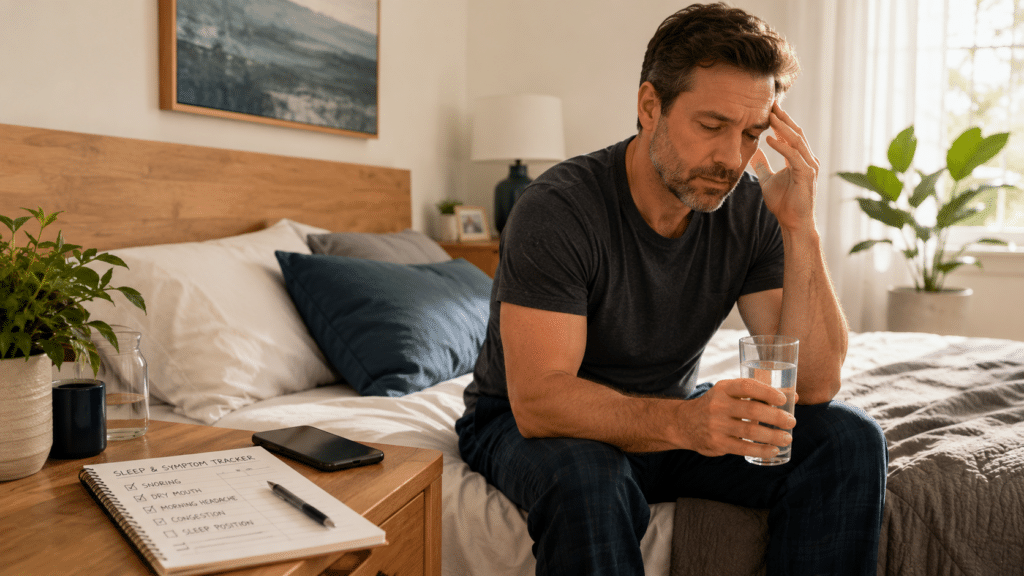
Morning jaw pain can come from sleep bruxism, daytime clenching, or a combination of both.
Awake Bruxism vs Sleep Bruxism Treatment: Why Timing Matters
Awake bruxism and sleep bruxism may both involve jaw-muscle activity, but they are not managed the same way.
With awake bruxism, you are conscious. That means you can learn to notice the behavior. You can practice a teeth-apart resting position. You can identify triggers. You can use reminders. You can use biofeedback. You can build small interruptions into your day before clenching turns into pain.
With sleep bruxism, you are not conscious. You cannot simply decide not to grind your teeth while asleep. Nighttime management may focus on protecting the teeth, evaluating sleep quality, reviewing airway clues, reducing sleep-disrupting factors, and checking whether other conditions are contributing.
This is also why a mouthguard can be useful but incomplete. A night guard may protect teeth from grinding damage. It may reduce the risk of tooth wear, cracked teeth, or damaged dental work. But it may not teach you to stop clenching during the day. It also may not address sleep fragmentation, airway concerns, medication effects, or stress physiology.
For awake bruxism, awareness is often the missing step. If you do not notice your teeth are touching until your jaw hurts, a real-time cue can help connect the behavior with the release. ClenchAlert is one example of a biofeedback training tool designed for that awareness step. In The BRUX Method, this supports the first move: Build Awareness. The goal is not to diagnose sleep bruxism or replace dental care. The goal is to help you recognize a daytime jaw habit while it is happening, release the jaw, and return to a teeth-apart resting position.
Awake Bruxism Is Often a Habit and Awareness Problem
Awake bruxism can become automatic. That does not mean it is imaginary. It means your nervous system has learned a pattern.
For example, your brain may begin to associate jaw tension with concentration. Every time you answer a stressful email, your teeth touch. Every time you drive in traffic, your jaw tightens. Every time you focus hard, your tongue presses, your shoulders lift, and your jaw braces.
Over time, the pattern becomes familiar. You may not notice the clenching because it feels normal.
That is why one-time advice usually does not solve awake bruxism. Telling yourself “stop clenching” may help for a moment, but it often fades as soon as your attention returns to work, stress, or distraction. Most people need repeated cues that bring the jaw back into awareness.
Useful daytime tracking questions include:
- Do my teeth touch when I work?
- Do I clench when I drive?
- Does my jaw tighten when I concentrate?
- Do I hold tension in my face during stress?
- Do I notice temple pressure by late afternoon?
- Do I feel better when I practice teeth-apart posture?
- Do I clench more when I am tired, rushed, or overstimulated?
For many people, the first meaningful change is simply noticing that the teeth are touching. At rest, the teeth should usually be slightly apart, the lips can be gently closed, and the jaw muscles should not be working hard.

Stress jaw is one way anxiety and pressure can show up as tooth contact, jaw bracing, and facial tension.
Sleep Bruxism May Involve Sleep Quality, Arousals, and Airway Clues
Sleep bruxism belongs in a different category because it happens during sleep. It is commonly discussed in sleep medicine as a sleep-related movement disorder.4
That does not mean every case has the same cause. Sleep bruxism can be influenced by many factors, including sleep fragmentation, arousals, stress, alcohol, caffeine, nicotine, certain medications, genetics, and coexisting sleep disorders.4,5 It may also overlap with airway-related symptoms in some people.
The relationship between sleep bruxism and obstructive sleep apnea is complex. It should not be oversimplified. Sleep bruxism does not automatically mean you have sleep apnea. However, research has found that sleep bruxism is common in adults with obstructive sleep apnea, and one large polysomnographic study reported that nearly half of adults with OSA had sleep bruxism at the same time.5
The point is not that grinding equals sleep apnea. The point is that nighttime grinding plus snoring, gasping, dry mouth, morning headaches, or daytime sleepiness is a different pattern than grinding alone.
If those symptoms are present, it is reasonable to discuss sleep evaluation with a qualified medical provider. Sleep bruxism may be a dental issue, a sleep issue, or both. The combination of symptoms matters.
Bruxism can affect sleep quality when jaw activity, arousals, headaches, and airway clues overlap.
How to Know If You Clench or Grind
You may be able to tell whether you clench or grind by tracking when symptoms appear.
If your symptoms build during the day, awake bruxism may be part of the pattern. If your symptoms are strongest when you wake up, sleep bruxism may be more likely. If you have both morning soreness and daytime tension, both patterns may be contributing.
Signs You May Clench During the Day
You may have awake bruxism if you notice:
- Your teeth touching while you work
- Jaw tension during concentration
- Jaw clenching while concentrating
- Clenching while driving
- Facial tension during stress
- Temple headaches later in the day
- Jaw fatigue after long computer sessions
- Neck and shoulder tension linked to focus or pressure
- Relief when you consciously separate your teeth
Signs You May Grind or Clench at Night
You may have sleep bruxism if you notice:
- Morning jaw pain
- Morning jaw pain from grinding
- Morning headaches
- Tooth soreness on waking
- Tooth sensitivity
- Worn or flattened teeth
- Cracked teeth or restorations
- Grinding sounds reported by someone else
- Jaw fatigue before breakfast
- Poor sleep quality
Signs You May Have Both
You may have both awake bruxism and sleep bruxism if you:
- Wake with jaw pain and clench during work
- Wear a night guard for bruxism but still have daytime jaw tension
- Have morning headaches and late-day temple pressure
- Notice stress-related clenching but also have tooth wear
- Feel like your jaw never fully relaxes
The goal is not to label yourself perfectly. The goal is to gather better clues.
If This Sounds Like You, Start Here
If your symptoms mostly happen during the day, start with awareness. Notice when your teeth touch. Practice a teeth-apart resting jaw position. Track your triggers. Consider biofeedback for bruxism if you do not notice clenching until pain appears.
If your symptoms mostly happen in the morning, start with a dental exam and a sleep symptom review. Ask your dentist about tooth wear, cracked teeth, restorations, muscle tenderness, and whether tooth protection is appropriate.
If you have daytime clenching and morning symptoms, track both patterns. You may need a combined plan that includes daytime awareness training, dental protection, sleep-quality review, and professional guidance.
If you grind at night and also snore, gasp, wake with dry mouth, have morning headaches, or feel sleepy during the day, ask a medical provider whether sleep testing or sleep evaluation is appropriate.
This does not mean you need to assume the worst. It means your symptom pattern can point you toward the right next step.
What Helps Awake Bruxism During the Day
Daytime clenching is often easier to influence because it happens while you are awake. That does not mean it is easy. It means you can train awareness.
Start with a simple jaw check:
- Are my teeth touching?
- Is my tongue pressing?
- Are my lips tight?
- Are my shoulders raised?
- Can I let my jaw soften?
Then practice the teeth-apart resting position. Let the teeth separate slightly. Keep the lips relaxed. Allow the jaw muscles to quiet. This should feel like less work, not more effort.
Next, connect the practice to common triggers:
- Before opening email, check your jaw.
- At every red light, separate your teeth.
- Before a meeting, relax your tongue and jaw.
- When your phone buzzes, use it as a jaw check.
- During focused work, place a note that says “teeth apart.”
- After a stressful conversation, release the jaw before returning to work.
Biofeedback may also help if you do not notice clenching until pain appears. A real-time cue can help connect the feeling of clenching with the action of releasing. That is the training loop: notice, release, repeat.
The teeth-apart resting jaw position is a simple cue many daytime clenchers need to relearn.
What Helps Sleep Bruxism at Night
Nighttime bruxism needs a different plan because you cannot monitor your jaw while asleep.
Start with your dentist. Ask about tooth wear, cracks, restorations, gum recession, tooth mobility, muscle tenderness, bite changes, and whether a custom night guard is appropriate. A guard may help protect teeth, especially if there are signs of wear or damage.
Then look beyond the teeth. Track your sleep symptoms. Do you snore? Do you wake with dry mouth? Do you wake with headaches? Do you feel unrefreshed? Has anyone noticed pauses in your breathing? Do you wake choking or gasping? Do you feel sleepy during the day?
Also consider evening factors that may affect sleep quality or muscle activity. These may include alcohol, caffeine timing, nicotine, stimulant medications, some antidepressants, stress, irregular sleep schedules, and poor sleep hygiene. Medication questions should always be discussed with a qualified healthcare provider. Do not stop or change medication without medical guidance.
Nighttime bruxism management may include:
- Dental evaluation
- A custom night guard when appropriate
- Sleep-quality review
- Airway screening when symptoms suggest it
- Stress and sleep routine changes
- Medication review with a clinician
- Referral to a sleep physician or orofacial pain specialist when needed
A guard may protect your teeth. A broader evaluation helps explain why the grinding may be happening.
What This Symptom Pattern May Mean
If you clench during the day, your jaw may be part of your stress or focus pattern. You may be using jaw tension as a form of bracing without realizing it. The pattern may become more noticeable during work, driving, deadlines, conflict, or concentration.
If you grind or clench at night, your jaw activity may be part of a sleep-related pattern. It may involve arousals, sleep fragmentation, dental overload, stress physiology, medication effects, or airway-related symptoms in some people. It may also occur without a clear single cause.
If you have both, your jaw may be overloaded around the clock. You may wake with soreness, clench through the workday, and go to bed with muscles that never fully settled.
The most useful question is not, “Which label do I have?” The better question is, “When does my jaw become active, and what else is happening at the same time?”
Why These Symptoms Can Overlap
Jaw tension rarely stays in one place. The jaw muscles connect with the temples, face, neck, teeth, and nervous system. When the jaw works too hard, symptoms may show up as facial soreness, tooth sensitivity, temple pressure, ear-area discomfort, neck tension, or headaches.
Sleep can make the picture more complicated. Poor sleep can lower pain tolerance. Morning headaches can overlap with jaw soreness. Daytime fatigue can increase stress and muscle tension. Stress can worsen sleep. Then poor sleep can make daytime clenching more likely.
This is why bruxism is not always only a tooth problem. It may sit at the intersection of jaw behavior, sleep quality, airway clues, headache patterns, stress physiology, and daily habits.
What to Track Before Your Appointment
Before you talk to a dentist, physician, or sleep provider, track your pattern for one to two weeks. You do not need a complicated journal. A simple note on your phone is enough.
Track:
- Morning jaw pain
- Evening jaw fatigue
- Morning headaches
- Late-day headaches
- Tooth sensitivity
- Times you notice teeth touching
- Work, driving, or stress triggers
- Snoring
- Dry mouth on waking
- Daytime sleepiness
- Sleep partner reports of grinding
- Guard use and whether it helps
- Caffeine, alcohol, and nicotine timing
- Medication changes
- Stressful days or poor sleep nights
Bring specific observations to your appointment. “My jaw hurts” is useful. “My jaw is sore when I wake, and I also catch myself clenching during computer work” is more useful.
Better details lead to better care.
When to Talk to a Dentist or Medical Provider
Talk to a dentist if you have tooth wear, cracked teeth, damaged restorations, tooth sensitivity, jaw pain, morning soreness, or headaches that may be related to clenching or grinding.
Talk to a medical provider or sleep specialist if grinding or morning jaw pain occurs with loud snoring, witnessed breathing pauses, choking or gasping, morning headaches, dry mouth, daytime sleepiness, high blood pressure, or unrefreshing sleep.
Talk to an orofacial pain specialist if jaw pain, facial pain, headaches, or ear-area pain are persistent, complex, or not improving with basic care.
You do not need to panic. You need to observe the pattern and choose the right next step.
Conclusion: The Timing Tells You Where to Start
Awake bruxism and sleep bruxism can both strain the jaw, teeth, temples, and face. But they are not the same pattern.
Awake bruxism often happens in plain sight. It may occur while you work, drive, focus, scroll, worry, or push through the day. Because it happens while you are awake, awareness training can be useful. You can learn when your teeth touch. You can practice a teeth-apart resting position. You can use reminders, relaxation cues, habit tracking, and biofeedback to interrupt the pattern earlier.
Sleep bruxism is different. It happens when you are not conscious. You may only see the aftereffects: morning jaw pain, worn teeth, tooth sensitivity, headaches, or a sleep partner’s report of grinding. Because it happens during sleep, it may require dental evaluation, tooth protection, sleep-quality review, and airway screening when other symptoms suggest a broader sleep issue.
Understanding awake bruxism vs sleep bruxism helps you choose the right first step instead of treating every jaw symptom the same way.
Start with one practical question:
When is my jaw working too hard?
If it happens during the day, begin with awareness. If it happens at night, begin with dental and sleep clues. If it happens in both places, build a plan that addresses both.
That is how you move from guessing to understanding.
FAQ
What is the difference between awake bruxism and sleep bruxism?
Awake bruxism happens while you are awake. It often involves jaw clenching, tooth contact, jaw bracing, or holding tension in the jaw during work, stress, driving, or concentration. Sleep bruxism happens during sleep and may involve grinding, clenching, or rhythmic jaw-muscle activity. The difference matters because daytime clenching may respond to awareness training, while nighttime grinding may need dental evaluation, tooth protection, sleep review, or airway screening when other symptoms are present.
Is daytime clenching the same as grinding teeth at night?
No. Daytime clenching and nighttime grinding can overlap, but they are not the same pattern. Daytime clenching often involves awareness, stress, focus, posture, and habit. Nighttime grinding happens during sleep and may be linked with sleep-related muscle activity, arousals, dental overload, or other sleep factors. Some people have one pattern. Some have both.
How do I know if I have awake bruxism?
You may have awake bruxism if you notice your teeth touching during the day, especially while working, driving, concentrating, scrolling, or feeling stressed. Other clues include jaw fatigue, temple pressure, facial tension, tooth sensitivity, or headaches that build as the day goes on. A useful self-check is to pause several times a day and ask, “Are my teeth touching right now?”
How do I know if I grind my teeth at night?
Possible signs of sleep bruxism include morning jaw pain, morning headaches, tooth sensitivity, worn teeth, cracked dental work, or a sleep partner hearing grinding sounds. A dentist may also notice signs during an exam. Tooth wear alone does not always prove active sleep bruxism, so it is important to interpret signs in context.
Can I have both awake bruxism and sleep bruxism?
Yes. Some people clench during the day and grind or clench at night. This can make symptoms more confusing because jaw pain may appear in the morning and worsen by evening. Tracking symptom timing can help you and your provider understand whether you may need a daytime awareness plan, a nighttime dental or sleep plan, or both.
Does a mouthguard stop bruxism?
A mouthguard may protect teeth from damage, but it may not stop the jaw-muscle activity itself. This is especially important for people with awake bruxism. If you wear a night guard but still clench during the day, you may need awareness training, teeth-apart posture practice, trigger tracking, or biofeedback in addition to dental protection.
Is sleep bruxism a sign of sleep apnea?
Sleep bruxism does not automatically mean you have sleep apnea. However, sleep bruxism can overlap with sleep-disordered breathing in some people. If nighttime grinding occurs with loud snoring, gasping, witnessed breathing pauses, dry mouth, morning headaches, or daytime sleepiness, it is reasonable to discuss sleep evaluation with a qualified medical provider.
What helps awake bruxism?
Awake bruxism may improve with awareness training, teeth-apart resting jaw posture, stress regulation, trigger tracking, relaxation cues, and biofeedback. The goal is to notice the clenching while it is happening, then release the jaw before the pattern turns into prolonged muscle tension.
What helps sleep bruxism?
Sleep bruxism may require dental evaluation, tooth protection, sleep-quality review, and medical evaluation when other symptoms are present. A custom night guard may help protect teeth, but your dentist or provider may also want to consider sleep symptoms, medications, alcohol or caffeine timing, stress, and airway clues.
Why do I clench my jaw during the day?
You may clench your jaw during the day because your nervous system has linked jaw tension with focus, stress, effort, or concentration. Many people clench while working, driving, scrolling, or thinking hard. The first step is noticing when your teeth touch, then practicing a relaxed teeth-apart position.
Why do I grind my teeth at night?
Nighttime teeth grinding can have more than one cause. It may be related to sleep arousals, stress, alcohol, caffeine, certain medications, genetics, or sleep-disordered breathing in some people. A dentist can check for dental signs, and a medical provider can review sleep symptoms when needed.
When should I see a dentist?
See a dentist if you have tooth wear, cracked teeth, tooth sensitivity, jaw pain, morning soreness, damaged restorations, or frequent headaches that may relate to jaw clenching or grinding. A dentist can help evaluate dental damage, muscle tenderness, and whether a custom guard or referral is appropriate.
References
- Lobbezoo F, Ahlberg J, Glaros AG, et al. Bruxism defined and graded: an international consensus. J Oral Rehabil. 2013;40(1):2-4. doi:10.1111/joor.12011
- Lobbezoo F, Ahlberg J, Raphael KG, et al. International consensus on the assessment of bruxism: report of a work in progress. J Oral Rehabil. 2018;45(11):837-844. doi:10.1111/joor.12663
- Herrero Babiloni A, Lavigne GJ, Svensson P, Dal Fabbro C, Carra MC. Navigating the assessment of sleep-related bruxism: clinical guidance for applying the 2023 ICSD-3-TR criteria. Sleep Med. 2026;137:106891. doi:10.1016/j.sleep.2025.106891
- Thomas DC, Greenburg MS, Basi DL, et al. Sleep related bruxism: comprehensive review of the literature based on a rare case presentation. Front Oral Maxillofac Med. 2024.
- Li D, Kuang B, Lobbezoo F, de Vries N, Hilgevoord A, Aarab G. Sleep bruxism is highly prevalent in adults with obstructive sleep apnea: a large-scale polysomnographic study. J Clin Sleep Med. 2023;19(3):443-451. doi:10.5664/jcsm.10390

Randy Clare is a writer, educator, and health communicator focused on making complex clinical topics easier to understand. Through The Sleep and Respiratory Scholar, he creates clear, practical content on bruxism, headache, sleep, airway health, and respiratory symptoms. He is the author of The Brux Method, President of ClenchAlert.com and host of The Clenching Chronicle Podcast, where he explores jaw tension, clenching, headaches, and behavior-based approaches to relief. His work helps readers better understand symptoms, recognize patterns, and take more informed next steps.