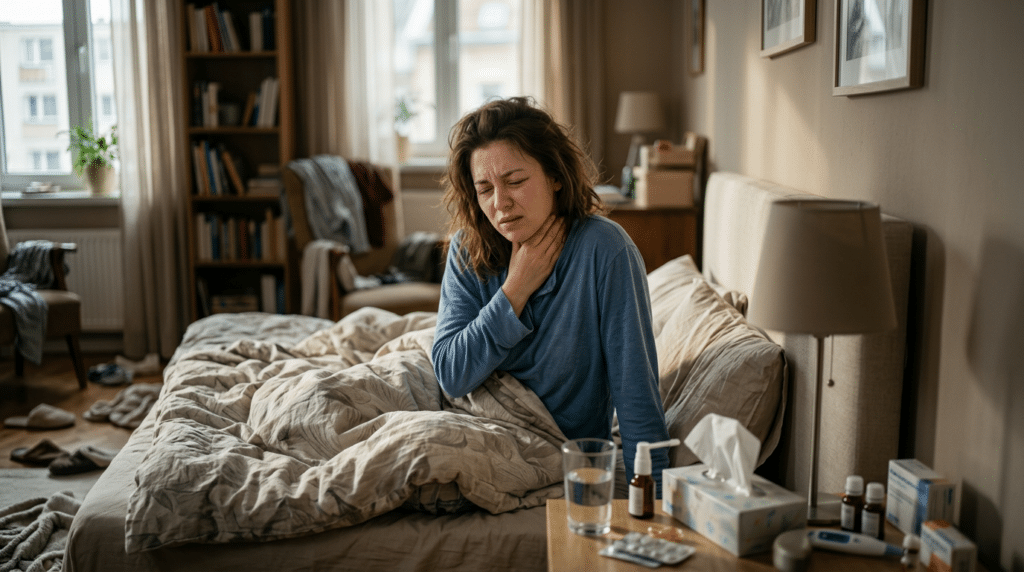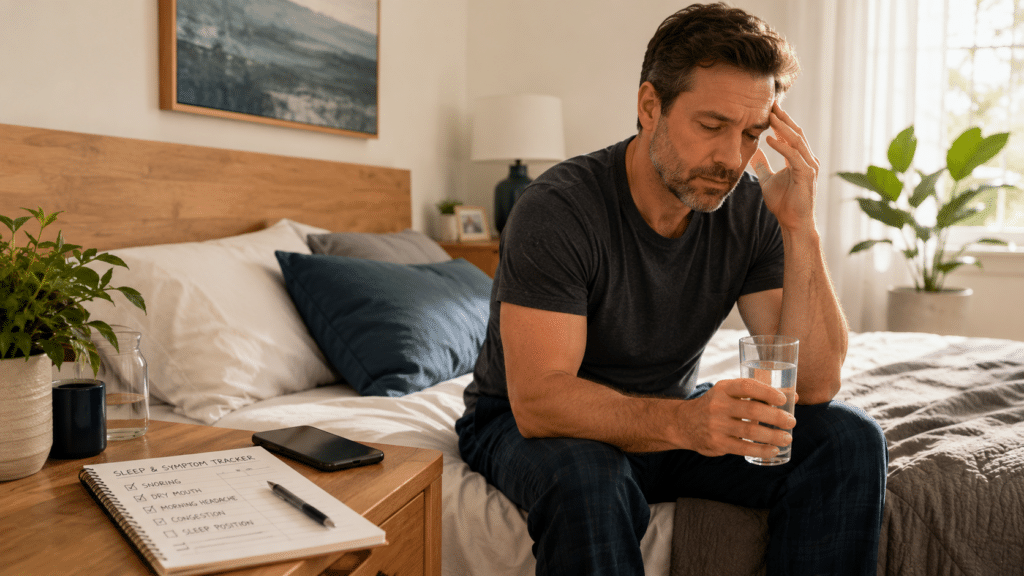

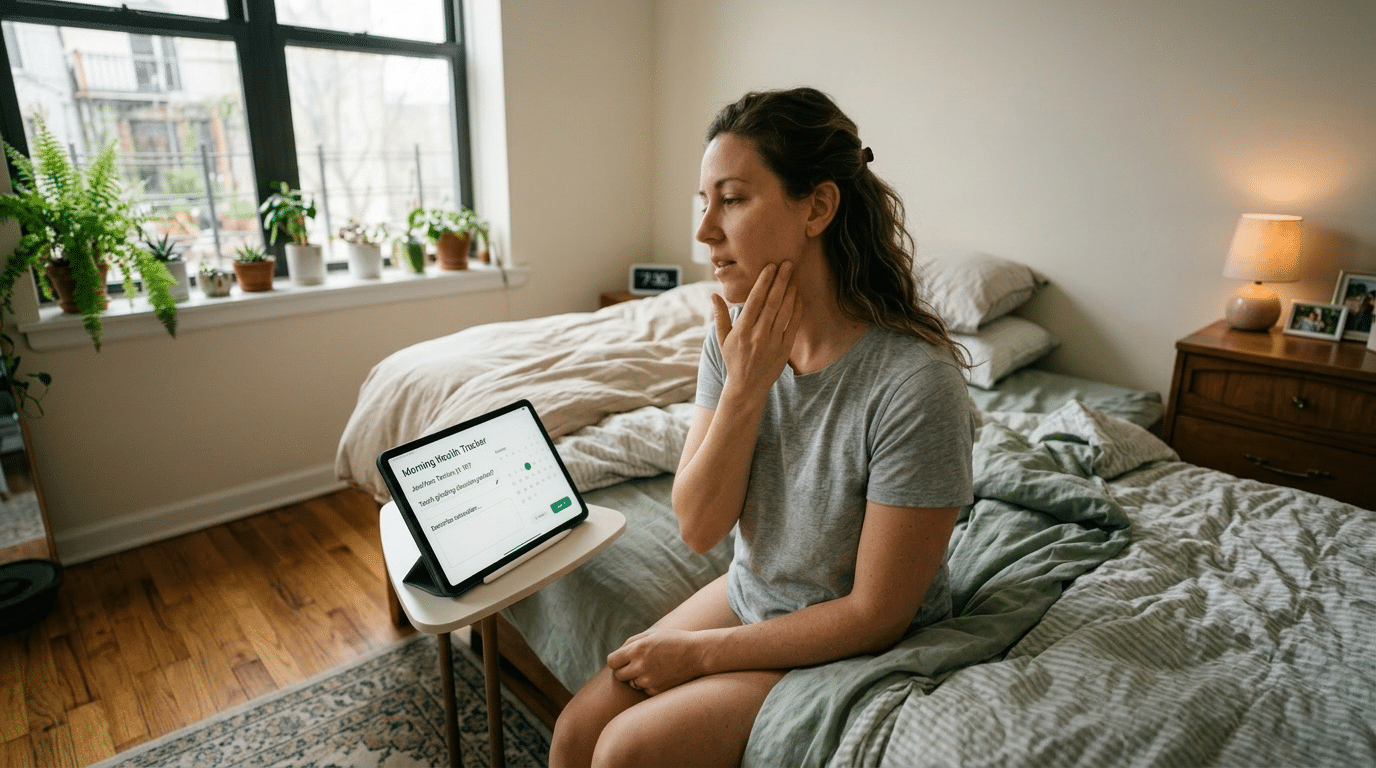
Jaw pain and snoring are often treated as separate problems. One sounds like a dental or jaw issue. The other sounds like a sleep or breathing issue.
Medically responsible content note:
This article is for education only and does not diagnose or treat medical, dental, or sleep conditions. Bruxism, jaw pain, headaches, snoring, breathing pauses, and respiratory symptoms can have multiple causes. Seek care from a qualified medical, dental, sleep, or orofacial pain professional when symptoms are persistent, worsening, severe, or disruptive.
For some people, they show up together.
That overlap does not mean one symptom automatically explains the other. Bruxism does not diagnose sleep apnea, and snoring does not prove that jaw pain is airway-related. Still, when jaw pain and snoring appear with dry mouth, morning headaches, gasping, unrefreshing sleep, or daytime sleepiness, the pattern deserves attention.
The goal is not to self-diagnose. A better goal is to notice the symptom cluster, track what keeps happening, and ask the right questions.
Quick Answer: Can Jaw Pain and Snoring Be Related?
Jaw pain and snoring can overlap when jaw-muscle activity, poor sleep, mouth breathing, or sleep-disordered breathing occur during the same night.
Bruxism can contribute to jaw soreness, tooth sensitivity, facial tension, temple pain, and morning headaches. Snoring and breathing-related sleep problems can appear with dry mouth, gasping, restless sleep, morning headaches, and daytime sleepiness.
Many people clench or grind their teeth without having sleep apnea. Plenty of people snore without waking up with jaw pain. Concern increases when symptoms cluster together and repeat over time.
If you wake with jaw pain and also have loud snoring, gasping, dry mouth, morning headaches, unrefreshing sleep, or daytime sleepiness, ask your dentist, physician, or sleep specialist whether both jaw-muscle activity and sleep breathing should be considered.
Why Jaw Pain and Snoring Can Overlap
Jaw pain and snoring often enter the healthcare system through different doors.
A dentist may notice worn teeth, tooth sensitivity, cracked teeth, sore chewing muscles, or signs of bruxism. A physician or sleep specialist may focus on snoring, breathing pauses, poor sleep, blood pressure, or daytime sleepiness.
The person experiencing the symptoms may only know this:
“I wake up tired.”
“My jaw hurts in the morning.”
“My partner says I snore.”
“I sleep long enough, but I do not feel rested.”
Nighttime symptoms are hard to observe. You may not know whether you are clenching, grinding, mouth breathing, snoring, gasping, or waking repeatedly during sleep.
Bed partner observations, dental findings, sleep symptoms, and morning symptoms can all provide clues. A single symptom rarely tells the whole story.
Four Common Symptom Patterns
A simple pattern-based approach can help you decide what to track and who to ask for help.
1. Mostly jaw symptoms
This pattern may include morning jaw pain, tooth soreness, tooth sensitivity, temple tightness, chewing discomfort, facial tension, or visible tooth wear.
Bruxism, jaw-muscle overuse, TMD, dental problems, bite changes, and daytime clenching may all be part of the discussion.
A dentist is usually a good starting point for this pattern.
2. Mostly breathing symptoms
This pattern may include loud snoring, gasping, choking sounds, witnessed pauses in breathing, restless sleep, dry mouth, morning headaches, or excessive daytime sleepiness.
These symptoms do not confirm sleep apnea. They do suggest that a breathing-related sleep problem should be considered.
A physician or sleep specialist may need to evaluate this pattern.
3. Mixed morning symptoms
Some people wake with jaw pain, dry mouth, headache, sore throat, and poor energy. That mixed pattern can be confusing because the clues point in more than one direction.
Jaw-muscle activity, mouth breathing, nasal congestion, poor sleep quality, and possible sleep-disordered breathing may all need to be considered.
This is where both dental and sleep questions can be useful.
4. Mostly daytime jaw tension
Not all jaw pain comes from sleep. Some people clench during focused work, driving, screen time, stress, or concentration.
Daytime jaw tension may point toward awake bruxism. In that case, tracking when your teeth touch during the day may be just as important as tracking morning symptoms.
Bruxism and Morning Jaw Pain
Bruxism is repeated jaw-muscle activity. It may include clenching, grinding, bracing, or thrusting the jaw.
Sleep bruxism happens during sleep. Awake bruxism happens while you are awake. Both can contribute to jaw discomfort, but they may show up in different ways.
Sleep bruxism may be suspected when symptoms are worse in the morning. Awake bruxism may be suspected when symptoms build during work, stress, driving, computer use, or intense focus.
When jaw muscles work too hard, you may notice:
- Jaw soreness
- Tooth sensitivity
- Tight temples
- Facial tension
- Morning headaches
- A tired or heavy jaw
- Tenderness when chewing
- Cheek or tongue irritation
- Tooth wear, cracks, or chipped teeth
That is why morning jaw pain is often evaluated first from a dental perspective. Your dentist may check your teeth, bite, jaw joints, chewing muscles, and signs of bruxism.
If jaw soreness is the symptom you notice first, our guide to waking up with jaw pain explains the common dental and muscle-related causes.
Snoring, Mouth Breathing, and Poor Sleep
Snoring happens when airflow causes soft tissues in the upper airway to vibrate during sleep. Occasional snoring may happen with congestion, alcohol use, back sleeping, or temporary airway irritation.
Loud, frequent, or disruptive snoring deserves more attention, especially when it appears with other symptoms.
Symptoms that may suggest an airway-related sleep issue include:
- Loud, frequent snoring
- Witnessed pauses in breathing
- Gasping or choking during sleep
- Waking with dry mouth
- Morning headaches
- Restless sleep
- Frequent nighttime waking
- Daytime sleepiness
- Brain fog
- Poor concentration
- Waking unrefreshed despite enough time in bed
Mouth breathing can make the picture more complicated. When the mouth stays open during sleep, you may wake with dry mouth, sore throat, bad breath, sticky saliva, thirst, or hoarseness.
Nasal congestion, allergies, dry indoor air, sleep position, airway anatomy, and possible breathing disruption during sleep can all contribute to mouth breathing at night.
To understand the airway side of the pattern, start with our overview of breathing during sleep.
If dry mouth is one of your strongest symptoms, our guide to dry mouth on waking explains common causes such as mouth breathing, nasal congestion, dry air, medications, and sleep-disordered breathing.
Are Bruxism and Sleep Apnea Related?
Sleep bruxism and obstructive sleep apnea can overlap in some people. Researchers have studied whether jaw-muscle activity may occur around breathing events, brief sleep arousals, oxygen changes, or airway instability.
The relationship is not simple.
Some patients with sleep-disordered breathing also show signs of sleep bruxism. Others have bruxism without sleep apnea. A person can also have snoring, jaw pain, dry mouth, and poor sleep for reasons that are not obstructive sleep apnea.
The practical takeaway is straightforward:
Bruxism and sleep apnea may overlap, but one does not diagnose the other.
Jaw pain should not be used as a sleep apnea diagnosis. Snoring should not be used as proof that jaw pain is airway-related. A sleep study is needed when obstructive sleep apnea is suspected.
Morning Headaches, Dry Mouth, and Unrefreshing Sleep
Morning headaches are an important overlap symptom because they may have more than one source.
Jaw clenching, temple muscle tension, neck tension, poor sleep, sleep-disordered breathing, dehydration, alcohol use, medication effects, caffeine changes, and migraine patterns can all play a role.
The pattern can help guide the next question.
Jaw pain, tooth soreness, and temple tenderness may suggest jaw-muscle involvement.
Snoring, gasping, dry mouth, and daytime sleepiness may suggest sleep breathing should be considered.
Both patterns can exist in the same person.
This is especially important when someone says, “I have a night guard, but I still wake up tired,” or “My teeth are protected, but my sleep still feels poor.”
A night guard may protect the teeth from clenching or grinding forces. It does not automatically address snoring, gasping, mouth breathing, or unrefreshing sleep.
If morning headaches are part of your pattern, our article on waking up with a headache can help you sort through common sleep, breathing, jaw, and tension-related clues.
Night Guard vs Sleep Apnea Oral Appliance
This distinction matters.
A standard dental night guard is designed to protect teeth from the forces of clenching or grinding. It may reduce tooth damage, but it does not diagnose or treat obstructive sleep apnea.
A sleep apnea oral appliance is different. It is prescribed and adjusted to help manage obstructive sleep apnea in appropriate patients. These appliances are usually designed to support the lower jaw or airway during sleep.
Do not assume a basic night guard is treating a breathing disorder. Also, do not assume that every person who snores needs an oral appliance.
Sleep apnea evaluation requires medical diagnosis and appropriate testing. Treatment decisions should be made with qualified clinicians.
When to Talk to a Dentist
A dentist is a good starting point when jaw pain appears with dental or jaw-muscle symptoms.
Talk to your dentist if you notice:
- Morning jaw pain
- Tooth soreness
- Tooth sensitivity
- Worn teeth
- Cracked or chipped teeth
- Pain when chewing
- Jaw clicking or popping
- Facial tension
- Temple pain
- A tired jaw at the end of the day
- A night guard that no longer feels effective
Your dentist may evaluate your teeth, muscles, jaw joints, bite, and signs of bruxism. Sleep quality may also come up during the conversation, especially if you report snoring, dry mouth, morning headaches, or fatigue.
That does not mean the dentist is diagnosing sleep apnea. It means the symptom pattern may deserve medical follow-up.
For a deeper look at how jaw-muscle activity can disturb rest, read bruxism and sleep quality.
When a Sleep Study May Be Appropriate
A sleep study may be appropriate when jaw pain and snoring appear with symptoms that suggest sleep-disordered breathing.
These symptoms include:
- Loud, frequent snoring
- Witnessed breathing pauses
- Gasping or choking during sleep
- Waking with dry mouth
- Morning headaches
- Waking unrefreshed
- Excessive daytime sleepiness
- Brain fog or poor concentration
- High blood pressure
- Sleepiness while driving
- A bed partner who is concerned
Sleep apnea cannot be diagnosed from jaw pain, snoring, or tooth wear alone. It requires medical evaluation and appropriate testing.
When snoring appears with gasping, witnessed pauses, morning headaches, or daytime sleepiness, a sleep study may be appropriate.
What to Track Before Your Appointment
Before you see your dentist, physician, or sleep specialist, track your symptoms for one to two weeks.
A simple note on your phone is enough.
Morning symptoms
Track:
- Jaw pain: none, mild, moderate, or severe
- Tooth soreness: yes or no
- Headache: location and intensity
- Dry mouth: yes or no
- Sore throat: yes or no
- Energy level: refreshed or tired
Nighttime clues
Track:
- Snoring reported by a bed partner
- Gasping or choking
- Restless sleep
- Waking often
- Mouth breathing
- Sleep position
- Alcohol use close to bedtime
- Nasal congestion
Daytime clues
Track:
- Jaw clenching during focus
- Stress-related jaw tension
- Neck tension
- Daytime sleepiness
- Brain fog
- Caffeine use
- Napping
- Drowsiness while driving
This information can help your clinician see the pattern more clearly.
You can also bring a short statement like this:
“I wake up with jaw pain, and my partner says I snore. I also notice dry mouth and morning headaches. Should we evaluate this as bruxism only, or should I ask about sleep-disordered breathing?”
That question helps shift the visit from a single-symptom discussion to a pattern-based discussion.
What Not to Assume
This topic is easy to oversimplify.
Avoid these assumptions:
- Snoring always means sleep apnea.
- Jaw pain always means bruxism.
- Bruxism always means stress.
- Sleep apnea explains every case of jaw pain.
- A standard night guard treats snoring or sleep apnea.
- Morning headaches always come from clenching.
- Dry mouth always means mouth breathing.
- One symptom explains the entire pattern.
A better approach is to track what is happening, look for repeated clusters, and involve the right professional.
A dentist can evaluate teeth, jaw muscles, TMD signs, and bruxism risk. A physician or sleep specialist can evaluate whether sleep-disordered breathing may be present.
In some cases, both perspectives are needed.
Medical Note
This article is for general education and does not diagnose bruxism, TMD, obstructive sleep apnea, or any other condition. If you have severe pain, witnessed breathing pauses, excessive daytime sleepiness, or drowsiness while driving, seek professional care.
The Bottom Line
Jaw pain and snoring can overlap, but they should not be reduced to one simple explanation.
Bruxism may contribute to jaw soreness, tooth sensitivity, facial tension, temple pain, and morning headaches. Snoring and poor sleep may point toward mouth breathing, nasal congestion, airway resistance, or sleep-disordered breathing.
The pattern matters most.
If jaw pain appears with loud snoring, gasping, dry mouth, morning headaches, unrefreshing sleep, or daytime sleepiness, track the symptoms and ask whether both dental and sleep evaluation make sense.
You are not trying to diagnose yourself. You are trying to notice the clues early enough to get the right help.
FAQ
Can sleep apnea cause jaw pain?
Sleep apnea does not directly explain every case of jaw pain. Some people with sleep-disordered breathing also have sleep bruxism or jaw-muscle activity, but the relationship is complex. Jaw pain should be evaluated by a dentist, while suspected sleep apnea requires medical evaluation and testing.
Can snoring cause jaw pain?
Snoring itself does not usually directly cause jaw pain. However, snoring may appear alongside mouth breathing, poor sleep, sleep disruption, or sleep-disordered breathing. Jaw pain may also be present if bruxism or jaw-muscle activity is occurring during sleep.
Are jaw clenching and sleep apnea related?
Jaw clenching and sleep apnea can overlap in some people, but one does not diagnose the other. Researchers continue to study the relationship between sleep bruxism, breathing events, and sleep arousals. If jaw clenching appears with loud snoring, gasping, dry mouth, or daytime sleepiness, ask whether both dental and sleep evaluation make sense.
Why do I wake up with jaw pain and dry mouth?
Waking with jaw pain and dry mouth may involve more than one factor. Jaw pain may point toward bruxism, jaw-muscle tension, or TMD. Dry mouth may point toward mouth breathing, nasal congestion, dry air, medication effects, or sleep-disordered breathing. Track the pattern and discuss it with your dentist or physician.
Should I get a sleep study if I have jaw pain and snore?
A sleep study may be appropriate if jaw pain and snoring appear with gasping, witnessed pauses in breathing, morning headaches, dry mouth, unrefreshing sleep, or daytime sleepiness. Jaw pain alone does not mean you need a sleep study, but a repeated symptom cluster deserves attention.
Should I see a dentist or a sleep doctor first?
If your main symptoms are jaw pain, tooth soreness, tooth wear, or chewing pain, start with a dentist. When loud snoring, gasping, witnessed breathing pauses, or daytime sleepiness are also present, ask whether a physician or sleep specialist should evaluate you.
Can a night guard help jaw pain and snoring?
A standard night guard may help protect teeth from clenching or grinding forces. It is not a treatment for snoring or sleep apnea. A sleep apnea oral appliance is a different device that must be prescribed and adjusted for appropriate patients after proper evaluation.
References
- Lobbezoo F, Ahlberg J, Raphael KG, et al. International consensus on the assessment of bruxism: report of a work in progress. Journal of Oral Rehabilitation. 2018;45(11):837-844. doi:10.1111/joor.12663.
- National Heart, Lung, and Blood Institute. Sleep Apnea: Symptoms. National Institutes of Health. Updated January 9, 2025.
- Kapur VK, Auckley DH, Chowdhuri S, et al. Clinical practice guideline for diagnostic testing for adult obstructive sleep apnea: an American Academy of Sleep Medicine clinical practice guideline. Journal of Clinical Sleep Medicine. 2017;13(3):479-504. doi:10.5664/jcsm.6506.
- American Academy of Dental Sleep Medicine. Oral Appliance Therapy. Accessed 2026.
- Spałka J, Kukwa W, Migacz E, et al. Morning headache as an obstructive sleep apnea-related symptom among sleep clinic patients. Brain Sciences. 2020;10(2):57. doi:10.3390/brainsci10020057.

Randy Clare is a writer, educator, and health communicator focused on making complex clinical topics easier to understand. He is the author of The Brux Method, host of The Clenching Chronicle Podcast, and a contributor to ClenchAlert. He previously served as Director of Digital Marketing at Glidewell Dental, is President of Hawkeye Group, and co-founded the American Sleep and Breathing Academy.