

Last updated on May 6th, 2026 at 07:42 am
Medically responsible content note:
This article is for education only and does not diagnose or treat medical, dental, or sleep conditions. Bruxism, jaw pain, headaches, snoring, breathing pauses, and respiratory symptoms can have multiple causes. Seek care from a qualified medical, dental, sleep, or orofacial pain professional when symptoms are persistent, worsening, severe, or disruptive.
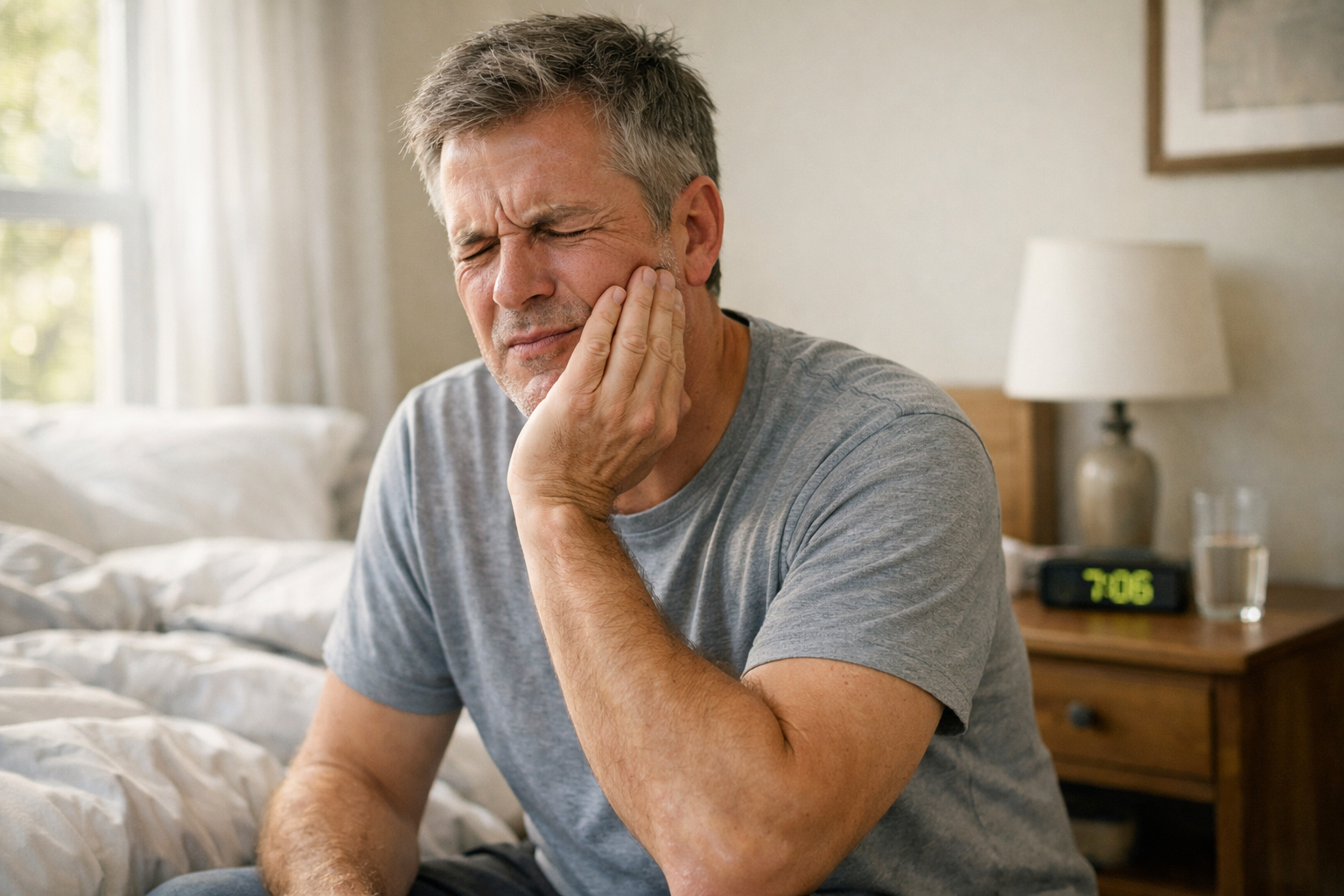
Waking up with jaw pain can make the day feel tense before it begins. Your jaw may feel tight, sore, heavy, or tired. Your temples may ache. Your teeth may feel sensitive. Your neck may feel stiff before you even get out of bed. Many people assume they grind their teeth at night, and sometimes they do. But morning jaw soreness can also come from daytime clenching, TMD symptoms, tooth problems, neck tension, sleep position, poor sleep quality, or breathing-related sleep disruption. A sore jaw is not a diagnosis. It is a clue worth tracking.
This article is part of our larger guide to Morning Symptoms: What Your Body May Be Telling You After Sleep, where we explain how headache, jaw pain, dry mouth, fatigue, breathing symptoms, and sleep quality can overlap.
Quick Answer: Why Do I Wake Up With Jaw Pain?
You may wake up with jaw pain because the jaw muscles, teeth, or temporomandibular joints were stressed during sleep, or because tension built up the day before. Common causes include sleep bruxism, daytime clenching, TMD symptoms, tooth problems, neck tension, sleep position, poor sleep quality, snoring, mouth breathing, or sleep disruption.
Sleep bruxism and awake bruxism are both forms of jaw muscle activity, but they happen in different states. Sleep bruxism occurs during sleep. Awake bruxism occurs during wakefulness and may include repeated tooth contact, sustained tooth contact, jaw bracing, or jaw thrusting.¹
Key takeaway: Waking up with jaw pain does not always mean nighttime grinding. It may come from sleep bruxism, daytime clenching, TMD symptoms, dental problems, neck tension, sleep position, poor sleep quality, or a combination.
Start Here If You Woke Up With Jaw Pain Today
Before trying to label the problem, notice a few basic clues:
- Where is the pain strongest? Teeth, jaw joint, cheek muscles, temples, ear area, or neck?
- Do your teeth feel sensitive? Is one tooth tender, or do all the teeth feel sore?
- Did you also wake with headache, dry mouth, snoring, gasping, or fatigue?
- Do you clench during the day? Check whether your teeth touch while working, driving, reading, or concentrating.
- Is the pain severe, worsening, or recurring? If so, consider speaking with a dentist or healthcare provider.
This quick check can help you decide whether your symptoms seem more dental, muscular, joint-related, sleep-related, posture-related, or mixed.
Why Does My Jaw Hurt When I Wake Up?
Your jaw may hurt when you wake up because the chewing muscles, teeth, or jaw joints were overloaded. That overload may happen during sleep, but it can also build during the day.
For example, clenching teeth while sleeping may leave the chewing muscles sore in the morning. But clenching during the day can also create low-level muscle fatigue that carries into the next morning. A cracked tooth, bite irritation, gum problem, or TMD symptom may also feel like jaw pain.
This is why the timing matters. Jaw pain that is strongest immediately on waking may suggest sleep-related jaw activity. Jaw pain that worsens during the day may suggest awake clenching, jaw bracing, stress jaw, posture, or oral habits. Jaw pain that feels sharp, localized, or tooth-specific may need dental evaluation.
Waking Up With Jaw Pain Is a Clue, Not a Diagnosis
Morning jaw pain is a repeated signal. It does not automatically mean you grind your teeth. It does not automatically mean you have TMJ. It does not automatically mean you have sleep apnea.
It means something in or around the jaw system may be irritated.
That system includes:
- Jaw muscles
- Temporomandibular joints
- Teeth and bite surfaces
- Gums and dental restorations
- Temples, neck, and facial muscles
- Sleep quality and nighttime arousals
- Breathing patterns during sleep
The National Institute of Dental and Craniofacial Research describes TMD symptoms as pain in the chewing muscles or jaw joint, jaw stiffness, limited movement or locking, painful clicking or popping, and pain that may spread to the face or neck.² That matters because morning jaw pain often overlaps with symptoms outside the jaw itself.
The goal is not to self-diagnose. The goal is to notice whether your pain looks more muscular, dental, joint-related, sleep-related, posture-related, or mixed.
Quick Self-Check: Are Your Teeth Touching Right Now?
Pause for a moment.
Are your upper and lower teeth touching?
If they are, gently separate them.
Try this reset:
Lips together. Teeth apart. Tongue resting gently. Jaw loose.
Your teeth are not supposed to stay together all day. For many people with daytime clenching, this simple check reveals a habit they did not know they had.
The Most Common Reasons Your Jaw Hurts in the Morning
1. Sleep Bruxism
Sleep bruxism is jaw muscle activity during sleep. It may involve rhythmic or non-rhythmic activity, and it may or may not include audible grinding.¹ Many people describe this as clenching teeth while sleeping, although sleep bruxism can include several types of jaw muscle activity.
Some people only discover it because a bed partner hears grinding. Others learn about it when a dentist notices tooth wear, cracked restorations, or signs of heavy bite forces.
Sleep bruxism may leave the jaw sore because the chewing muscles were active when they should have been resting. The pressure may also leave teeth feeling tender or sensitive in the morning. Some people notice temple soreness or headache when they wake up.
But sleep bruxism is not always a simple nighttime habit. It may overlap with stress physiology, sleep arousals, medications, alcohol use, pain, and sleep-disordered breathing symptoms in some people. That is why jaw pain in the morning should be considered in context rather than treated as a one-cause problem.
If you are unsure whether the problem is daytime clenching or nighttime grinding, the article on awake bruxism vs sleep bruxism will help you sort the difference. If you are also noticing tooth wear, jaw fatigue, or temple soreness, it may help to review the broader guide to bruxism symptoms.
2. Daytime Clenching That Carries Into the Morning
But not every sore jaw begins while you are asleep.
Many people assume jaw pain in the morning must come from grinding at night. Sometimes it does. But daytime clenching can also leave the jaw sore the next morning.
Awake bruxism often looks different from sleep bruxism. It may show up as:
- Holding the teeth together while concentrating
- Clenching during emails, driving, or screen time
- Bracing the jaw during stress
- Pressing the tongue or jaw forward
- Keeping the jaw muscles “ready” all day
Over time, that low-level tension can fatigue the jaw muscles. If your teeth touch for hours or your jaw stays braced through the day, the soreness may still be there when you wake up.
A simple cue can help you interrupt this during the day:
Lips together. Teeth apart. Tongue resting gently. Jaw loose.
For many clenchers, learning to notice tooth contact is the first step toward changing the pattern.
3. TMD or TMJ-Related Symptoms
Many people say they “have TMJ,” but TMJ simply means temporomandibular joint. You have two TMJs, one on each side of your jaw. TMD refers to disorders or dysfunction involving the jaw joints, jaw muscles, or related structures.
TMD symptoms may include jaw pain, chewing muscle pain, jaw stiffness, painful clicking or popping, limited opening, locking, and pain that spreads to the face or neck.² Mayo Clinic also notes that clicking alone does not always require treatment if there is no pain or movement limitation.³
Some readers may think of this as TMJ pain in the morning, especially when pain is near the joint or ear.
Morning jaw pain may be more likely to involve TMD when you notice pain near the jaw joint or ear, clicking with pain, popping with limited motion, jaw locking, difficulty opening wide, pain while chewing, one-sided jaw soreness, or symptoms that flare during stress or heavy chewing.
TMD can overlap with bruxism, headaches, neck pain, and sleep problems. NIDCR notes that TMDs can occur alone or with other conditions, including migraines, back pain, sleep problems, fibromyalgia, arthritis, and irritable bowel syndrome.⁴ That overlap is one reason jaw pain can be hard to sort out without professional evaluation.
4. Tooth Pain or Dental Disease
Sometimes the problem is not the jaw muscle or joint at all.
A cracked tooth, inflamed nerve, gum problem, bite issue, infection, or dental restoration problem may feel like jaw pain. This is especially important when the pain is sharp, localized, or triggered by biting, heat, cold, or pressure.
Pay attention if your pain feels like it comes from one tooth or one small area rather than the whole jaw. Also notice swelling, gum tenderness, lingering sensitivity, or pain that does not fade after you get moving.
If the pain feels like it comes from one tooth instead of the whole jaw, compare your symptoms with the guide to tooth pain in the morning and contact a dentist for evaluation.
5. Headaches and Jaw Pain
Jaw pain and morning headaches often travel together. The jaw muscles connect functionally with the temples, face, head, and neck. If the chewing muscles are overloaded, the temples may feel sore or pressured. Some people describe this as a tension-type feeling around the head.
Morning headache and jaw pain may involve sleep bruxism, awake clenching that carried over from the day before, TMD symptoms, neck tension, poor sleep quality, sleep disruption, migraine, another headache disorder, or breathing-related sleep symptoms.
Morning headaches can also be associated with obstructive sleep apnea and other sleep-related breathing problems. Mayo Clinic lists morning headache, waking with dry mouth, loud snoring, gasping for air during sleep, and daytime sleepiness among common sleep apnea symptoms.⁵
If jaw pain shows up with temple pressure or head pain, the guide to morning headache and jaw pain is the next logical read.
6. Neck Pain, Sleep Position, and Jaw Tension
The jaw does not work in isolation. Neck position, shoulder tension, pillow height, and sleep posture can all influence how the jaw feels in the morning.
For example, sleeping with the jaw pressed into the pillow may irritate one side. A pillow that pushes the head too far forward or lets it fall too far back may increase neck strain. Neck stiffness can also change how the jaw muscles feel when you wake up.
This set of clues may be more likely when you notice neck stiffness with jaw pain, pain that is worse on one side, headache at the base of the skull, jaw soreness after changing pillows, shoulder tension with morning symptoms, or symptoms that improve as the neck loosens.
If your morning symptoms include stiffness at the base of the skull, read the guide to neck pain and headache in the morning.
7. Sleep Quality, Snoring, Mouth Breathing, or Airway Clues
The final clue is not in the jaw itself, but in the quality of sleep around it.
Jaw pain does not mean you have sleep apnea. But morning jaw pain can appear alongside symptoms that suggest poor sleep quality or breathing disruption during sleep.
These clues matter:
- Loud snoring
- Waking up gasping
- Dry mouth on waking
- Morning headaches
- Daytime sleepiness
- Brain fog
- Trouble staying asleep
- Bed partner reports breathing pauses
- High blood pressure
Mayo Clinic lists loud snoring, observed pauses in breathing, gasping for air during sleep, dry mouth on waking, morning headaches, insomnia, and daytime sleepiness among sleep apnea symptoms.⁵ If these symptoms are present with morning jaw pain, it is reasonable to discuss sleep quality and breathing with a medical professional.
Is it Sleep Bruxism, Daytime Clenching, or Both?
One of the most useful things you can do is separate sleep clues from daytime clues.
Sleep Bruxism Clues
Sleep bruxism may be more likely when jaw pain is strongest right when you wake up, a bed partner hears grinding sounds, your dentist sees tooth wear, teeth feel sensitive in the morning, restorations chip or break, or you wake with temple soreness or jaw fatigue.
Because sleep bruxism happens while you are asleep, you may not be aware of it. A dental exam can help identify tooth wear, bite trauma, cracked teeth, and other clues.
Awake Bruxism Clues
Awake bruxism may be more likely when you catch your teeth touching during the day, clench while concentrating, brace your jaw while driving, feel jaw tension rise during stress, or notice symptoms worsening by late afternoon or evening.
Awake clenching is often more trainable because you can become aware of it in real time. The first goal is not perfection. The first goal is noticing.
Both May Be Present
Many people have both patterns. That is why a night guard may help protect teeth during sleep but may not solve daytime clenching. A night guard can be useful for dental protection, but daytime clenching often requires awareness, behavior change, stress regulation, habit retraining, or biofeedback-style strategies.
This is where the distinction between awake bruxism vs sleep bruxism becomes clinically useful. Different patterns may need different management strategies.
A Simple 5-Part Morning Jaw Pain Tracker
Tracking symptoms for one to two weeks can make your dental or medical visit more useful. You do not need a complicated system. A short note on your phone is enough.
1. When Does It Happen?
Notice the timing.
- Is it present immediately on waking?
- Does it fade after 30 to 60 minutes?
- Does it worsen through the day?
- Is it worse after stressful days?
- Is it worse after poor sleep?
- Is it worse after long computer work or driving?
2. Where Does It Hurt?
Notice the location.
- Jaw joint
- Cheek muscles
- Temples
- Teeth
- Ear area
- Neck
- One side
- Both sides
3. What Does It Feel Like?
Describe the sensation.
- Sore
- Tight
- Sharp
- Dull
- Burning
- Locked
- Clicking
- Pressure-like
- Tooth sensitivity
4. What Comes With It?
Morning jaw pain becomes more meaningful when you pair it with other clues.
- Morning headache
- Tooth pain
- Neck pain
- Ear pressure
- Dry mouth
- Snoring
- Gasping
- Fatigue
- Brain fog
- Pain with chewing
5. What May Have Triggered It?
Look for repeated triggers.
- Stress
- Focused work
- Driving
- Chewing gum
- Hard foods
- Alcohol
- Poor sleep
- New pillow
- Recent dental work
- Congestion or illness
- Long phone or computer use
Morning Jaw Pain Pattern Guide
| Morning pattern | Possible clue | Who to ask |
| Jaw pain plus tooth sensitivity | Bruxism, cracked tooth, bite pressure, dental irritation | Dentist |
| Jaw pain plus temple headache | Jaw muscle tension, bruxism, TMD, headache disorder | Dentist or healthcare provider |
| Jaw pain plus neck stiffness | Sleep position, posture, cervical muscle tension | Dentist, physician, or physical therapist when appropriate |
| Jaw pain plus snoring or gasping | Sleep-disordered breathing may need review | Medical provider or sleep specialist |
| Jaw pain that worsens during the day | Awake clenching, jaw bracing, stress jaw | Dentist, orofacial pain provider, behavioral awareness strategy |
| Jaw pain with locking or limited opening | TMD symptoms or joint dysfunction | Dentist or orofacial pain specialist |
| One-tooth pain with biting | Cracked tooth, bite problem, dental disease | Dentist |
What May Help While You Are Figuring It Out
These steps are not a substitute for evaluation. They are gentle ways to reduce jaw overload while you observe your symptoms.
Start With Awareness
Several times a day, ask:
Are my teeth touching?
If the answer is yes, reset:
Lips together. Teeth apart. Tongue resting gently. Jaw loose.
This is especially useful during work, driving, scrolling, cooking, reading, or any task that requires focus.
Reduce Jaw Overload
During an active flare, avoid adding more strain.
You may want to limit chewing gum, hard foods, chewy foods, nail biting, repeated jaw testing, wide yawning without support, and aggressive jaw stretching.
Gentle relaxation is different from forcing the jaw to move. If movement increases pain, stop and ask a professional.
Review Sleep Position
Notice whether your jaw pain is worse after sleeping on one side. Also check whether your pillow pushes your head forward, lets your head fall back, or places pressure on the jaw.
Small changes in pillow height or sleep position may help some people, especially when morning jaw pain appears with neck stiffness.
Consider Dental Evaluation
A dentist can look for tooth wear, cracked teeth, bite tenderness, gum problems, restoration damage, muscle tenderness, jaw range of motion, joint sounds, and other signs that may explain your symptoms.
A dentist may also discuss whether a night guard, oral appliance, referral, or sleep evaluation is appropriate. If symptoms keep returning, the guide on when to see a dentist for bruxism can help you decide what deserves evaluation.
Consider Medical or Sleep Evaluation When Other Symptoms Are Present
If jaw pain appears with loud snoring, gasping, dry mouth, morning headaches, daytime sleepiness, or trouble concentrating, ask a medical professional whether sleep quality or sleep-disordered breathing should be evaluated. Sleep problems should not be guessed at based on symptoms alone.
Do Not Ignore These Symptoms
Most morning jaw pain is not an emergency, but some symptoms deserve prompt attention.
Seek professional care quickly if you have:
- Jaw locking or sudden limited opening
- Facial swelling
- Fever
- Severe one-sided tooth pain
- Pain after injury or trauma
- New, severe, or unusual headache
- Facial weakness, numbness, or drooping
- Chest pain or shortness of breath
- Trouble swallowing
- Rapidly worsening pain
- Loud snoring with gasping or severe daytime sleepiness
Dental pain, jaw pain, headaches, and sleep symptoms often overlap, but severe or rapidly changing symptoms should not be watched indefinitely.
When to Talk to a Dentist or Healthcare Provider
You should consider talking to a dentist or healthcare provider if:
- Jaw pain lasts more than a few days.
- Jaw pain keeps coming back.
- Pain is getting worse.
- You have tooth sensitivity.
- You see tooth wear, chips, or cracks.
- You wake with frequent morning headaches.
- Your jaw clicks painfully.
- Your jaw locks or does not open normally.
- You have ear pain or pressure that has not been evaluated.
- You snore heavily or wake up gasping.
- You feel tired after enough sleep.
- A mouthguard is not helping.
- A mouthguard seems to worsen symptoms.
- Pain affects chewing, speaking, work, or sleep.
A dentist is often a good starting point when the symptoms involve tooth sensitivity, bite pain, jaw soreness, tooth wear, or suspected bruxism. A physician, sleep specialist, or orofacial pain specialist may be needed when symptoms suggest broader sleep, headache, airway, neurologic, or chronic pain involvement.
What Your Symptom Pattern May Mean
If jaw pain is paired with tooth sensitivity
This may point toward bruxism, bite pressure, cracked tooth, dental disease, or restoration problems. A dental exam is important because tooth-related pain can worsen if ignored.
If jaw pain is paired with morning headache
This may involve jaw muscle tension, sleep bruxism, TMD symptoms, sleep disruption, neck tension, migraine, or another headache disorder. If headaches are frequent, severe, or changing, ask a healthcare provider.
If jaw pain is paired with neck pain
This may involve sleep position, cervical muscle tension, posture, or a combined jaw-neck muscle pattern. The jaw, head, and neck often need to be considered together.
If jaw pain is paired with dry mouth, snoring, or gasping
This may suggest that sleep quality or breathing deserves review. It does not prove sleep apnea, but it is a reason to ask a medical professional about next steps.
If jaw pain worsens during the day
This may point toward awake clenching, jaw bracing, stress jaw, focus clenching, posture, or oral habits. Awareness training may be especially useful in this symptom pathway.
Read Next Based on What You Notice
If jaw pain comes with head pressure or temple soreness, read morning headache and jaw pain.
If the pain feels like it starts in one tooth, compare your symptoms with tooth pain in the morning.
If jaw soreness appears with stiffness at the base of the skull, read neck pain and headache in the morning.
If you are unsure whether this is daytime clenching or nighttime grinding, read awake bruxism vs sleep bruxism.
If symptoms keep returning or you notice tooth damage, read when to see a dentist for bruxism.
If jaw pain is part of a larger morning symptom cluster, return to the guide on morning symptoms after sleep.
Conclusion
Waking up with jaw pain can be frustrating because the cause is not always obvious. It may come from sleep bruxism, daytime clenching, TMD symptoms, tooth pain, neck tension, sleep position, poor sleep quality, or breathing-related sleep symptoms. In many people, the answer is not one cause. It is a combination of clues.
Start by noticing when the pain appears, where it hurts, what it feels like, and what other symptoms show up with it. Does your jaw hurt most right after waking? Do your teeth feel sensitive? Do you also wake with headaches, neck stiffness, dry mouth, or fatigue? Do you catch yourself clenching during the day? Does your pain worsen after stress, driving, computer work, or poor sleep?
Those details matter. They can help a dentist or healthcare provider sort out whether the issue looks more muscular, dental, joint-related, sleep-related, or mixed.
You do not need to panic, but you should not ignore jaw pain that is persistent, worsening, or linked with tooth pain, headaches, jaw locking, snoring, gasping, or poor daytime energy.
A sore jaw in the morning is not something to fear, but it is something to notice. The more clearly you can describe the clues, the easier it becomes to get the right kind of help.
FAQ
Why do I wake up with jaw pain?
You may wake up with jaw pain because your jaw muscles, teeth, or jaw joints were stressed during sleep or because tension built up the day before. Common causes include sleep bruxism, daytime clenching, TMD symptoms, tooth problems, sleep position, neck tension, poor sleep quality, or breathing-related sleep symptoms.
Does waking up with jaw pain mean I grind my teeth?
Not always. Grinding during sleep is one possible cause, but daytime clenching, jaw bracing, TMD symptoms, dental problems, and neck tension can also cause morning jaw pain. The set of clues matters more than the assumption.
Can daytime clenching cause jaw pain in the morning?
Yes. Daytime clenching can fatigue the jaw muscles. If you hold your teeth together during stress, focus, driving, or screen time, those muscles may still feel tight or sore the next morning.
Can sleep bruxism cause morning jaw pain?
Yes. Sleep bruxism can involve jaw muscle activity during sleep. It may contribute to morning jaw soreness, tooth sensitivity, temple pain, or dental wear. A dentist can help look for signs of bruxism and dental damage.
What is the difference between awake bruxism and sleep bruxism?
Awake bruxism happens while you are awake and often involves tooth contact, jaw bracing, clenching, or jaw tension. Sleep bruxism happens during sleep and may involve rhythmic or non-rhythmic jaw muscle activity.¹ The two can overlap, but they often need different management strategies.
When should I see a dentist for morning jaw pain?
Consider seeing a dentist if jaw pain keeps returning, worsens, comes with tooth sensitivity, tooth wear, cracked teeth, jaw locking, painful clicking, morning headaches, or if a mouthguard is not helping.
Can jaw pain and morning headaches be connected?
Yes. Jaw muscle tension, bruxism, TMD symptoms, neck tension, poor sleep, and headache disorders can overlap. Morning headaches may also appear with sleep-disordered breathing symptoms, especially when paired with snoring, gasping, dry mouth, or daytime sleepiness.⁵
Can tooth pain feel like jaw pain?
Yes. A cracked tooth, inflamed tooth, gum problem, bite issue, or dental infection can sometimes feel like jaw pain. Localized pain, swelling, pain with biting, or lingering hot or cold sensitivity should be evaluated by a dentist.
Can neck pain cause jaw pain in the morning?
Neck tension and jaw tension can overlap. Sleep position, pillow height, posture, and muscle tightness may contribute to jaw pain, headache, and neck soreness in the morning.
Can sleep apnea cause jaw pain?
Sleep apnea does not explain every case of jaw pain. However, sleep-disordered breathing symptoms such as snoring, gasping, dry mouth, morning headache, and daytime sleepiness can overlap with morning jaw symptoms. If those symptoms are present, ask a medical professional whether sleep evaluation is appropriate.⁵
References
- Lobbezoo F, Ahlberg J, Raphael KG, et al. International consensus on the assessment of bruxism: report of a work in progress. J Oral Rehabil. 2018;45(11):837-844.
- National Institute of Dental and Craniofacial Research. TMD (temporomandibular disorders). Accessed April 29, 2026.
- Mayo Clinic. TMJ disorders: symptoms and causes. Accessed April 29, 2026.
- National Institute of Dental and Craniofacial Research. Temporomandibular disorders and jaw pain. Accessed April 29, 2026.
- Mayo Clinic. Sleep apnea: symptoms and causes. Accessed April 29, 2026.

Randy Clare is a writer, educator, and health communicator focused on making complex clinical topics easier to understand. He is the author of The Brux Method, host of The Clenching Chronicle Podcast, and a contributor to ClenchAlert. He previously served as Director of Digital Marketing at Glidewell Dental, is President of Hawkeye Group, and co-founded the American Sleep and Breathing Academy.