

Last updated on May 6th, 2026 at 06:46 am
Medically responsible content note:
This article is for education only and does not diagnose or treat medical, dental, or sleep conditions. Bruxism, jaw pain, headaches, snoring, breathing pauses, and respiratory symptoms can have multiple causes. Seek care from a qualified medical, dental, sleep, or orofacial pain professional when symptoms are persistent, worsening, severe, or disruptive.
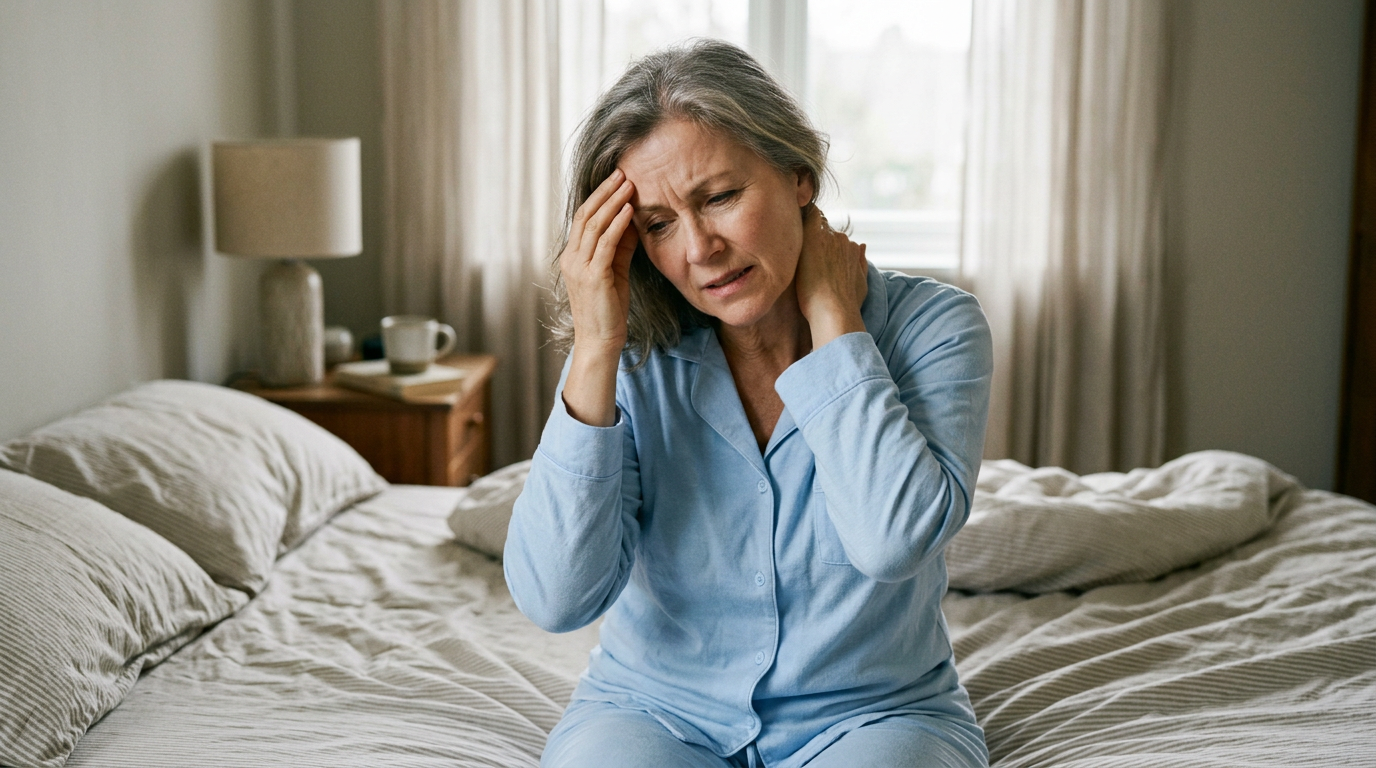
Waking up with morning neck pain and headache can make the day feel difficult before it begins. You may notice stiffness at the base of your skull, pressure in your temples, shoulder soreness, or a dull headache as soon as you wake. Many people assume they “slept wrong.” Sometimes that is true. However, if you keep waking up with neck pain and headache, especially with jaw soreness, dry mouth, snoring, or fatigue, the pattern may involve more than your pillow. Sleep posture, jaw clenching, teeth grinding, breathing disruption, and poor sleep quality can all overlap.
This article is part of our larger guide to Morning Symptoms: What Your Body May Be Telling You After Sleep, where we explain how headache, jaw pain, dry mouth, fatigue, breathing symptoms, and sleep quality can overlap.
Quick Answer: Why Do I Wake Up With Neck Pain and a Headache?
You may wake up with neck pain and a headache because of sleep position, pillow support, jaw clenching, teeth grinding, mouth breathing, snoring, poor sleep quality, or sleep apnea. Neck strain may come from poor alignment during sleep. Jaw clenching can tighten the jaw, temples, and upper neck. Breathing-related sleep disruption may contribute to morning headache, dry mouth, fatigue, and brain fog. If this pattern repeats, track your symptoms and ask a qualified professional for guidance.
Key Takeaways
- Morning neck pain and headache may come from sleep position, pillow support, jaw clenching, breathing problems, or mixed causes.
- Jaw soreness, temple tenderness, and tooth sensitivity may point toward clenching or grinding.
- Dry mouth, snoring, gasping, fatigue, and brain fog may suggest breathing-related sleep disruption.
- Track symptoms for 7 to 14 days before your appointment.
- Seek urgent care for sudden severe headache, neurologic symptoms, fever with neck stiffness, trauma, or symptoms unlike your usual pattern.
Common Reasons Morning Neck Pain and Headache Happen
Morning neck pain and headache usually fall into three broad buckets: posture, jaw and muscle activity, and breathing or sleep quality.
Mechanical factors include sleep position, pillow height, mattress support, travel sleep, stomach sleeping, or sleeping in a recliner or on a couch. These factors can keep the neck bent, twisted, or unsupported for long periods. A headache and stiff neck in the morning may be posture-related, especially if it improves after movement.
Jaw and muscle factors include jaw clenching, teeth grinding, TMJ-related symptoms, temple muscle tenderness, tooth sensitivity, and tension-type muscle patterns. Bruxism is repetitive jaw-muscle activity. Sleep bruxism happens during sleep, while awake bruxism happens during wakefulness and may include tooth contact, jaw bracing, or jaw thrusting.²
Sleep and breathing factors include mouth breathing, snoring, nasal congestion, sleep fragmentation, and obstructive sleep apnea. Common signs of obstructive sleep apnea can include loud snoring, gasping or choking during sleep, pauses in breathing, unrefreshing sleep, daytime sleepiness, morning headaches, and difficulty concentrating.³
A neck-related headache is also possible. The International Classification of Headache Disorders describes cervicogenic headache as a headache caused by a disorder of the cervical spine or soft tissues of the neck. It is often, but not always, accompanied by neck pain.⁴ That does not mean every morning headache with neck pain is cervicogenic. It means the neck can be part of a headache pattern.
The key is to look at the whole picture. Neck pain and headache after sleeping on one bad hotel pillow is different from a repeating pattern of neck pain, jaw soreness, dry mouth, snoring, and fatigue.
Sleep Position and Pillow Support: The First Thing to Check
Sleep posture is the most obvious starting point because it is visible and often adjustable. Your neck usually feels best when it rests in a neutral position. If your pillow holds your head too high, your neck may stay bent forward. If your pillow is too low, your neck may sag downward. If you sleep on your stomach, your head may stay rotated to one side for much of the night.
That can irritate muscles and joints in the neck and upper shoulders. You may feel soreness at the base of the skull, stiffness across the top of the shoulders, or pain on one side of the neck. The headache may feel like it starts in the neck and travels upward.
Sleep position may be a bigger part of the pattern if the pain is mostly one-sided, improves after movement, starts after a pillow or mattress change, or gets worse after travel. It may also be more likely if you do not have jaw soreness, tooth sensitivity, dry mouth, snoring, or daytime fatigue.
Tonight, notice whether your pillow keeps your nose, chin, and breastbone roughly aligned when you lie on your back or side. The goal is not perfect posture. The goal is to avoid sleeping with your chin pushed toward your chest, your head tilted downward, or your neck twisted for long periods.
The right pillow is not always the most expensive one. It is the one that keeps your neck supported without forcing your head up, down, or sideways.
How Jaw Clenching Can Lead to Neck Pain and Headache
Jaw clenching does not always feel like a jaw problem at first. Some people notice temple pressure, morning headache, ear-area discomfort, facial soreness, or neck tension before they realize their teeth are touching too often.
One important point: morning symptoms do not always mean the entire problem happened overnight. Daytime clenching can fatigue the jaw and neck muscles before you ever go to bed. Morning pain can be the bill that comes due after a day of unnoticed jaw tension.
Sleep bruxism may leave you with morning jaw soreness, tooth sensitivity, temple tenderness, or a tired feeling in the chewing muscles. Awake bruxism may happen while you work, drive, concentrate, exercise, scroll your phone, or respond to stress. During stress, the jaw, temples, neck, and shoulders can tighten as one system.
Jaw clenching may be part of your morning neck pain and headache pattern if you wake with jaw soreness, your temples feel tender, your teeth feel sensitive, your dentist has mentioned tooth wear or cracks, or you catch yourself clenching during the day. This is one reason jaw clenching neck pain can be difficult to recognize at first: the pain may show up in the neck, temples, or head before you notice the clenching habit.
It may also be part of the pattern if a mouthguard protects your teeth but your muscle symptoms continue. A mouthguard can be useful for tooth protection, but it may not retrain daytime clenching habits or solve every source of muscle tension.
If jaw soreness is part of your morning pattern, read more about waking up with jaw pain and what it may mean. For a clearer distinction between daytime and nighttime jaw activity, review awake bruxism vs sleep bruxism.
Could Breathing During Sleep Be Part of the Pattern?
Breathing during sleep can affect how restored you feel in the morning. Mouth breathing, nasal congestion, snoring, airway resistance, and obstructive sleep apnea may fragment sleep. When sleep is fragmented, the body may not recover well. Some people wake with dry mouth, morning headache, fatigue, brain fog, or the feeling that they slept enough hours but did not get good sleep.
Obstructive sleep apnea happens when breathing repeatedly stops or is reduced during sleep. Common symptoms can include loud or frequent snoring, silent pauses in breathing, choking or gasping sounds, unrefreshing sleep, daytime tiredness, morning headaches, and difficulty concentrating.³
Breathing may be part of your morning neck pain and headache pattern if you notice loud snoring, gasping, witnessed breathing pauses, dry mouth, morning headache, daytime sleepiness, brain fog, fatigue after enough sleep time, restless sleep, or known high blood pressure or cardiovascular risk factors.
Neck pain is not specific to sleep apnea. But if neck pain appears with morning headache, snoring, dry mouth, gasping, and daytime fatigue, breathing deserves attention. Sleep apnea cannot be diagnosed from symptoms alone. It requires appropriate medical evaluation and sleep testing.
If you regularly wake with a dry mouth, read more about waking up with dry mouth and how mouth breathing, snoring, and sleep apnea may overlap. If your main complaint is fatigue despite enough time in bed, see the guide to waking up tired after 8 hours of sleep.
Morning Neck Pain and Headache: The Main Patterns to Notice
Many morning symptom patterns are mixed. Still, these clues can help you decide what to track first.
| Pattern | Common Clues | Who to Ask |
| Sleep position | One-sided stiffness, pillow change, travel sleep, pain improves with movement | Physical therapist, physician, or other qualified clinician |
| Clenching | Jaw soreness, temple tenderness, tooth sensitivity, tooth wear, daytime clenching | Dentist or orofacial pain specialist |
| Breathing | Snoring, dry mouth, gasping, witnessed pauses, fatigue, brain fog | Physician or sleep specialist |
| Mixed | Neck pain, jaw pain, morning headache, dry mouth, and poor sleep together | Start with dentist, physician, or sleep professional based on the strongest clues |
More likely sleep-position related if:
The pain is mostly one-sided.
It started after a pillow or mattress change.
It improves after movement.
It is worse after sleeping in a hotel, recliner, couch, or unusual position.
You sleep on your stomach with your head turned.
You do not have jaw soreness, tooth sensitivity, dry mouth, snoring, or daytime fatigue.
More likely clenching-related if:
You wake with jaw soreness.
Your temples feel tender.
Your teeth feel sensitive.
Your dentist has mentioned tooth wear, cracks, or grinding signs.
You catch yourself clenching during the day.
Your headache appears with jaw fatigue.
You feel jaw tension during email, driving, focus work, or stress.
More likely breathing-related if:
You snore.
You wake with dry mouth.
You wake gasping or choking.
A bed partner notices pauses in breathing.
You feel tired after enough sleep.
You wake with morning headaches and daytime brain fog.
You have known high blood pressure or cardiovascular risk factors.
More likely mixed if:
You have neck pain, jaw pain, morning headache, dry mouth, and poor sleep together.
Symptoms vary with stress, sleep position, congestion, alcohol, or sleep schedule.
A mouthguard protects your teeth but symptoms continue.
Pain improves temporarily but returns repeatedly.
You have both daytime clenching and nighttime sleep symptoms.
The goal is not to force your symptoms into one category. The goal is to gather enough information to guide the right professional conversation.
What to Track Before Your Appointment
Track your symptoms for 7 to 14 days. You do not need a complicated system. A simple note on your phone is enough.
Track:
Morning headache location
Neck pain location
Jaw soreness
Temple tenderness
Tooth sensitivity
Dry mouth
Snoring
Gasping or choking
Sleep position
Pillow or mattress changes
Nasal congestion
Stress level
Alcohol use
Caffeine timing
Daytime clenching
Fatigue or brain fog
Whether pain improves after movement
Whether jaw relaxation helps
Whether symptoms happen after poor sleep
This helps you avoid vague descriptions like “I wake up feeling bad.” Instead, you can tell a provider: “I wake with left-sided neck pain and temple pressure three mornings a week. I also have dry mouth and my partner says I snore.”
That gives your provider a clearer starting point.
For a more detailed tracking tool, use the morning headache checklist before your next appointment.
What May Help at Home
Home steps should be practical and cautious. They should not replace professional evaluation when symptoms are persistent, severe, worsening, or paired with warning signs.
Adjust your sleep setup
Check whether your pillow keeps your neck neutral. Avoid sleeping on your stomach if it clearly worsens neck rotation. Try to keep your head aligned with your spine. If you recently changed your pillow or mattress, note whether symptoms started around the same time.
Move gently in the morning
Use gentle morning movement instead of aggressive stretching. Some neck pain patterns can become more irritated with forceful stretching. Gentle range of motion, heat, a warm shower, or slow movement may be better tolerated.
Relax the jaw during the day
Your teeth should not stay together at rest. Many clenchers need to relearn the “lips together, teeth apart” position. This means the lips can rest gently closed while the teeth remain slightly apart and the jaw muscles stay relaxed.
Try brief jaw check-ins during computer work, driving, phone scrolling, exercise, concentration, stressful conversations, and evening wind-down.
For a practical guide, read about the teeth-apart resting jaw position and why clenchers often need to relearn it.
Watch breathing clues
If you suspect mouth breathing or nasal congestion, discuss it with a medical professional, especially if it is chronic. If you snore, wake gasping, or have witnessed pauses in breathing, do not try to manage those symptoms with pillow changes alone. Those clues need appropriate sleep evaluation.
Keep sleep consistent
A consistent sleep schedule, reduced alcohol close to bedtime, and good sleep habits may help some people improve sleep quality. Alcohol can disrupt sleep later in the night, even if it makes you feel sleepy at first.⁵
When to Ask for Professional Help
Morning neck pain and headache may involve more than one professional. The right starting point depends on the symptom pattern.
Talk to a dentist if:
You have tooth wear.
Your teeth feel sensitive in the morning.
You have cracked, chipped, or sore teeth.
You wake with jaw soreness.
Your jaw clicks, locks, or feels tired.
You suspect grinding or clenching.
A night guard is not helping your symptoms.
You wake with jaw pain and headache repeatedly.
A dentist can check for tooth wear, cracked teeth, gum recession, jaw muscle tenderness, and signs of bruxism. A dentist may also help determine whether symptoms suggest a need for medical or sleep referral.
Talk to a physician or sleep specialist if:
You snore loudly.
You wake gasping or choking.
Someone has noticed breathing pauses.
You wake tired after enough sleep.
You have morning headaches with daytime sleepiness.
You have morning headache with high blood pressure or brain fog.
You have dry mouth and frequent nighttime awakenings.
Sleep apnea and other sleep-related breathing disorders require appropriate medical evaluation and sleep testing. Symptoms alone are not enough to diagnose or rule them out.
Talk to a physical therapist if:
Your neck pain seems posture-related.
You have limited neck range of motion.
Pain is linked to certain sleep positions.
You have shoulder involvement.
You have recurring stiffness that improves with movement.
Your symptoms fit a musculoskeletal pattern.
A physical therapist can evaluate neck mobility, posture, strength, joint movement, and muscle patterns.
Seek urgent medical care if:
Your headache is sudden and severe.
You have weakness, confusion, fainting, vision changes, chest pain, fever, or neurologic symptoms.
Your headache follows trauma.
You have severe neck stiffness with fever or illness.
Your pain is new, intense, or unlike your usual pattern.
Do not assume a severe or unusual headache is from sleep position, clenching, or stress.
What This Pattern May Mean
Morning neck pain and headache may mean your posture, jaw muscles, breathing, and sleep quality are overlapping.
A stiff neck alone may be posture-related, especially if it follows an awkward sleep position and improves after movement. Jaw soreness plus temple headache may suggest clenching or grinding. Dry mouth plus fatigue plus morning headache may suggest sleep-disordered breathing. Neck pain plus temple pressure plus daytime clenching may suggest a muscle tension pattern.
Poor sleep can also make pain feel stronger. Research has shown that sleep deprivation can increase pain sensitivity and affect pain modulation in healthy participants.¹ That may help explain why a restless night can make neck stiffness, jaw tension, or headache feel more intense the next morning.
If headache is your main symptom, start with the broader guide to why you wake up with a headache before narrowing the pattern to neck, jaw, or breathing clues.
Symptoms do not always stay in one lane. That is why morning symptoms should not be viewed one at a time. The Sleep and Respiratory Scholar helps readers connect symptoms that are often treated separately.
FAQ
Why do I wake up with neck pain and a headache?
You may wake up with neck pain and a headache because of sleep position, pillow support, jaw clenching, teeth grinding, mouth breathing, snoring, poor sleep quality, or a combination of factors. If it happens often, track related symptoms such as jaw soreness, dry mouth, snoring, fatigue, and tooth sensitivity.
Why do I wake up with a headache and stiff neck?
You may wake up with a headache and stiff neck because of sleep position, pillow support, jaw clenching, teeth grinding, neck muscle tension, poor sleep quality, or breathing-related sleep disruption. If it happens repeatedly, track whether you also have jaw soreness, tooth sensitivity, dry mouth, snoring, gasping, fatigue, or brain fog.
Can a bad pillow cause neck pain and headache?
Yes. A pillow that is too high, too low, too firm, too flat, or poorly matched to your sleep position can keep your neck bent or unsupported for hours. This may contribute to morning neck stiffness and headache. If symptoms began after a pillow change or improve when you sleep elsewhere, pillow support may be part of the pattern.
Can sleeping wrong cause a morning headache?
Yes. Poor sleep posture can strain the neck and upper shoulder muscles, which may contribute to headache in some people. This is more likely when pain is one-sided, improves after movement, or follows a change in pillow, mattress, travel, or sleep position.
Can jaw clenching cause neck pain?
Jaw clenching may contribute to neck pain because the jaw, temples, face, and upper neck muscles often work together. Some people with bruxism notice morning jaw soreness, temple tenderness, tooth sensitivity, headache, and neck tension.
Can teeth grinding cause neck pain and headaches?
Teeth grinding or jaw clenching may contribute to neck pain and headaches because the jaw, temples, face, and upper neck muscles often work together. Clues include morning jaw soreness, temple tenderness, tooth sensitivity, tooth wear, and daytime clenching.
Can sleep apnea cause morning headache and neck pain?
Sleep apnea is associated with morning headaches in some people, especially when sleep is fragmented or breathing is disrupted. Neck pain is not specific to sleep apnea, but it may appear alongside poor sleep, snoring, dry mouth, fatigue, or muscle tension. Symptoms such as loud snoring, gasping, witnessed pauses, and daytime sleepiness should be discussed with a medical professional.³
Why do I wake up with neck pain, headache, and dry mouth?
Waking with neck pain, headache, and dry mouth may suggest more than one factor. Neck pain may relate to sleep position or muscle tension. Headache and dry mouth may occur with mouth breathing, snoring, nasal congestion, or sleep-disordered breathing. If you also snore, wake gasping, or feel tired during the day, ask a medical professional whether sleep testing is appropriate.
How do I know if my headache is from my neck?
A neck-related headache may start in the neck or base of the skull and travel upward. It may be one-sided, linked to neck movement, or paired with limited range of motion. However, headache types can overlap, so recurring or worsening symptoms should be evaluated by a qualified professional.⁴
How do I know if my morning headache is from clenching?
Clenching may be part of the pattern if you wake with jaw soreness, temple tenderness, tooth sensitivity, facial soreness, or a tired feeling in your chewing muscles. It is also a clue if you catch yourself clenching during the day or your dentist has noticed tooth wear.
What should I track if I wake up with neck pain and headache?
Track headache location, neck pain location, jaw soreness, tooth sensitivity, dry mouth, snoring, gasping, sleep position, pillow changes, stress, nasal congestion, daytime clenching, fatigue, and brain fog. Bring this pattern to your dentist, doctor, sleep specialist, or physical therapist.
When should I worry about morning neck pain and headache?
Seek prompt medical care if the headache is sudden and severe, follows trauma, or occurs with fever, confusion, weakness, vision changes, fainting, chest pain, or neurologic symptoms. For recurring symptoms, schedule a non-urgent evaluation with the appropriate professional.
References
- Staffe AT, Bech MW, Clemmensen SLK, Nielsen HT, Larsen DB, Petersen KK. Total sleep deprivation increases pain sensitivity, impairs conditioned pain modulation and facilitates temporal summation of pain in healthy participants. PLoS One. 2019;14(12):e0225849. doi:10.1371/journal.pone.0225849.
- Lobbezoo F, Ahlberg J, Raphael KG, et al. International consensus on the assessment of bruxism: report of a work in progress. J Oral Rehabil. 2018;45(11):837-844. doi:10.1111/joor.12663.
- American Academy of Dental Sleep Medicine. Obstructive sleep apnea & snoring. Accessed April 29, 2026.
- International Headache Society. 11.2.1 Cervicogenic headache. The International Classification of Headache Disorders, 3rd edition. Accessed April 29, 2026.
- Mayo Clinic. Sleep tips: 6 steps to better sleep. Accessed April 29, 2026.

Randy Clare is a writer, educator, and health communicator focused on making complex clinical topics easier to understand. He is the author of The Brux Method, host of The Clenching Chronicle Podcast, and a contributor to ClenchAlert. He previously served as Director of Digital Marketing at Glidewell Dental, is President of Hawkeye Group, and co-founded the American Sleep and Breathing Academy.